
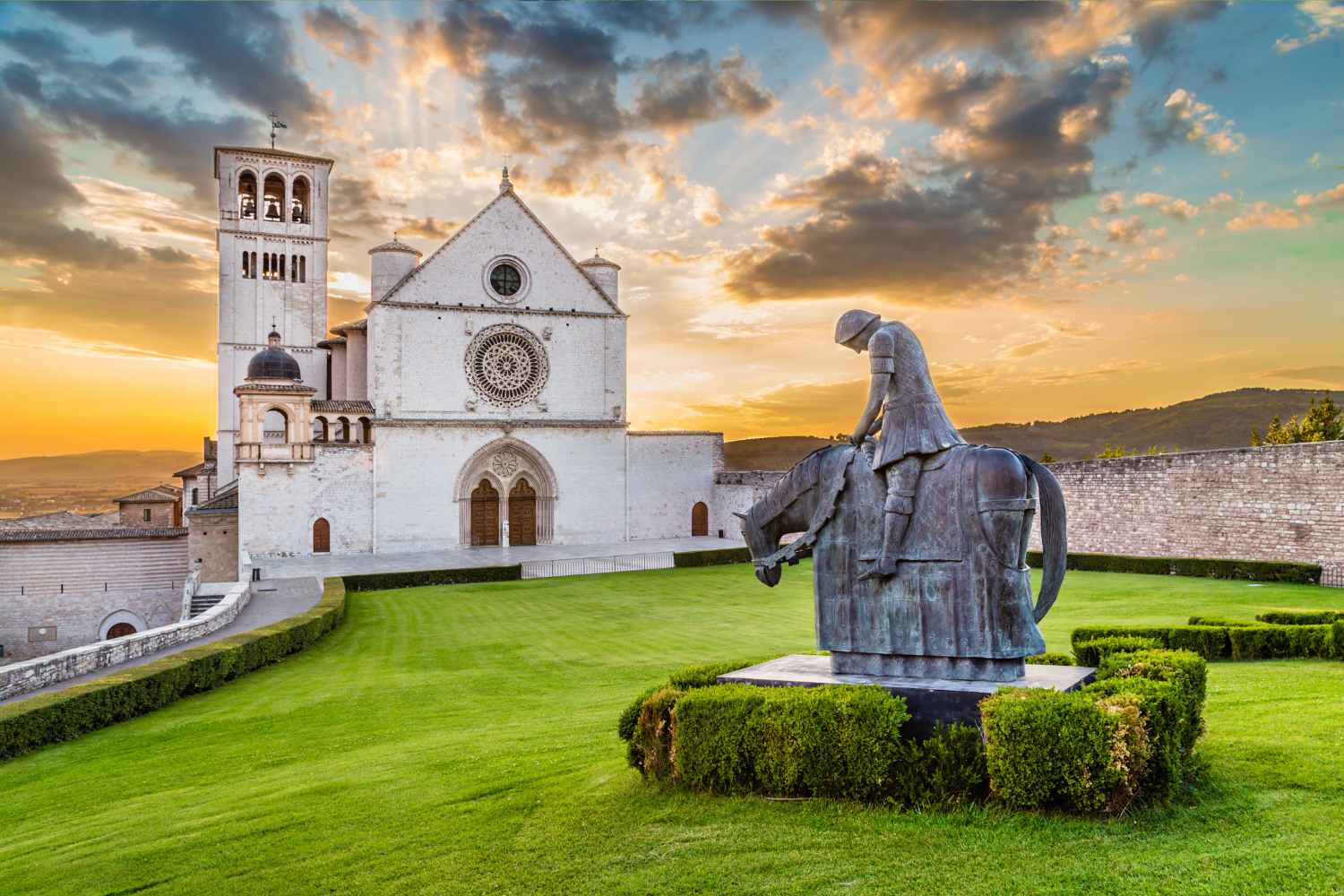
Thirty-five kilometers, almost two thousand meters of altitude difference and about twelve hours of walking. Certainly not a path for everyone, but if you decide to tackle it, you will literally find yourself following in Francesco’s footsteps in the last days of his life. On 26 April 2026, the new section of the Via di Francesco was officially inaugurated which connects Assisi to Bagnara di Nocera Umbra and the Grotta dell’Angelo, included in the official route as the 15th stage. The name chosen could only be “The Last Walk of Francis”
An itinerary that retraces history
According to the Franciscan Sources, when the Municipality and the Bishop of Assisi knew that the Saint’s death was imminent, they sent a solemn delegation of knights to Bagnara, where Francis was, to escort him to Assisi, so that he would not die outside the city’s territory. This new stretch retraces that itinerary in reverse: it starts from Assisi and goes up towards Nocera Umbra, through the woods of the Monte Subasio Park, until reaching the Romita hermitage, Bagnara and finally the Grotta dell’Angelo, also known as the Grotta di Sant’Angelo.
The route leads through some of the most evocative places in the area between Assisi and Nocera Umbra, linked to the last days of the Saint’s life, with paths immersed in a landscape that invites slowness, listening and reflection. Places still intact, far from the circuits of mass tourism.
How the inauguration took place
The inaugural day took shape with a double departure: the first group at 8 am from the Hospitale Laudato Si in Assisi, the second at 9.30 am from Villa Postignano in the Nocera Umbra area. The two groups met at the small church of Satriano, the symbolic heart of the day, for the celebration of the Holy Mass at 12 pm, accompanied by the reading of passages from the Franciscan Sources. Followed by a convivial lunch in San Leonardo.
Not a simple inaugural excursion, therefore, but a day built to give the route its most authentic tone right from the start: walking, silence, spirituality and sharing.
The stage in detail
From a technical point of view, this is a stage classified as demanding. The official data speak clearly: 35.27 km, a positive difference in altitude of 1,862 meters and a negative difference of 1,153 metres, with an estimated travel time of around 12 hours. The surface alternates asphalt, dirt road and unpaved sections. The signage is the usual one of the Via di Francesco (white-red CAI signs and yellow/blue indications) with rest points and water sources along the route.
Those who tackle the entire stretch must be physically prepared, although it must be said that the stage can be broken up and made more accessible (even to less experienced hikers) thanks to the possibility of downloading the GPX route from the official website.
The Way of Francis: a multi-directional journey
This new segment is part of the wider network of the Via di Francesco, the official Franciscan route of Umbria which can be tackled in two main directions: from the north, starting from Florence or Rimini with a stop at La Verna and arriving in Assisi; or from the south, departing from Rome. In both cases the heart of the journey is Assisi, and from there the variations radiate towards the places most linked to the life of the Saint.
View this post on Instagram
Stage 15a completes and enriches the Rome–Assisi direction, adding a segment that until now was missing in the official mapping and which takes the pilgrim well beyond the basilica, into the woods of the Apennines and up to the geographical and spiritual borders of Francis’ last journey.
Slow tourism, lively territory
The inauguration of this stretch comes at a time when the Italian paths are registering growing interest, even among non-believers, because pilgrimage has now transformed into a form of slow travel, as an alternative to mass tourism. For territories such as the one between Assisi and Nocera Umbra, still intact, little frequented, rich in hermitages and villages, these routes can represent a good tourist resource, given that they enhance the reception facilities of the territory and can generate an income that does not depend on large seasonal flows.
