
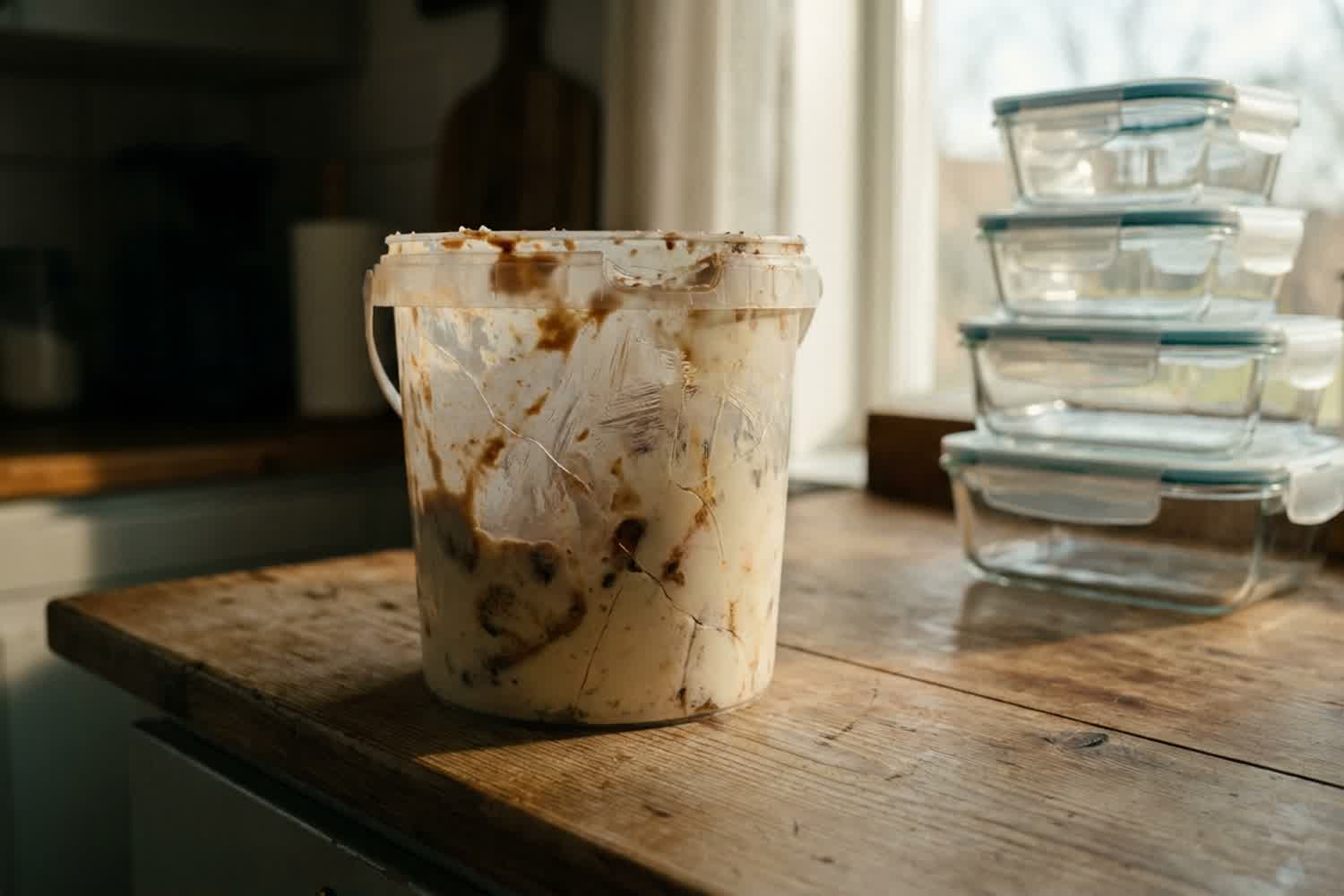
How many times, once you’ve finished the ice cream, have you thought: “This tray is still perfect, I’ll use it to store the leftover sauce”? It is an instinctive, almost virtuous gesture. But according to experts and increasingly recent studies, reusing disposable plastic packaging to store other foods is one of those habits that would be best abandoned – and not for a question of order, but of health.
The problem is not the plastic itself, but how we use it outside of its original purpose. Trays of ice cream, yogurt, margarine or other similar products are packaging designed for single use: that is, designed to contain a specific food, in specific temperature and storage conditions. Everything else is uncharted — and potentially risky — territory.
What happens when we reuse them
Dr. Birgit Brendel from the Saxony consumer center explains it clearly:
Tubs of ice cream, margarine and similar are disposable packaging that is not intended for further storage, freezing or heating.
As soon as you use the packaging differently than intended, unwanted substances in the plastic can migrate into the food. A practical example:
Ice cream tubs are designed for cold, frozen masses and are harmless to health when used in this way. However, if you fill them with hot soup, unwanted substances may be released due to the heat.
Some thermoplastics deform at higher temperatures, and if the package is heated or even exposed to repeated temperature changes, the plastic can degrade and release chemicals into the food.
The microplastic issue: what the new studies tell us
In recent years, research on the topic has intensified considerably. Recent studies published in journals such as Environment International And Nature Food confirm that reusing single-use plastic containers — especially if scratched, deformed or repeatedly washed in the dishwasher — accelerates the release of microplastics and nanoplastics into food. Particles so small that they are invisible to the naked eye, but enough to cross the intestinal barrier and accumulate in the tissues.
2024 research from the University of Hull found that polypropylene (PP) containers reused multiple times release up to 40% more microplastics than single use, especially when exposed to temperatures above 40°C — such as those from a dishwasher or hot food.
This is not just a theoretical alarm: microplastics have been found in human blood, breast milk, lungs and even the brain. The scientific community is still working to quantify the long-term effects, but the precautionary principle suggests reducing exposure as much as possible.
Glass is better (and not just for the freezer)
The advice of experts remains unanimous: to preserve and freeze food, it is better to opt for glass jars, which do not release chemical substances, resist temperature variations and last practically forever. Stainless steel containers are also an excellent alternative, especially for those who are always on the move.
However, if you want to reduce plastic at the source, the best option is to buy food in bulk whenever possible — a growing trend, with more and more supermarkets and shops offering this option.
So do we throw away the empty trays?
Absolutely not. Not being able to use them to store food doesn’t mean they have to end up in the bin right away. Rigid plastic packages are excellent for holding objects: pens, paper clips, screws, nails, jewellery, seeds to plant in spring. And then let your imagination run free with creative recycling or crafts with children – activities which, among other things, teach the little ones the value of conscious reuse.
The difference lies in the context: reusing plastic away from food is a smart gesture. Using it to store food, however, is a risk that is not worth taking.
