
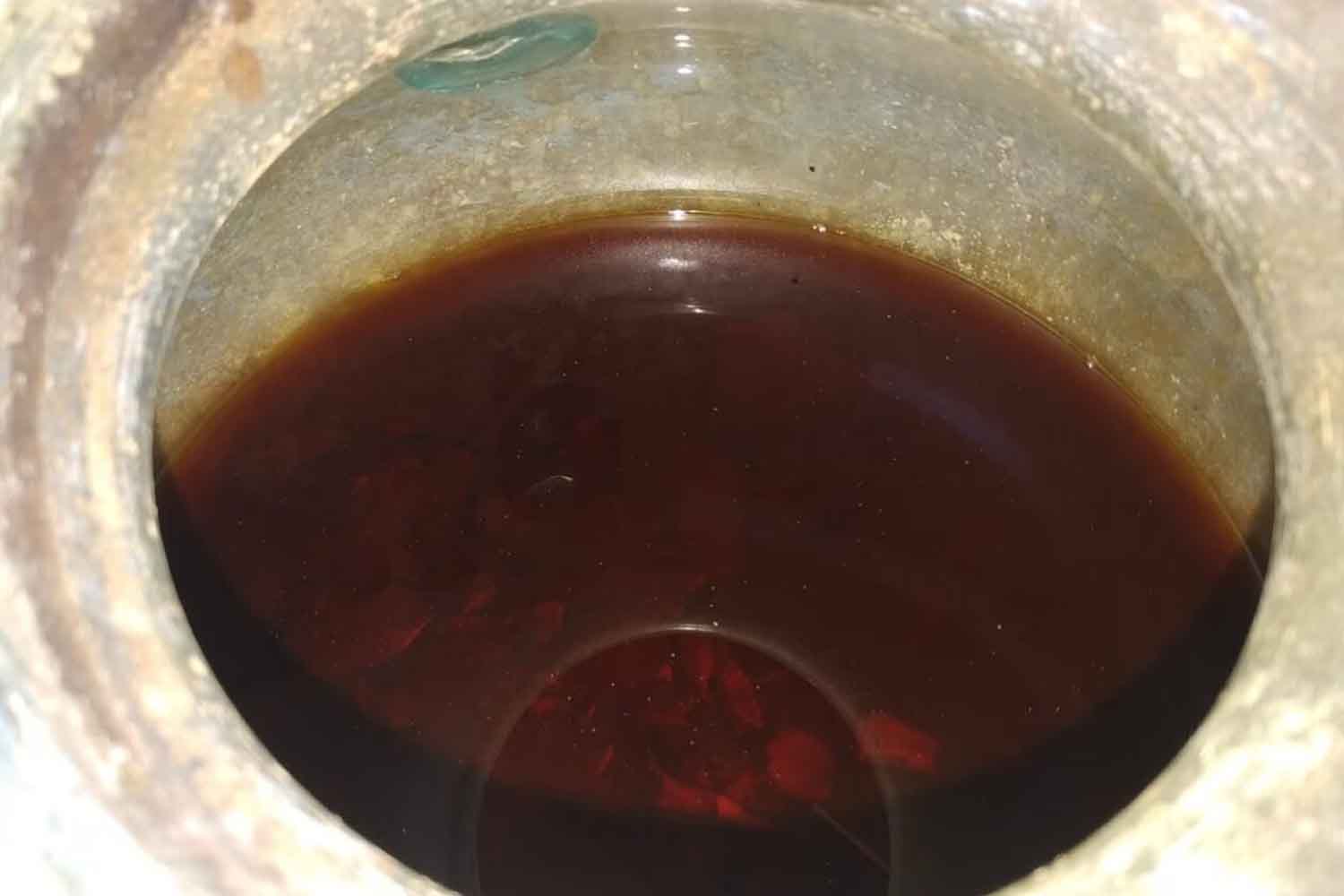
Inside a Roman tomb even a missed glass can say a lot. In Carmona, in southern Spain, the oldest wine in the world still preserved in liquid form had been closed in a funerary urn for about two thousand years. Dark, reddish, almost disturbing if we think about the context. We had already talked about the discovery: a Roman wine from the 1st century AD that has come down to us while still liquid. Now, however, a new scientific reading adds a more uncomfortable wrinkle. That wine also tells of the hierarchies between men and women in ancient Rome.
The tomb was discovered in 2019 during some renovation work on a private house. Under the floor, an intact Roman mausoleum appeared, dug into the rock and remained sealed for centuries. Inside there were six people: Senicius, Hispana and others four individuals with no known name, two men and two women. The wine was found in the urn associated with a man, along with his cremated remains. Next to it, a gold ring with the depiction of Janusthe Roman god of thresholds, passages, beginnings and ends. A presence that is almost too precise, considering that we are in front of a burial. When the Romans decided to be symbolic, they came down hard.
The analyzes published in 2024 had clarified the nature of the liquid: it was probably wine originally white winealthough today it appears reddish-brown due to the chemical transformations that have occurred over time. The most recent study, published in 2025, however, shifts the gaze from the archaeological primacy to the social meaning of that funerary choice. The wine was not there as a poetic detail, nor as an accessory for a curious story. It was part of a ritual language. And that language, coincidentally, spoke to the masculine.
In the male urn there was wine
The Carmona burial chamber is also important for a very simple reason: it had remained closed. This allowed researchers to rule out more mundane explanations, such as water infiltration, flooding or condensation. The other urns did not have the same liquid. So that wine had been poured on purpose, into that urn, with a specific intention. A ritual gesture, of course. Also a gesture of status.
The mausoleum, probably belonging to a wealthy family, was located along the road that connected Carmo, the ancient Roman Carmona, to Hispalis, present-day Seville. Once it would have been visible from the outside, perhaps marked by a tower that later disappeared. These tombs were not just private places of grief. They were also public statements. They said to passers-by: we were here, we counted for something, remember us. Sober, the Romans, indeed.
Within this framework, wine takes on a different weight. In ancient Rome it was a daily drink, a commodity, a ritual, a pleasure, an offering, a social symbol. It accompanied banquets, cults, libations and important passages. In Carmona’s urn, however, he accompanies a man. It is there with him, along with the gold and cremation remains. The new study reads precisely this association as a material trace of male powera confirmation of how gender differences continued to organize social life even at the moment of death.
Senicius, or in any case the man associated with wine, is remembered through a kit that speaks of authority, passage, belonging to a certain rank. Death closes the body, the ritual keeps the role standing. A very Roman thing, in the end: even when dead, one had to present oneself well.
Hispana had perfumes and amber
Hispana was also in the same tomb. His urn tells another story, with other objects and another vocabulary. Not wine, but amber jewelrya container for patchouli perfume and remains of fabrics probably made of silk. Precious, refined materials, linked to the body, to ornamentation, to sensorial memory. All very nice, of course. Also very codified.
The comparison between the two urns is the most interesting part. On the one hand the wine, the ring, the male language of ritual and status. On the other hand perfume, amber, fabrics, body care. Different objects for different identities, as if Roman society had continued to distribute roles even beyond the threshold of life. For men certain symbols, for women others. With a precision that almost makes more noise than the discovery itself.
Roman women’s relationship with wine was complicated and guarded. Ancient sources tell of prohibitions, moral condemnations, family controls, a long obsession with female behavior that sounds very ancient and at the same time annoyingly familiar. Then, as always happens, real life was more nuanced than the rules: some evidence suggests that women drank wine in certain contexts, perhaps sweet or less strong varieties, such as passum, obtained from dried grapes. The point remains the symbolic weight.
A white that has become dark
To identify the liquid, the researchers analyzed pH, mineral salts, organic compounds and polyphenols. They used techniques such as inductively coupled plasma mass spectrometry, useful for reconstructing the mineral profile, and high-performance liquid chromatography coupled to mass spectrometry, used to identify wine markers. Less laboratory-like: they looked for chemical fingerprints in the liquid capable of saying “yes, this stuff was wine” after twenty centuries spent inside a funerary urn.
Seven wine-compatible polyphenols have been identified, also present in modern wines from Andalusian areas such as Montilla-Moriles, Jerez and Sanlúcar de Barrameda. The absence of syringic acid, associated with red wines, led researchers to refer to it as white wine. The current color is deceiving: time, chemical reactions and contact with the materials of the tomb have transformed it into a dark liquid, very far from its original appearance.
Establishing the precise provenance remains difficult, because there are no identical Roman samples with which to make a direct comparison. The mineral profile, however, is consistent with the white wines of the area that in Roman times belonged to Betica, roughly Roman Andalusia. A rich agricultural area, crossed by wine production, trade and culture. Columella, a Roman author born in Hispania, wrote about agriculture and winemaking techniques. In short, that wine doesn’t appear out of nowhere like a forgotten souvenir. It comes from a landscape where the vine counted a lot.
The comparison with the famous Spira bottle, found in Germany in the 19th century and dated to the 4th century AD, remains inevitable. For a long time it was considered the oldest wine still preserved. The case of Carmona is different because the liquid was chemically analyzed and comes from an intact funerary context, with names, objects, human remains and a precise disposition. We don’t just have one bottle that has survived the test of time. We have a whole scene. And in that scene every object seems to be placed there to continue speaking.
Then there remains the most human detail, almost comical in its obviousness: no one really wants to taste this wine. Even without particular signs of toxicity, we are still talking about a liquid that remained for two thousand years next to cremated human remains. Archaeological curiosity has its limits, thank goodness.
And maybe that’s okay. That wine was not intended for us, nor for a glass, nor for the most disturbing tasting in history. He had been left next to a man to accompany him, represent him, fix him in a family memory. Today it comes to us as a kind of liquid document: it talks about rituals, wealth, death, wine, men placed at the center and women told through other objects, other borders, other permissions. Two thousand years later, the wine is still there. It changed color. The hierarchy, however, is very well recognisable.
