

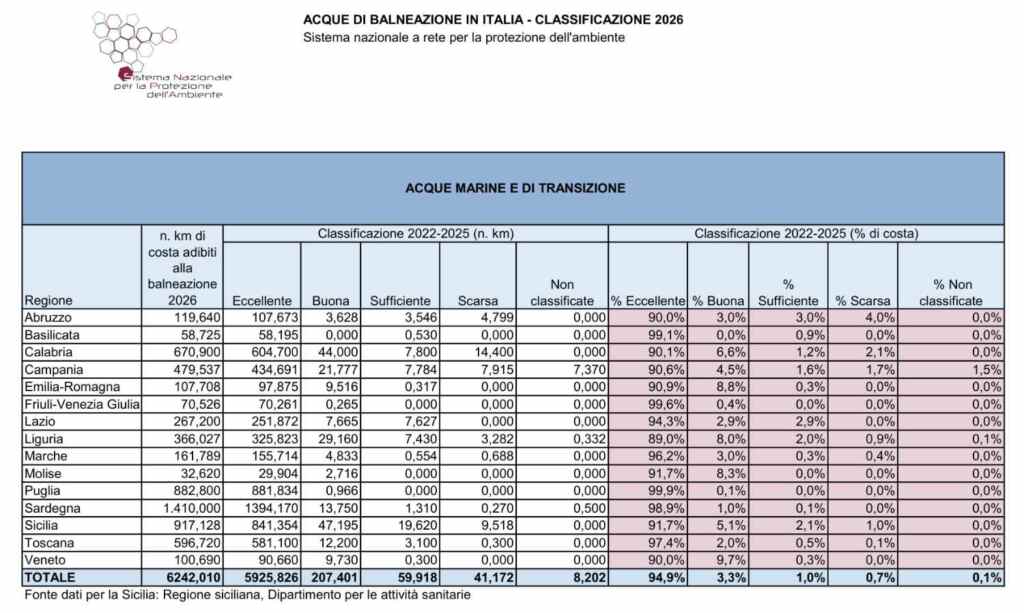
The Italian coasts continue to stand out for their water quality which remains at the top. The updated data released by the National System for Environmental Protection (SNPA) and ISPRA paint an extremely positive picture: out of 6,242 kilometers of monitored coastline, 5,926 kilometers fall into the excellent quality category, the highest required by European regulations on bathing.
Translated into a percentage, it means that 94.9% of the monitored coasts offer top-level environmental standards. A result that confirms the solidity of the Italian monitoring system and the effectiveness of the protection activities that are carried out throughout the year throughout the national territory.
Great satisfaction with the results obtained was expressed by Maria Alessandra Gallone, President of ISPRA and SNPA:
The sea is one of our country’s most precious assets. The results on the quality of bathing water are a source of satisfaction, but they also remind us how important it is to continue investing in the knowledge, monitoring and protection of marine ecosystems. Protecting the sea means protecting biodiversity, territories, communities and the future.
Numbers that confirm the excellence of the coasts
The analysis concerns the 4,524 bathing waters into which the Italian sea coast is divided. Alongside the predominant share of excellent quality, equally encouraging data emerge: 207 kilometers of coast are classified as good quality, equal to 3.3% of the total monitored.
Only 60 kilometers, or 1%, fall into the sufficient category, while just 41 kilometers are classified as poor quality, corresponding to 0.7% of the total. Finally, 8 kilometers remain unclassified, as they do not yet have a sufficient historical series of data for a definitive evaluation. These are numbers that confirm how almost all of the Italian coasts respect extremely rigorous environmental parameters.
Puglia, Friuli and Basilicata lead the ranking
Looking at the percentage of coast classified as excellent, the regional ranking sees Puglia in the lead with 99.9%, followed by Friuli-Venezia Giulia at 99.6%, Basilicata at 99.1% and Sardinia at 98.9%. The figures for Tuscany are also very high, with 97.4%, Marche, with 96.2%, and Lazio, with 94.3%.
In the middle of the table are Molise and Sicily, both at 91.7%, then Emilia-Romagna at 90.9%, Campania at 90.6%, Calabria at 90.1%, Abruzzo and Veneto at 90.0%. Liguria closes with 89.0%, a lower figure than the other regions but still within a very solid national framework, in which even the last position remains close to nine kilometers of excellent coastline out of ten.
The Puglia case: six consecutive years at the national top
Among the Italian regions, Puglia once again stands out, confirming itself as the best in Italy for the quality of bathing water for the sixth consecutive year. According to SNPA data, 99.9% of Apulia’s waters are classified as excellent, a result that places it ahead of all other regions.
Along approximately 1,000 kilometers of coastline, the Region has identified 676 areas intended for bathing, equal to approximately 900 kilometers of monitored coastline. Every year Arpa Puglia carries out thousands of checks and approximately 8,500 analytical laboratory determinations, constantly checking the levels of intestinal Escherichia coli and Enterococci. The only stretch not classified as excellent concerns the area called “Fogna Cittadina Molfetta (500 meters south)”, which however maintains a good quality classification.
The general director of Arpa Puglia, Vito Bruno, underlined the value of the result:
The result that sees Puglia confirmed, for the sixth consecutive year, at the national top for the quality of bathing water represents the recognition of a daily work carried out with competence, scientific rigor and a great sense of responsibility by all Arpa Puglia staff.
The regional ranking of the best bathing waters
Below is the ranking of the regions with excellent sea with percentages:
- Puglia 99.9%
- Friuli-Venezia Giulia 99.6%
- Basilicata 99.1%
- Sardinia 98.9%
- Tuscany 97.4%
- Brands 96.2%
- Lazio 94.3%
- Molise 91.7%
- Sicily 91.7%
- Emilia-Romagna 90.9%
- Campania 90.6%
- Calabria 90.1%
- Abruzzo 90.0%
- Veneto 90.0%
- Liguria 89.0%
How water quality is controlled
Behind these results there is constant and highly specialized work. The checks are carried out by monitoring two fundamental microbiological indicators: Escherichia coli and intestinal enterococci, elements that allow the identification of any contamination of faecal origin.
During the bathing season, the regional environmental agencies carry out at least one sampling per month for each area intended for bathing. In 2025 alone, approximately 30,000 samples were carried out between ordinary checks and additional checks, activated when possible critical situations emerged.
If the limits established by law are exceeded, municipal administrations are immediately informed and can adopt temporary measures prohibiting bathing to guarantee the safety of citizens.
Not just bathing: the health of the sea is much more
Experts underline, however, that bathing is only one indicator of the overall health of the sea. Alongside water quality, equally crucial aspects come into play such as biodiversity, the conservation of marine habitats, the protection of the seabed, the fight against microplastics and the effects of climate change.
Precisely in this direction are numerous national projects dedicated to the protection of marine ecosystems. Among these, the MER – Marine Ecosystem Restoration program stands out, financed by the PNRR, which aims at the recovery and conservation of biodiversity through interventions ranging from the restoration of Posidonia oceanica meadows to the protection of particularly vulnerable species and habitats.
You might also be interested in:
