
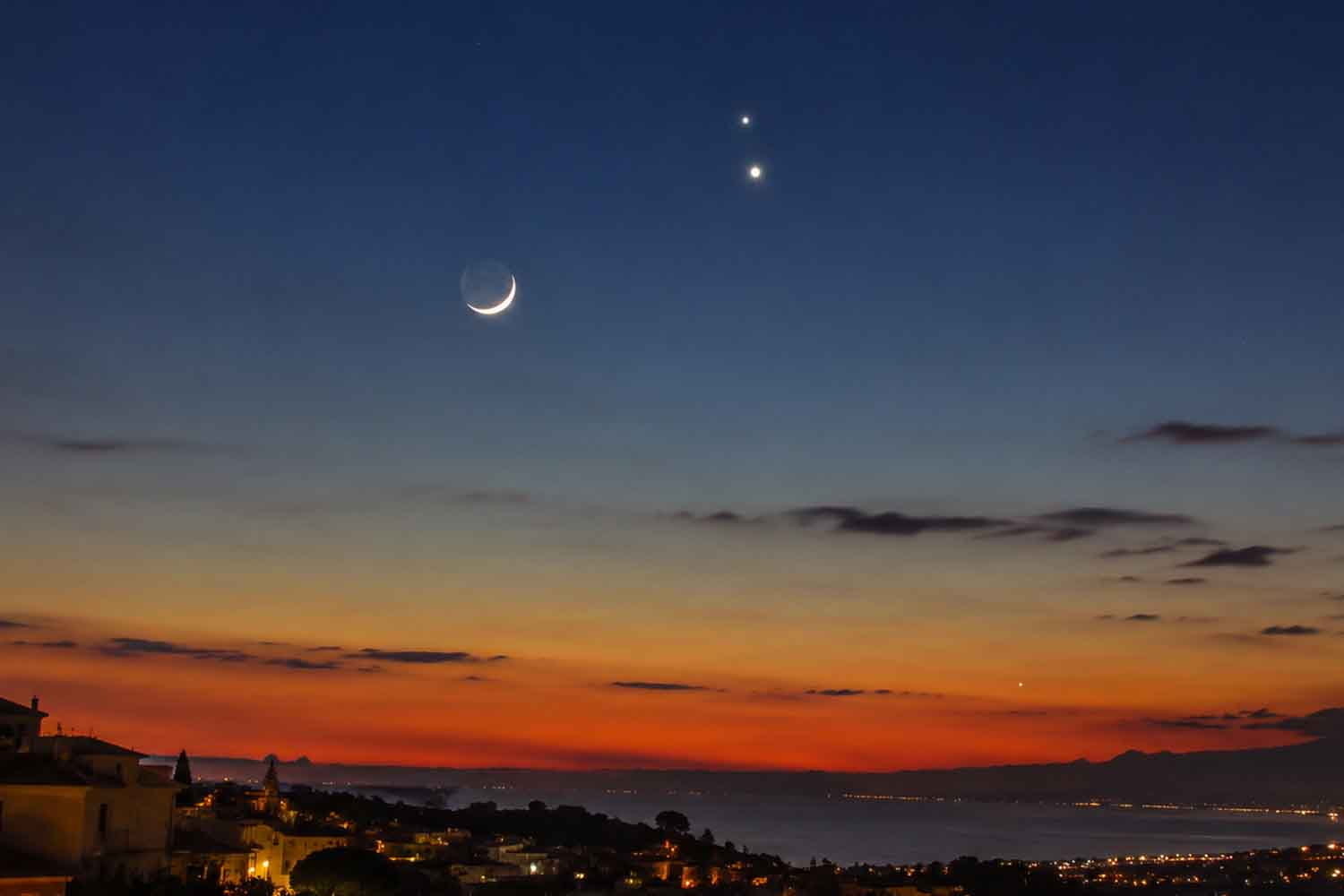
The sky of June he asks something very simple, almost banal: a piece of free horizon towards the west. No buildings that are too tall, no hills right in front, no mist placed in the wrong place. Because the show is also there from Italy, yes, but it’s all played low, in the delicate band of the sky that remains lit shortly after sunset. Anyone who has an open terrace, a beach, a lookout or an obstacle-free field in front of them already has a huge advantage.
Between 9 and 17 June 2026Venus, Jupiter, Mercury and the Moon will draw a small evening scene visible to the naked eye. The most awaited moment of the first part of the month will be the conjunction between Venus and Jupiter, scheduled for the evening of June 9, when the two brightest planets will appear very close in the western sky. Further down, almost to complete the composition, there will also be Mercury, increasingly difficult to intercept because it is close to the horizon.
You look west
To observe them from Italy you will have to look towards the west-northwest shortly after sunset. Venus will be the easiest reference: bright, clear, much more obvious than the stars just starting to appear in the evening sky. Jupiter will keep her company in the same area, less dazzling and still easily recognisable. Mercury, however, will remain the most capricious of the group: present, interesting, but low and very dependent on the clarity of the air.
According to the astronomical calendar of Italian Amateur Astronomers Unionon the evening of June 9th will be dedicated to the “trio” Venus-Jupiter-Mercury, with a live broadcast scheduled for 8.45pm together with EduINAF. The passage is interesting because it brings together the two brightest planets in the sky and, just below, the innermost planet of the Solar System, the one that often escapes notice due to its apparent proximity to the Sun.
Mercury, between June 9th and 15th, will pass through a favorable window of evening observability. This helps, without turning it into a beacon. You will have to look for it as soon as the sky begins to darken enough, with your gaze low on the western horizon. Binoculars can help, as long as they are used only after complete sunset and never with the Sun still present in the observation area.
The Moon enters on the 17th
The second scene comes a few evenings later. On June 17th, after the show on the 9th, the crescent Moon will approach Venus, while Jupiter will remain in the same area of the sky and Mercury will appear lower. The configuration will also be visible from Italy, always with the same practical condition: clear sky towards the west and observation in the first part of the evening.
The Moon will be a thin sickle, that clear blade that does not last long and makes everything more recognizable. Next to Venus and Jupiter it will form an apparent line, with Mercury closing the lower part of the scene. Castor and Pollux, the two main stars of Gemini, will also be present in the area, useful as a reference for those who are a little familiar with the sky.
Here it is important to be precise: talking about the alignment of the planets is fine, as long as we mean a perspective arrangement seen from the Earth. Venus, Jupiter and Mercury will be very far from each other in real space. What seems close will be their position on the celestial vault, as happens in conjunctions and apparent meetings between planets and the Moon. The sky, every now and then, knows how to use perspective very well.
How not to miss it
The best advice is to go out about 30-45 minutes after sunset and check the western part of the sky. Venus and Jupiter will be the easiest objects. Mercury will require more patience, especially from cities, where buildings, humidity and artificial lights can eat up the lower part of the horizon. The Moon on June 17 will make the composition easier to identify even for those observing without astronomical maps.
Those who live in very urbanized areas can try from a high point, perhaps a terrace or an unobstructed view. Those who have the opportunity to move towards the sea, countryside or hills with an open view to the west will have better conditions. The dark sky helps, of course, but in this case the most important requirement remains a low and clean view.
The show will not last long. These objects will be close to the Sun from our perspective and will soon dip below the horizon. It’s best to come prepared, know where to look and give yourself a few minutes without expecting the perfect photograph the first time. Sometimes it is enough to recognize Venus, then Jupiter, then that lowest dot that tries to resist in the twilight.
June brings the rest: long evenings, warm air, light that slowly goes out. The alignment of the planets will be there, low, discreet, much more concrete than certain glossy images that promise planetarium skies above any balcony. We just need to find a piece of the west without obstacles. Heaven will do its part. We, for once, can limit ourselves to raising our heads.
