
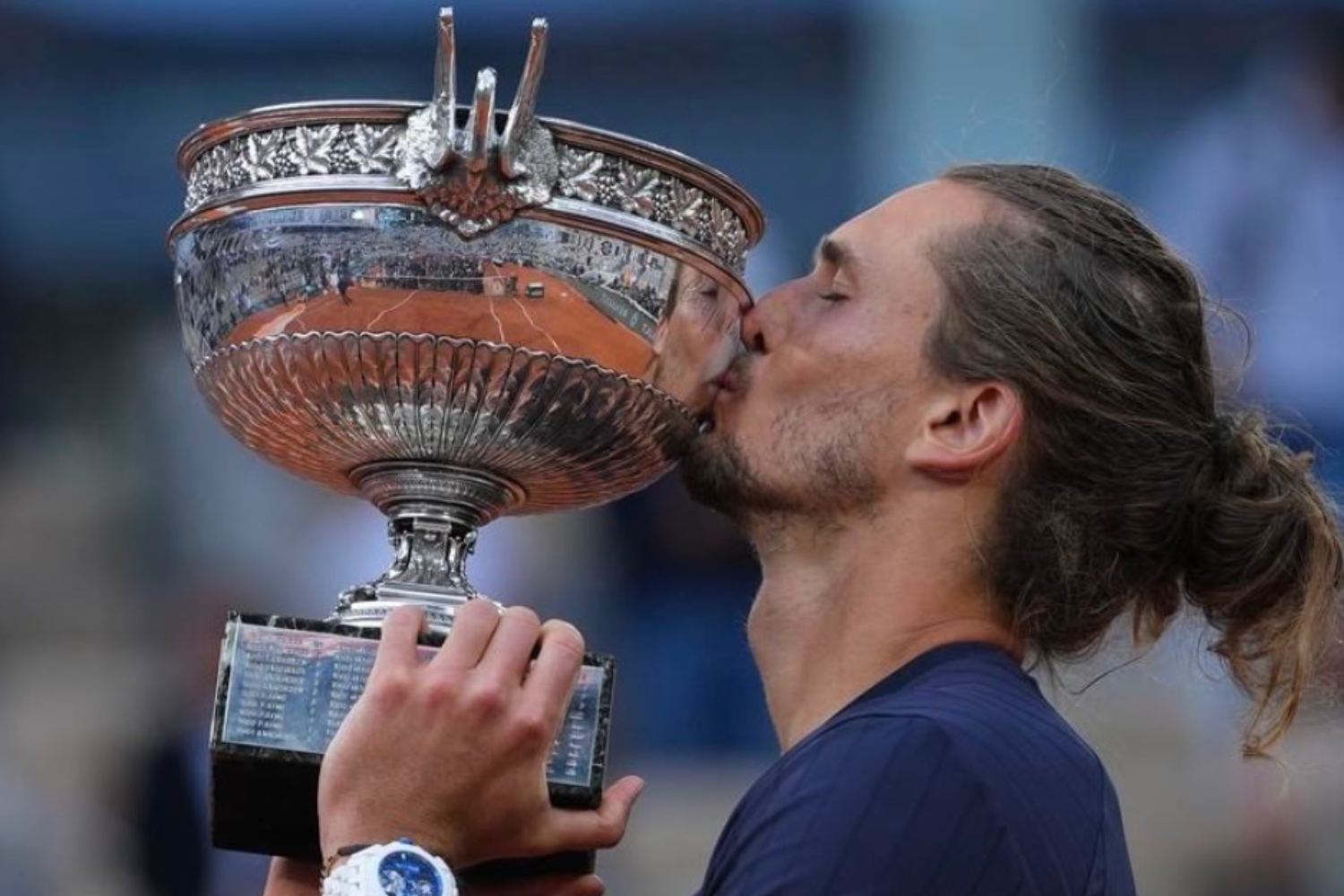
Alexander Zverev has finally written the chapter he has been chasing for an entire career: the conquest of Roland Garros against Flavio Cobolli gave him his first Grand Slam title, transforming years of waiting into a moment of sporting liberation. On the Philippe-Chatrier, the world number 3 closed a journey that for too long had been described through the word “unfinished”, between blurry finishes and missed opportunities just when the finish line seemed one step away.
Paris’ success did not come in a linear fashion. Before this triumph, Zverev had already experienced three Slam finals that ended in pain: against Dominic Thiem at the 2020 US Open, against Carlos Alcaraz at Roland Garros 2024 and against Jannik Sinner at the 2025 Australian Open. Three matches, three moments in which the title had seemed possible, but always slipped away at the decisive moment. A sequence that had fueled the narrative of enormous talent, but never fully blossomed in the most important tournaments.
View this post on Instagram
Type 1 diabetes: the invisible game that never stops
Behind this victory, however, there is also much more, first and foremost a condition that has accompanied Zverev since childhood: type 1 diabetes, diagnosed when he was just four years old. A reality that never disappears, not even during the Slam finals, and which transforms every match into a double challenge.
For a child, and then for a growing athlete, this means learning early to manage a routine made up of checks, injections and continuous attention to the body’s signals. Not a marginal detail, but a condition that enters into every daily choice, from nutrition to training, up to recovery pace.
Zverev has said several times that for years he lived this reality in a reserved, almost hidden way, also for fear of being labeled more for his illness than for his talent. Only in 2022 did he decide to talk about it publicly, transforming a personal condition into a social responsibility. The tennis player spoke of a “second match” that is played away from the eyes of the public:
There are two games being played at the same time: the one that everyone sees and the one that only I hear.
This “second game” concerns everything that happens between one point and another: blood sugar control, the evaluation of energy levels, the decision on when to take rapid sugars or insulin as he did in the final won against Cobolli and as we have seen him do several times recently, without being “ashamed” anymore. This management requires a delicate balance: too much insulin can lower blood sugar too much, while a deficiency can compromise energy and concentration.
From difficulty at school to the silence of his youth
Before becoming an ATP champion, Zverev also had to deal with the social side of the disease. He said he suffered episodes of exclusion and difficulties in school related to diabetes, a condition that was less well known and often misunderstood at the time.
This led him, for a long period, to experience the disease in a discreet way, avoiding making it public even in professional sport. The fear was that it would become a limit perceived by others, rather than a simple condition to be managed. Only with time, and especially after reaching the top of world tennis, did he decide to change his approach, transforming his experience into a message aimed at younger people.
The birth of the project: from personal pain to a public mission
When Alexander Zverev decided to speak openly about his type 1 diabetes, he did not limit himself to talking about a personal condition. He took a further step, transforming his experience into a structured support project: the Alexander Zverev Foundation, born in 2022.
The objective is precise and concrete: to help children and adolescents with diabetes, especially in contexts where access to care is limited or complicated. It is not just about raising awareness, but about direct interventions, with the provision of insulin, medical devices and essential healthcare support. At the basis of the foundation is a principle that Zverev has repeated several times: no child should give up their life or their dreams because of diabetes. A concept that comes directly from his sporting history, marked by moments in which he too had been suggested to change path.
The project is not limited to fundraising, but aims to have a direct impact on communities. Through partners and local organizations, the foundation distributes medical materials and supports ongoing care programs, with particular attention to countries where diabetes management is more difficult. According to data released by the organization itself, over 1,000 children have been reached in recent years, with millions of euros raised through donations and collaborations.
View this post on Instagram
Injury and Roland Garros: the court that destroyed him and then rebuilt him
Returning to Roland Garros, the tournament was not only the scene of his victory, but also the site of his most serious injury. In 2022, during the semifinal against Rafael Nadal, Zverev suffered an ankle injury with the rupture of three ligaments, an event that profoundly affected his career.
That moment represented not only a physical fracture, but also a mental one. Rehabilitation was long and complex, and a return to the highest level was by no means guaranteed. Winning in Paris, in the same tournament where everything had collapsed, transformed the triumph into a form of closing the circle, a way to regain a place that in the past had taken much more than one match away from him.
Lost finals and the weight of a “waiting” generation
The path of Zverev, who in recent years has been accused of domestic violence by two former partners (accusations which the tennis player has always denied), also fits into a broader context: that of the so-called “lost generation” of tennis, crushed between the era of the Big Three and the explosion of new dominators, Jannik Sinner and Carlos Alcaraz. For years, the German has been one of the most representative faces of this category.
Despite important successes such as the ATP Finals, the Masters 1000 and the Olympic gold medal in Tokyo, the result remained incomplete in the Slams. Lost finals have created a narrative that is difficult to shake off, that of the player always close to the finish line but never decisive in the final moments. The victory at Roland Garros changes this perception into a sort of liberation for Sverev.
Victory as a point of arrival and new beginning
The triumph at Roland Garros marks a clear transition for Zverev: from a player often told through what he was missing to a finally complete champion. But the path that brought him this far remains built on complex elements, where sporting success is intertwined with the daily management of a chronic illness and with overcoming a serious injury. It is not just a trophy, but the result of years in which each match was also an invisible management of balance, resistance and adaptation. And it is precisely this dimension that makes his victory different from many others: not the end of a story, but the transformation of a long journey into a new starting point.
You might also be interested in:
