
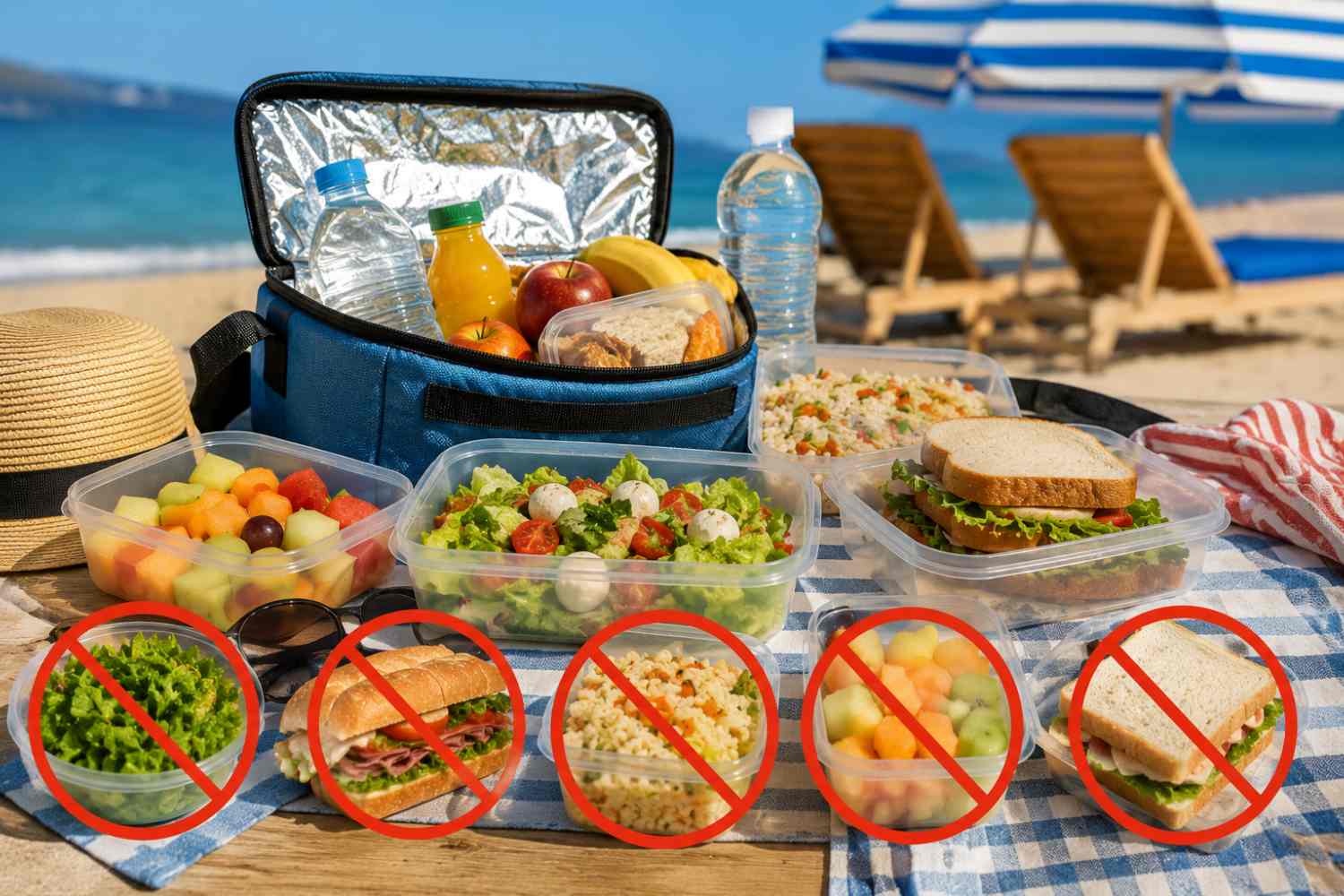
Cooler bag loaded, towel spread out, umbrella set up: everything ready for the perfect day at the seaside. But there’s a detail that few really consider — and that can turn a moment of relaxation into a weekend in bed feeling nauseous.
We’re talking about what we put in our lunch bag. Prolonged exposure to heat, sand, hands that are not always very clean and the far from controlled hygienic conditions of the beach create a perfect cocktail for bacterial proliferation. And no, the cooler bag alone is not always enough.
Here are the foods that would be best left at home when you go to the beach – with the relevant scientific explanations – and some practical advice for eating well and safely even under the umbrella.
Fresh salad (even the one in a bag)
Raw salad is among the most perishable foods that exist and, not surprisingly, it consistently figures among the main sources of food-borne diseases according to European health authorities.
Even the classic bag of already washed and packaged salad is not risk-free: taking it to the beach means exposing it for hours to temperatures that favor bacterial proliferation, deterioration of the leaves and – in the worst cases – the formation of toxins that are difficult to eliminate even by cooking.
Recent studies by the EFSA (European Food Safety Authority) confirm that fourth range salads are among the most common vectors of contamination by E. coli And Listeria monocytogenesespecially when the cold chain is broken.
Anything that contains mayonnaise
Sandwiches, potato salad, cocktail sauce, filled wraps: if there is mayonnaise, it is better to keep it away from the beach.
The problem is not just the presence of raw (or undercooked) eggs, but the combination of fats, proteins and moisture that makes mayonnaise an ideal breeding ground for bacteria such as Salmonella And Listeria. A few hours outside the safe temperature (below 4°C) are enough to make a harmless sandwich a potential risk.
This also applies to vegan mayonnaise based on soy or aquafaba: the bacterial component changes, but the risk of rapid deterioration remains.
Already cut fruit
A sliced watermelon, a fruit salad, mixed fruit from the kiosk on the seafront: pre-cut fruit is one of the most insidious traps of summer.
Once stripped of the protective skin, the fruit heats up rapidly, begins to oxidize, attracts insects and — above all — exposes the pulp to potential contaminants present in the environment. A 2021 study highlighted how cut fruit sold by street vendors or at the lido bar can be contaminated during the peeling, slicing and packaging phases by Salmonella, E. coli, Listeria And Norovirus.
The advice? Bring the whole fruit and cut it at the moment, after having washed your hands and cleaned your knife and cutting board.
Cured meats and cold cuts in sandwiches
The classic ham sandwich seems harmless, but if prepared early in the morning and left in your bag for three or four hours in the sun (or even just in a hot car), it can become a serious problem.
Cured meats, cold cuts and processed meats – ham, turkey, mortadella, salami, roast beef – contain bacteria that multiply rapidly as soon as the temperature exceeds 4°C. Although seasoning and preservatives help, they do not eliminate the risk, especially in extreme heat conditions like those we are experiencing in recent Italian summers.
The bonus: rice in salad (yes, that too)
Often forgotten on warning lists, cooked rice stored at room temperature is one of the most dangerous foods there is. The Bacillus cereusa bacterium naturally present in uncooked rice, produces spores resistant to cooking which – at temperatures between 10°C and 50°C – multiply, producing toxins capable of causing vomiting and diarrhea even in a few hours. The rice salad brought to the beach is, literally, a time bomb.
How to eat well (and safely) on the beach
The good news is that with a little forethought you can still eat very well at the seaside. Here are the golden rules:
We also recommend:
