
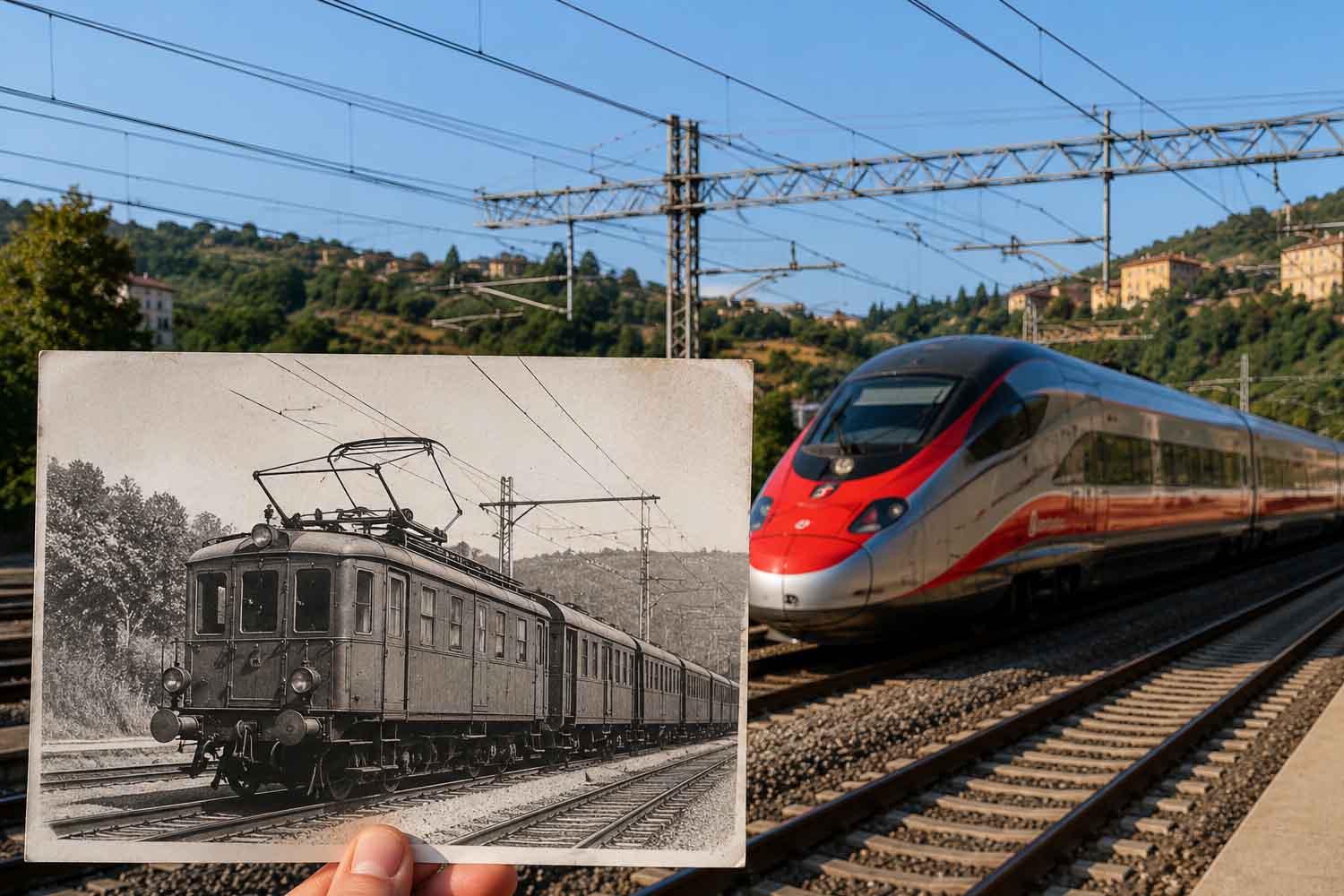
In Italy we are very good at treating the train as a commuter sentence: delays, missed connections, crackling announcements, full carriages at hours when everyone just wants to evaporate. But then, as soon as you look wider, a fact emerges that changes your perspective a bit: our country has a much longer and less obvious history of electric trains in Italy than it seems.
According to Istat data on transport development, Italy had already been a pioneer in Europe in railway electrification, with 4,000 kilometers of electrified lines before the Second World War. Today the electrified railway network accounts for approximately three-quarters of the total, i.e. 75%. A higher share than that of France, which stands at 61%, and Germany, where electrified lines represent around 55% of the network.
An early departure
The data is striking because it tells of an Italy different from the one we often imagine when we talk about infrastructure. A country that today still struggles to guarantee regular connections in too many internal areas, which continues to move with a complicated relationship between iron and rubber, had already understood a simple thing very early on: bringing electricity to the tracks meant improving the quality of the network, increasing efficiency and pushing rail transport towards a more solid modernity.
Those 4,000 kilometers electrified before the world war tell of a technical and industrial choice that arrived well in advance. Inside there is a piece of Italian transport history that rarely enters public discourse, perhaps because we are more accustomed to looking at the train from the window of a late regional train than from a century-long perspective.
Yet the trajectory is clear. Railway electrification is indicated by Istat as one of the elements that have contributed to improving the quality of the infrastructure, together with doublings, signs and more advanced systems. The network, over time, has also changed in this way: less dependent on traditional traction, more suitable for supporting higher operating speeds and more intense use of the lines.
The European comparison
The comparison with France and Germany makes the data even more concrete. Today Italy has electrified approximately 75% of the railway network. France reaches 61%, Germany 55%. Numbers that must be read carefully, because each country has a different network in terms of extension, structure and territorial distribution. However, the Italian share remains high and says something precise: over time, Italy has built an important infrastructure base on electric trains.
This of course does not erase everyday problems. An electrified network alone is not enough to make the service punctual, widespread, accessible and convenient. We need maintenance, investments, adequate frequencies, decent local connections, well-kept stations, true integration with buses, metro and urban mobility. The concrete point remains there: starting from an already largely electrified network is an advantage that deserves to be treated as such.
Also because talking about sustainable mobility without looking at the tracks means leaving out a huge part of the issue. The electric train has a characteristic that makes it different from many “green” promises told in the future: it already exists, it already runs, it already crosses the country. In Italy this history has deep roots, preceding the Second World War, and today it is seen in a percentage that weighs heavily in European comparison.
A story already on track
There is something almost ironic about all this. While we discuss ecological transition as if it were always a door to be opened tomorrow, part of the answer has been traveling on rails for decades. Electric trains in Italy are not a laboratory novelty, nor a suggestion from a strategic plan yet to be written. They are a real infrastructure, grown over time, with a history that starts before the war and reaches a network that is approximately three-quarters electrified.
This figure does not ask for patriotic celebrations or railway postcards polished for the occasion. If anything, it asks us to take a closer look at what we already have under our feet, because such a large electrified network can become a much stronger lever in daily mobility, especially if it stops being treated as a technical detail for professionals.
The country that complains about the train, often rightly, is also the one that brought electricity to the tracks before many others. The difficult part comes now: making that story travel with the same punctuality with which we started it.
You might also be interested in:
