
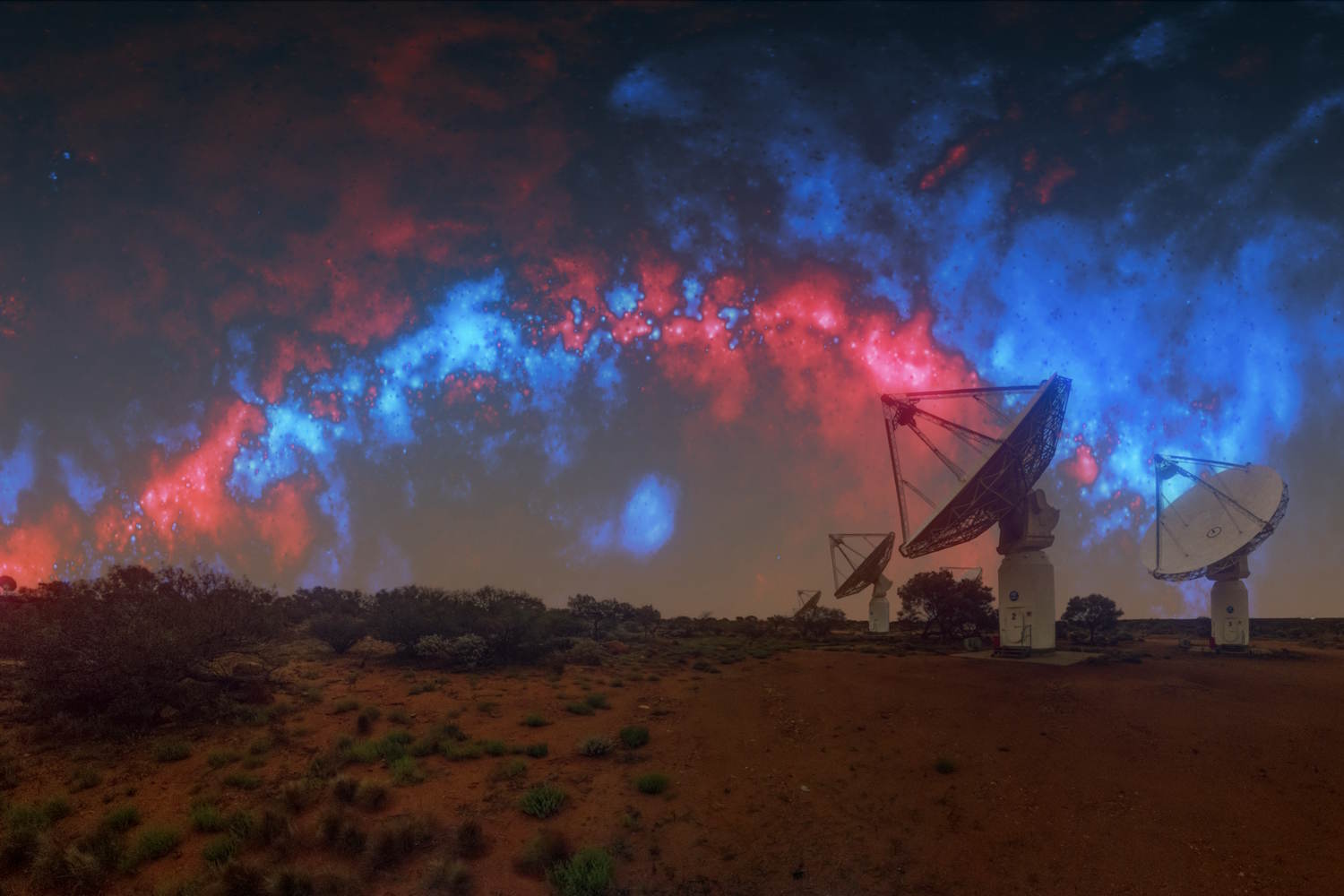
How wonderful! AND the largest magnetic map of the Universe ever madefive times larger than all the previous ones combined: it was obtained by a research group led by CSIROAustralia’s national science agency, and the SKA Observatory (SKAO), an intergovernmental organization that is building two of the largest radio telescopes in the world.
As we know, magnetic fields influence the growth of galaxies, the movement of matter in space and the evolution of the Universe over billions of years. This is why the creation of this map not only marks the beginning of one new generation of research in the field of intergalactic magnetism, but opens new windows, previously unimaginable, on the study of the cosmos.
For the first time, we can study the finest details of matter among nearby stars and analyze huge numbers of distant galaxies
explains Alec Thomsoncommissioning scientist at SKAO
How the map was obtained
The result is the result of very advanced science and technologies: the CSIRO ASKAP radio telescope, in fact, a precursor of the international SKA telescopes under construction in Australia and South Africa, is capable of observe large areas of the sky simultaneously and with one greater depth than many other telescopes.
The tool is found in particular at Inyarrimanha Ilgari BundaratheMurchison Radio Astronomy Observatory of the CSIRO, in the reserve of Wajarri Yamajiin the’Western Australiawhere SKAO is building the SKA-Low telescope.
ASKAP is used to regularly scan the sky and create extremely detailed maps of the Universe’s radio signals, called Rapid ASKAP Continuum Surveys (RACS). Since the first RACS, completed in 2020 and setting a record, the fastest and most extensive survey of the radio sky ever undertaken, several maps have been produced.
The latter, called SPICE-RACSis based on the principle that light deforms when it passes through magnetic fields. In particular, by measuring the twist of the light detected by ASKAP, scientists were able to pinpoint the position of the magnetic fields and their relative intensity.
A magnetic image of this size and scale it was previously unattainablebut new technologies such as ASKAP’s wide field of view and unique disk rotation system, combined with the ability to process huge amounts of diverse data, have opened a new chapter in astronomical research.
We collected the rotation measurements of every galaxy detected by RACS, almost four million galaxies – explains Thomson – and we reprocessed the original ASKAP data to obtain a complete picture
Framework that it really is far superior to what has been done in the past.
For the last 20 years we have been working with essentially the same data set, which did not even cover the Southern Hemisphere – reveals team member Naomi McClure-Griffiths – Now, finally, we can answer some big questions with a much clearer picture of the magnetic structures of the Universe
What can you get from the map
©CSIRO
Thanks to the information we now have about magnetic fields in the Universe, we can study phenomena such as the influence of magnetic fields on the galactic interaction of our Milky Way and its neighbors, the Magellanic Clouds – specifies McClure-Griffiths – We could even find out when magnetic fields first appeared in the Universe. We once thought it was impossible to answer these questions. I’m thrilled to say that’s no longer the case
To make everything even more exciting for the scientific community, is the complete layout of the data setwhich gives us hope great progress in the relative short-medium term.
Our data is accessible to anyone, both for original research purposes and to replicate experiments already conducted, a fundamental aspect of the scientific process. Data from this project is already being used by many research groups to produce new discoveries. By making these resources freely available, we contribute to the continued advancement of our collective understanding of the Universe
And when new telescopes like those at SKA come online (later this decade), they will allow astronomers to map the details of the cosmic web with greater precision and will help explain theorigin of magnetic fields in the Universe.
The results are already available for this link and the article has been accepted for publication by Publications of the Astronomical Society of Australia.
Source: CSIRO
