
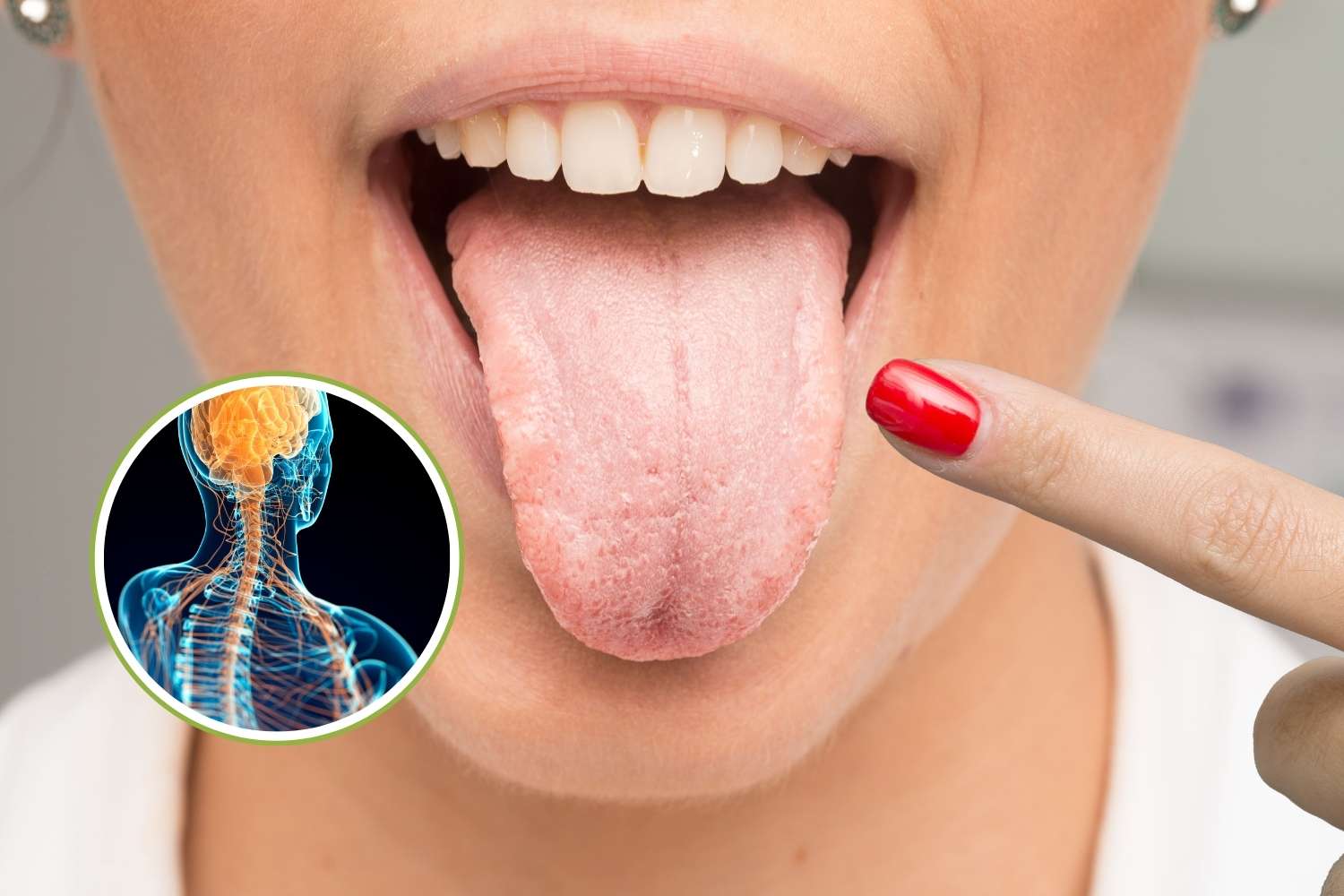
It seems like one of those things that’s too silly to be taken seriously: sit down, stick out your tongue, stay like that for 40 seconds. Yet the gesture ended up in one of the most popular areas of online wellbeing, the one that brings together stress, the vagus nerve, cortisol and small body exercises to do at home, possibly without tools, without apps and without yet another subscription.
The promise circulating on social media is very strong: repeating this movement twice a day would help reduce stress and even lower cortisol. Putting it this way sounds a little too convenient. Liquidating it en bloc, however, would be equally hasty. Because the gesture itself, taken for what it may be, has a meaning: it forces us to pay attention to the mouth, the jaw, the throat, the neck. In other words, bring your mind back into your body for a few seconds. And when we are under stress, it is often best to start from there.
Because language has to do with tension
The tongue seems like a small, almost banal muscle, until you realize how much tension passes through that area. Jaw clenched, teeth clenched, throat contracted, shoulders raised, neck stiff. These are very common signs on days when the body stays on for too long, even when on the outside we seem to simply be sitting in front of a computer.
Anatomically, the tongue is connected to deep muscles in the mouth and throat. Its motricity depends above all on the hypoglossal nerve, while the vagus nerve innervates only a specific part, such as the palatoglossus. This is also explained by a StatPearls sheet published on the NCBI portal, which is useful for bringing some order back into a social narrative that often simplifies a lot.
The movement of sticking out the tongue, however, can produce a practical effect: it breaks the automatism. It makes you feel how tight your mouth is, how stiff your jaw is, how little you’re breathing. In some people this is enough to create a small break, and breaks, when stress rises, are worth more than they seem.
The vagus nerve without magic

@123rf/Canva
The vagus nerve has become something of a wellness celebrity. It is cited for everything: anxiety, digestion, inflammation, heartbeat, breathing, mood. Its importance is real, because it is part of the parasympathetic system, the one that helps the body slow down and recover after an alert phase. The Cleveland Clinic reminds us that the vagus nerve carries signals between the brain, heart and digestive system and is a key component of the parasympathetic response.
Some practices have a more solid rationale: slow breathing, moderate physical activity, singing, humming, massage, relaxation techniques. Here too, measure is needed, because “resetting the vagus nerve” is more of a social media formula than a clinic formula, but the general principle holds: the body can be helped to exit the alarm mode through repeated gestures, breathing and attention. The Cleveland Clinic itself cites several daily strategies related to regulating the vagus nerve, from controlled breathing to movement.
Within this framework, sticking your tongue out for 40 seconds can be read as a micro-exercise in body awareness. A kind of simple switch: I do something unusual, I feel the body, I interrupt the flow of thoughts, I start again from the breath.
Cortisol wants caution
The most delicate part concerns cortisol. This hormone is produced by the adrenal glands and participates in the stress response, regulation of metabolism, blood pressure and inflammation. Cortisol tests are primarily used to evaluate conditions related to excess or deficiency of the hormone, such as Cushing’s syndrome or adrenal insufficiency. MedlinePlus explains that it can be measured in blood, urine or saliva, and that an altered result requires further evaluation.
This is why the phrase “lowers cortisol in two weeks” should be taken with caution. Psychological stress and cortisol talk about each other, of course, but a hormonal value depends on many factors: sampling time, sleep, medications, physical activity, illnesses, circadian cycle, individual conditions. Reducing everything to a movement of the tongue risks transforming a curious practice into too great a promise.
Anxiety also follows a more complex path. Anxiety disorders are assessed through symptoms, duration, impact on daily life, and clinical interview. The Cleveland Clinic describes these conditions as persistent, disproportionate forms of fear or worry that interfere with daily life. A quick exercise can help manage a tense moment. An anxiety condition deserves more stable tools and, when needed, professional support.
The useful part to try
So, does it make sense to try? Yes, if it is taken for what it can be: a small physical break. You sit down, let the tension from your shoulders drop a little, stick your tongue out without forcing, and listen for a few seconds. Then you close your mouth, notice your jaw, and breathe slowly. It only takes a few moments to understand if the gesture relaxes, annoys or simply makes you laugh.
And even laughing, on some days, is worth it.
The interesting thing is to combine it with more solid practices. The National Center for Complementary and Integrative Health reports preliminary evidence that diaphragmatic breathing can help reduce stress, with possible improvements in some physical measures such as cortisol and blood pressure. In practice: the gesture of the tongue can open the door, the breath does the deeper work.
A very simple sequence could be this: tongue out for 20-40 seconds, jaw relaxed, then three slow breaths, with exhalation longer than inhalation. No huge promises: just a little routine to tell your body that it can let go a little.
Experts interviewed by Verywell Health explain that there is currently a lack of direct evidence on the specific effectiveness of the tongue-out method, while acknowledging that the gesture can offer someone brief relief because it interrupts the flow of stressful thoughts and shifts attention to a physical sensation. And it is probably here that this practice finds its best place: among the minimal, everyday, subjective tools. Those that don’t cure everything, but help you come back to yourself.
Stress loves automatic gestures: gritting your teeth, holding your breath, shrugging your shoulders, running even when standing still. Sticking your tongue out for a few seconds does the opposite. He interrupts. It brings you back to your mouth, your neck, your breath. Maybe it’s not life-changing. But for a moment the pace changes. Tongue out remains a break worth trying. The rest is done by breathing, time and, when needed, someone who really knows how to listen.
You might also be interested in:
