
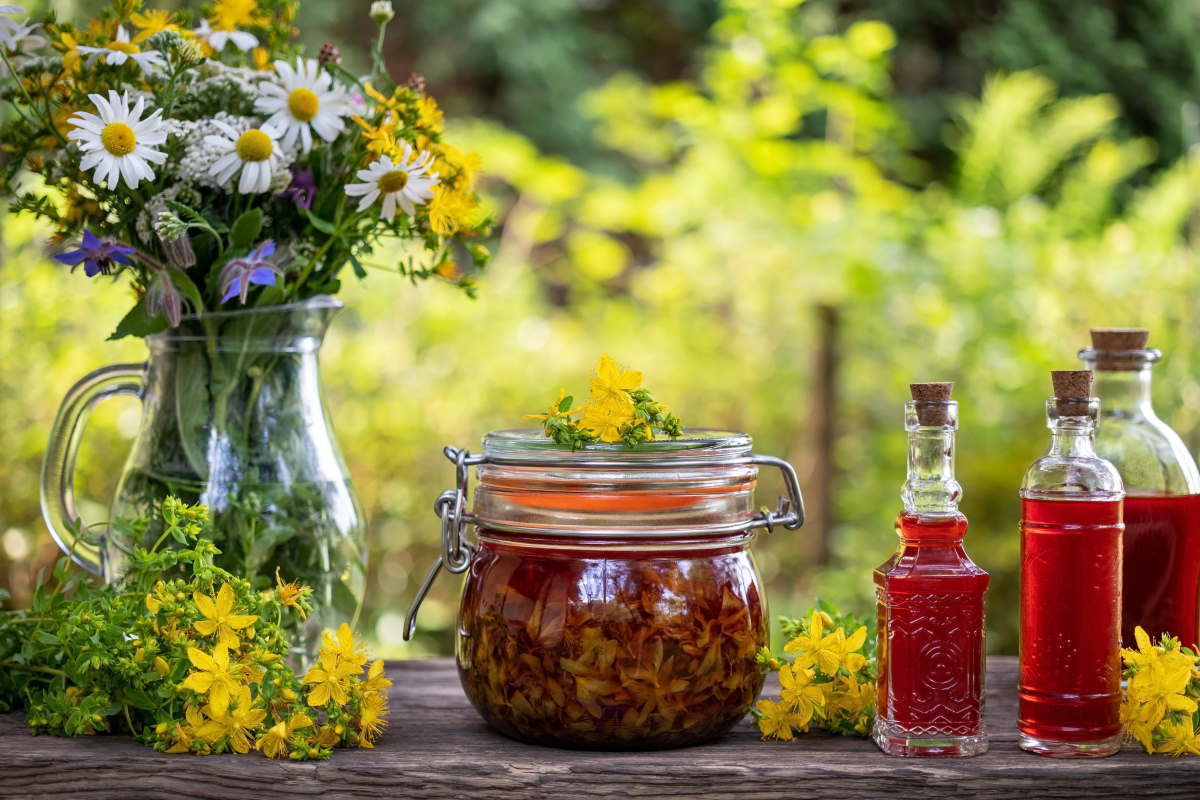
There is a natural remedy that the Templars already used in the 12th century, which popular tradition collected on the most magical night of the year and which modern scientific research continues to study with growing interest. Is called St. John’s wortand it is much more than just a field herb.
Also known as St. John’s wort, St. John’s wort is a perennial plant widespread in Europe, the northern part of Africa and Western Asia. The stem reaches a maximum size of about 80 centimetres, while the flowers, gathered in panicles, are made up of five petals and characterized by an intense golden yellow colour.
Its scientific name is Hypericum Perforatumsince the leaves, seen against the light, appear pitted. In reality, what appear to be small holes are vesicles containing hypericin, the main active ingredient of St. John’s Wort.
St. John’s Wort flowers are harvested in conjunction with the summer solstice, when the sun is at its zenith on the Equator. The plant reaches the peak of its balsamic period, i.e. the maximum concentration of active ingredients, on 24 June, the day consecrated to the celebration of San Giovanni.
Hence the custom of collecting St. John’s wort on the day and especially on the night of Saint John, the so-called witches’ night, when herbs were collected in the fields and propitiatory rituals were practiced. It is precisely to this ancient tradition that St. John’s Wort owes its popular name.
What is St. John’s wort oil
St. John’s wort oil is an oleolite, that is to say an ointment in which the active ingredients of the plant are extracted through the maceration of its aerial parts in vegetable oil.
Generally, to obtain St. John’s Wort oleolite, the flowers, but also the leaves and buds of the plant are used, macerated in extra virgin olive or sunflower oil.
This ointment, with its characteristic bright red color given to it byhypericinis a very precious natural remedy, a real panacea in the treatment of all skin problems, as well as having important anti-inflammatory and analgesic properties.
In addition to hypericin, which belongs to the naphthodiantron family, St. John’s wort oil contains flavonoids, tannins and phloroglucinols (hyperforin). The benefits of St. John’s wort oil do not derive from a single active ingredient, but from the synergistic action of the phytocomplex as a whole – a concept that modern phytotherapy has widely validated and which research continues to deepen.
St. John’s wort oil: properties
For external use, St. John’s Wort oil is extremely effective. If massaged on the affected area, it has properties:
Recent studies have also explored the role of hyperforin as a modulator of the skin microbiome, opening up interesting scenarios for the treatment of chronic inflammatory skin conditions. Dermatological research looks at St. John’s wort with ever more attentive eyes, especially in the era of bioactive cosmetics.
St. John’s wort oil: benefits
For topical use, it is used in the treatment of all skin conditions and irritations.
It cures burns, sores, wounds, reduces stretch marks and skin blemishes, and is an ally in the treatment of psoriasis and rosacea. It promotes cell regeneration, combats skin aging and has a powerful anti-inflammatory action. It is no coincidence that it is often defined as one of the most effective natural anti-wrinkle products.
It can be used locally with excellent results in case of:
St. John’s wort oil: warnings and recommendations
For external use, St. John’s Wort oil has no particular contraindications, with the exception of possible hypersensitivity to the active ingredients, first and foremost hypericin.
The only important recommendation concerns the prohibition of exposure to sunlight or artificial sources of ultraviolet radiation immediately after using St. John’s wort oil. This product is in fact highly photosensitizing, i.e. it tends to amplify the effects of sun rays on the skin, especially in the case of people with light complexions or freckles. This also applies to some commercial cosmetic formulations that contain it: it is best to always read the label.
St. John’s wort oil: internal use
St. John’s wort oil can also be used internally. In this case, it has properties:
St. John’s wort oil as a natural antidepressant: what science says today
St. John’s Wort oil works by preventing the reuptake, or reabsorption, of the neurotransmitters serotonin, norepinephrine and dopamine, responsible for good mood and mental well-being. Furthermore, it is able to modulate the production of melatonin, a precursor of serotonin.
On this front, scientific research has made significant progress. A systematic review published in Cochrane Database confirmed that St. John’s wort extracts are more effective than placebo in the treatment of mild and moderate forms of depression, with a more favorable side effect profile than some synthetic antidepressants. However, for severe forms of depression, conventional medicine remains the main reference.
Especially in periods of strong psychophysical stress or in conjunction with seasonal changes – let’s think of the increasingly discussed seasonal depression (SAD) – St. John’s Wort oil can be an excellent mood tonic. However, it is always recommended to take it under medical supervision.
St. John’s wort oil: contraindications
St. John’s wort oil is a product with an extremely powerful action, which in some cases can have negative repercussions on our body. It can interact with some types of drugs, enhancing their effects or, on the contrary, nullifying their action. In particular, its use is contraindicated in case of:
In the case of contraceptives, St. John’s wort oil is able to nullify their effects, while patients being treated with antidepressants can experience an excessive increase in serotonin in circulation, to the point of experiencing the so-called serotonin syndrome.
This disorder is characterized by a wide spectrum of symptoms including headache, hallucinations, agitation, confusion, tremors, muscle twitches, chills, tachycardia, sweating, nausea and diarrhea. In short, not to be underestimated: natural does not automatically mean risk-free.
Not just St. John’s wort oil: herbal teas, tablets and mother tincture
The antidepressant function of St. John’s wort has also been recognized by official medicine, so much so that there are several drugs based on St. John’s wort on the market. They range from milder remedies, such as herbal teas, through tablets or capsules to mother tincture.
Compared to oil, the advantage of tablets or mother tincture is that they are titrated preparations, i.e. containing a certain constant and guaranteed quantity of active ingredient. A non-negligible aspect, especially when looking for a specific and measurable therapeutic effect.
How to prepare St. John’s wort oil at home
The preparation of St. John’s wort oleolite is quite simple and within everyone’s reach. And it is also one of those slow, almost meditative rituals that the movement of slow living he rediscovered with enthusiasm.
First of all you need St. John’s wort flowers, but you can also use the buds and leaves, and a vegetable oil that acts as a solvent.
The percentage is 1:5, that is, one part of the drug macerated in the equivalent in grams of 5 parts of oil. For example, for 100 grams of flowers you need 500 grams of vegetable oil.
In the preparation of the oleolite, sunflower oil or extra virgin olive oil is generally used, but other types are also suitable, such as almond or corn oil. Those looking for a final product even richer in emollient properties can opt for jojoba or rose hip oil, perfect for mature or sensitive skin.
The flowers should be washed and dried in the sun. Then they pour into a jar, covering them completely with oil.
Usually the oleolites are left to macerate in the shade. St. John’s wort, on the other hand, is the only one that requires constant exposure to the sun’s rays, for a period of approximately 30 days, corresponding to an entire lunar cycle.
The container must not be closed hermetically, to avoid fermentation processes. It is advisable to place gauze on the top of the jar, covering it with the lid only resting on it and not screwing it on.
After a few days you will notice the characteristic red color, given by the hypericin contained in the flowers. At the end of the preparation, the ointment can be filtered.
It is recommended to filter it 2 times: the first with a strainer, to eliminate larger impurities; the second using gauze or a nylon stocking.
At this point, our St. John’s wort oleolite is ready. It should be stored in dark glass jars, in a dry place and away from heat sources. The duration is generally 12 months, but depends greatly on the quality of the carrier oil used.
St. John’s wort oil: where to find it
Anyone who doesn’t have the time, desire or way to prepare St. John’s Wort oil at home can easily find it on the market. This wonderful product can be purchased in herbalist shops, pharmacies, shops specializing in organic and natural products and even in the supermarkets of large distribution chains. Finally, you can buy online. (affiliate link)
When purchasing, it is worth checking that the product contains the hypericin or hyperforin title on the label: it is the best way to make sure you are taking home something truly effective.
St. John’s wort: curiosities that (maybe) you didn’t know
According to legend, the St. John’s wort plant was born from the blood of Prometheus, the Greek hero symbol of rebellion against authority and freedom against power, punished for stealing fire from the Gods to give it to men. His punishment consisted of being tied to a cliff, where every day a gigantic eagle visited him to eat his liver. Every night, the liver grew back.
The history of St. John’s wort is also linked to that of the Templars. These knights were among the first to discover, in the 12th century, the antidepressant properties of this plant: they realized that, in addition to healing wounds and treating burns, St. John’s wort was able to lift the mood of wounded soldiers immobilized in bed for long periods.
In common language, St. John’s wort is also called devil swatter, as it was believed to have the power to ward off evil spirits. It was often placed above sacred images, and the plant takes its name from this ancient custom: from the Greek hyper (above) and eikon (image).
And finally, the most domestic nickname of all: St. John’s wort oil is also called “housewife’s oil”, because it has always been the most common remedy for treating dry and chapped skin on the hands. Simple, effective, within everyone’s reach. Exactly how we like it.
