
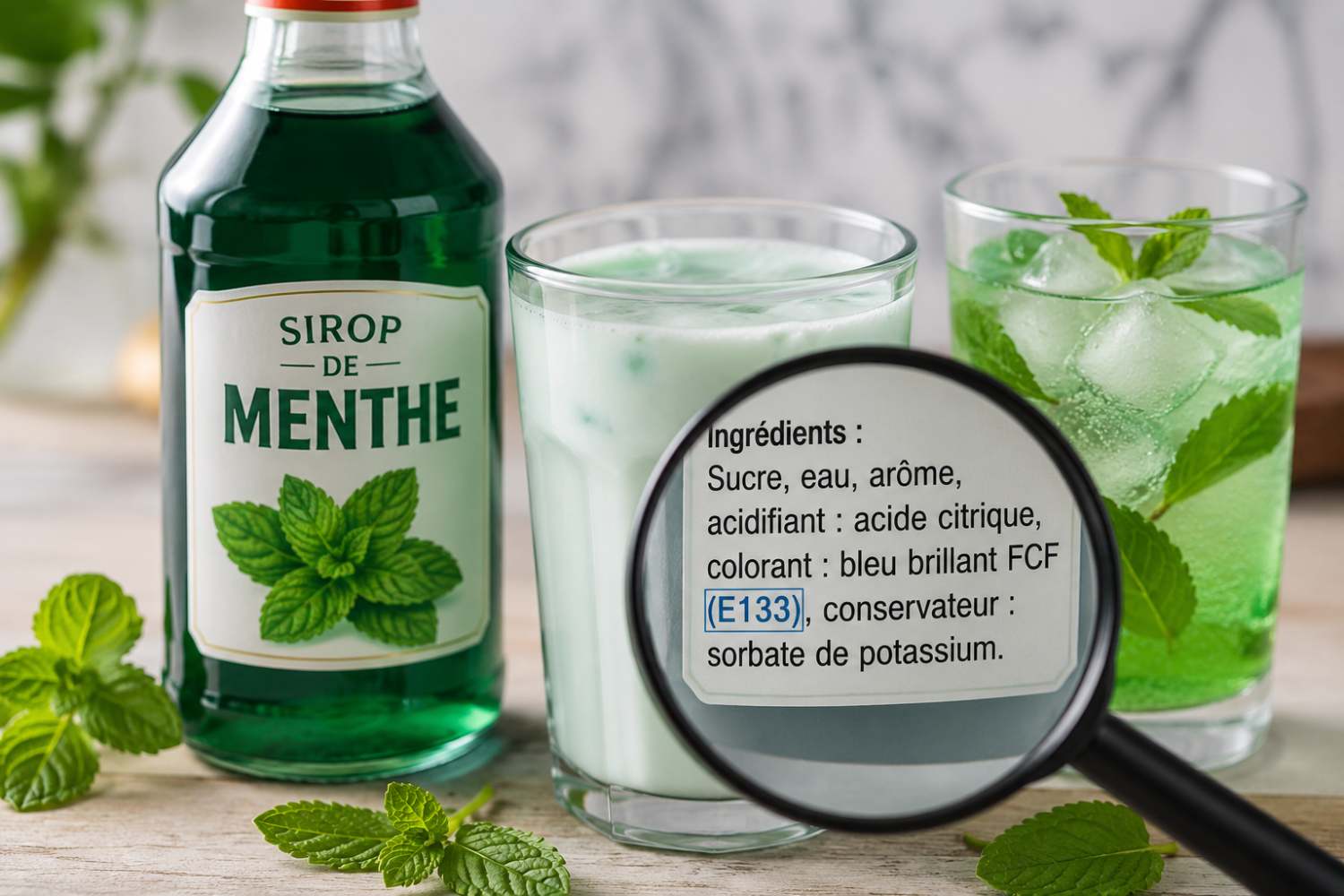
With the heat it’s having these days it’s hard to resist a nice glass of cold water and mint syrup. There are those who prefer it diluted with sparkling water, those who instead mix it with milk to obtain the classic “milk and mint”. A summer ritual, almost an icon of the Italian summer. But that emerald green shade, so lively and inviting, hides something worth knowing.
Bringing the issue to the attention of the general public is Yuka, the famous French app for analyzing food ingredients, which conducted an in-depth investigation into mint syrups sold in France. The results? Far from reassuring, and there is every reason to believe that the situation is not much different on Italian shelves.
Mint green
Let’s start with a fact that will surprise at least some of you: industrial mint syrup is not naturally green. The mint we know – aromatic, fresh, with bright leaves – is not infused directly into the product in industrial versions. Manufacturers use synthetic flavors, extracted from the plant’s chemical compounds, which give the characteristic minty flavor but do not carry with them the green pigments of the leaves. The basic result is a transparent or at most slightly yellowish syrup.
To obtain that intense green that everyone mentally associates with mint, many manufacturers add an artificial coloring: brilliant blue FCF, also known by the European code E133. Paradoxically, a blue dye is used to obtain a green effect, combining it with other yellow pigments. The final color has nothing to do with the quality of the product, with the quantity of mint used, nor with the flavour: it is pure visual marketing, an artificial signal built to evoke freshness and naturalness.
According to Yuka’s database, E133 is present in 65% of mint syrups marketed in France, in products of large brands such as Teisseire, Monin, and in the branded lines of chains such as Leclerc, Auchan, Lidl and Intermarché.
Bright blue FCF (E133), risks to children
Brilliant blue FCF is a synthetic dye belonging to the family of azo and triphenylmethane dyes, derived from petroleum chemistry. In Europe it is regularly authorized as a food additive, but its presence on labels is far from peaceful from a scientific point of view.
It does not perform any useful technological function: it does not preserve the product, it does not improve its flavor, it does not stabilize the ingredients. Its only function is aesthetic, to make the product visually more attractive. Yet, it is not without its shadows, there are in fact risks for children and this is the most delicate point, the one on which Yuka’s investigation focuses in greater detail.
Bright blue FCF is suspected of promoting hyperactivity and attention deficit disorder (ADHD) in children. These are not isolated alarms: already in 2012, a scientific review including a meta-analysis that examined over 20 independent studies concluded that artificial food colors could significantly contribute to some cases of ADHD, although they are not the main cause.
But there’s more. The European Food Safety Authority (EFSA) has found that children – the main consumers of syrups and sweet drinks – are at real risk of exceeding the Acceptable Daily Intake (ADI) established for this colourant. In other words, the quantities consumed habitually may go beyond the threshold that the authorities themselves consider safe.
Added to this are two further concerns that have emerged from the scientific literature: studies have detected a genotoxic potential of brilliant blue FCF, i.e. the ability to damage DNA, and a cytotoxic potential, i.e. the ability to alter the function or survival of cells. These are data that do not authorize definitive conclusions, but which impose the precautionary principle.
Finally, there is an often overlooked aspect: some formulations of this additive may contain aluminum as a component. Excessive exposure to aluminum is associated with adverse effects on the nervous system, reproductive system and development. The metal is also suspected of causing DNA damage and increasing the risk of serious neurological conditions, including multiple sclerosis, epilepsy and Alzheimer’s disease.
It is worth remembering that, according to the data reported in the survey, 59% of French people have a bottle of syrup in the pantry – a percentage that rises to 66% in families with children. It is therefore consumed widely and daily.
Zoé Kerlo, Yuka’s toxicologist, is lapidary:
When a controversial additive has only an aesthetic function, the precautionary principle should push manufacturers to remove it.
Alternatives exist, but they cost more
Perhaps the most disconcerting part of the investigation concerns the availability of alternatives. Of the 12 products analyzed by Yuka, 9 have a version without E133 already on the market. The problem is the price: on average, versions without dye cost 50% more than versions with E133.
In some cases — when the colorant-free alternative is only available in the organic line, as for Carrefour, Leclerc, Auchan and Coopérative U — the price difference even reaches 99%. Practically, to avoid a dye that only serves to make a good impression on the shelf, the consumer has to pay almost double.
There are some virtuous exceptions: Intermarché, for example, offers a conventional alternative without E133 at a price practically identical to the colored version (2% difference). This shows that it is technically and commercially possible — it’s just not a priority for most in the industry yet.
@Yuka
What the producers say
When asked by Yuka, some brands responded. Teisseire admits that he has been working on alternative recipes for years but reports technical difficulties linked to the stability of the color over time with natural substitutes. Carrefour speaks of “significant technical challenges” in finding sufficiently stable natural green dyes. Lidl says it wants to avoid E133 “as far as possible” and has started discussions with suppliers.
Maison Guiot is more direct: the dye is used “only to contribute to the green color expected by some consumers“, but the brand is reportedly evaluating both total removal and replacement with spirulina.
Carrefour, most significantly, calls mint green a culturally ingrained “market code,” and argues that a transition would require a collective movement from all industry players. An answer which, ultimately, contains an uncomfortable truth: it was us consumers, conditioned by decades of marketing, who associated mint with that artificial greenery. And now that same association is being used as justification to continue using a questionable additive.
What to look for on the label
Yuka’s investigation concerns the French market, but the Italian situation also deserves attention. Some of the brands mentioned — such as Monin — are also present on Italian shelves, and European regulations on additives are the same in all EU countries. E133 is authorized everywhere in Europe, and the industrial logic that pushes producers to use it – reducing costs, responding to a “visual code” rooted in consumer expectations – does not stop at the borders.
Checking the labels of mint syrups found in Italian supermarkets is therefore a small gesture that is absolutely worth doing. Look for “bright blue FCF” or “E133” in the ingredient list of your favorite mint syrup. If you find it, know that alternatives already exist — often in the organic range, sometimes even in the conventional range.
A mint syrup without artificial coloring will likely be clear or slightly amber—an unusual look, perhaps, but proof that you’re buying a product that forgoes unnecessary cosmetic gimmicks. The minty flavor isn’t because of that bright green, even though we’ve always thought so.
The best solution? Try making mint syrup at home, you can follow our recipe:
