
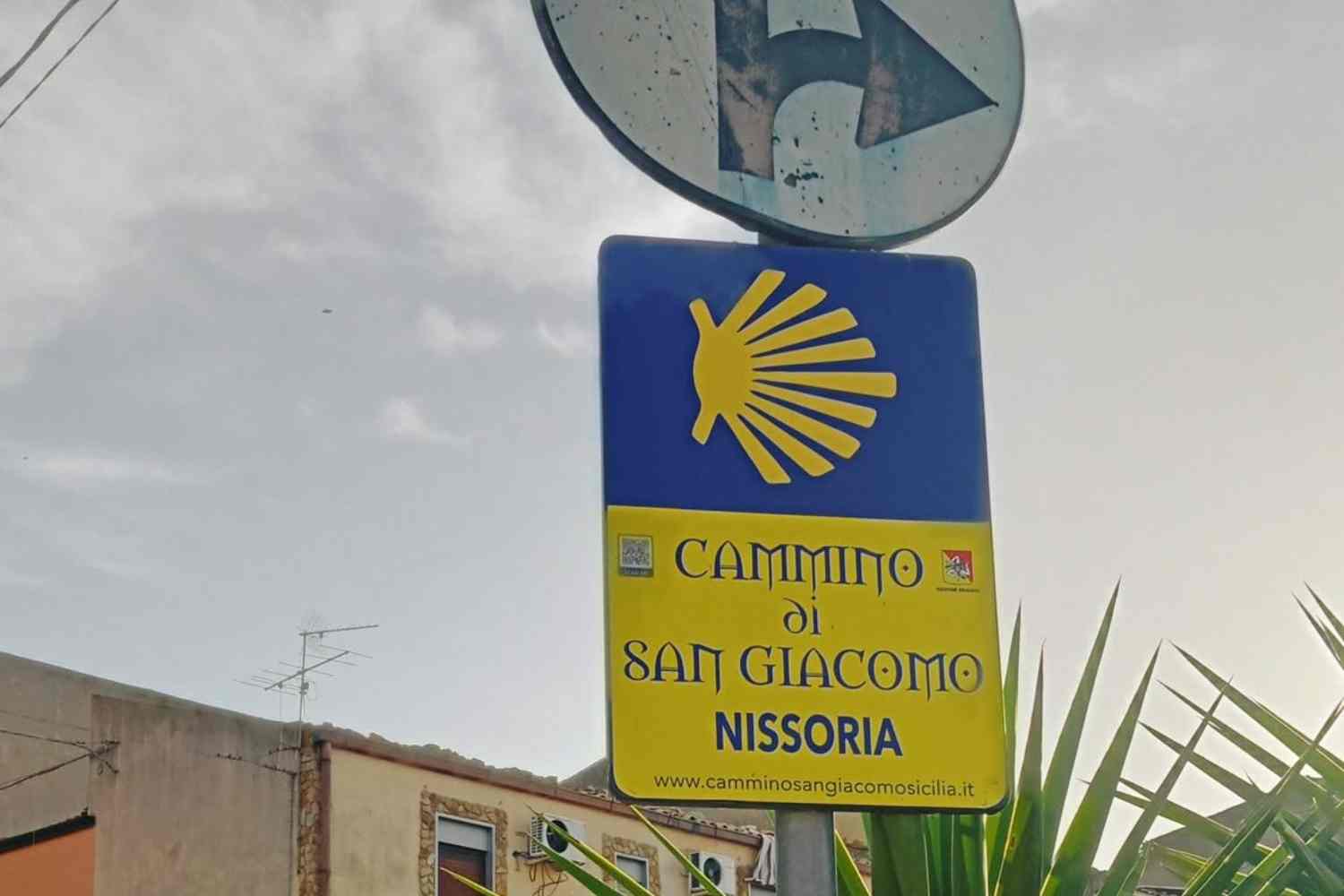
There is a Sicily that escapes the most popular tourist circuits, far from the beaches and the great cities of art. It is a Sicily made of cultivated hills, small historic centers, silent woods and ancient communication routes that have accompanied travellers, merchants and pilgrims for centuries. The Cammino di San Giacomo in Sicilia develops through this territory, an itinerary that connects Caltagirone to Capizzi, approximately 130 kilometers long, crossing the provinces of Catania, Enna and Messina.
In recent years the route has become one of the most interesting proposals for those who want to discover the Sicilian hinterland at a slow pace. It is not just a hiking experience, but a journey that intertwines history, spirituality, local culture and landscapes. A journey that allows you to closely observe a part of the island that is often little talked about, but rich in historical evidence and traditions that are still alive.
View this post on Instagram
A project born from the recovery of memory
The Camino di San Giacomo in Sicily was officially inaugurated in 2018 thanks to the work of the Friends of the Cammino di San Giacomo in Sicily Association. The objective was to recover and enhance the ancient devotion towards Saint James the Greater, a particularly important figure in various areas of the island.
The route connects two symbolic places of the Sicilian Jacobean cult. On one side, the church dedicated to the saint in Caltagirone, the starting point of the pilgrimage. On the other, the sanctuary of Capizzi, considered one of the oldest places of worship dedicated to San Giacomo in Sicily.
The idea was not to create a completely new itinerary, but rather to recover historical paths, ancient rural roads and routes already used in past centuries. In this way the journey fits into the broader European tradition of pilgrimages linked to Santiago de Compostela, while offering a dimension deeply rooted in the Sicilian territory.
View this post on Instagram
From Caltagirone to Capizzi crossing the hinterland
The route is divided into six stages and presents a level of difficulty accessible to those with average physical preparation. Although it is not a technical itinerary, it still requires a certain amount of walking experience to tackle the climbs, descents and long dirt roads.
The first day leads from Caltagirone to Mirabella Imbaccari (19.5 km). After leaving the historic center of the city famous for ceramics, the path enters an agricultural landscape characterized by cultivated fields, olive groves and gentle reliefs. Along the route it is possible to reach San Michele di Ganzaria, another center linked to the religious tradition of the area.
The second stage connects Mirabella Imbaccari to Piazza Armerina (21 km). A significant part of the route follows the path of an old disused railway line, now transformed into a quiet rural crossing road. Arrival in Piazza Armerina also offers the opportunity to visit one of the most important archaeological sites in Sicily, the Villa Romana del Casale, famous for its mosaics.
The third day represents one of the most evocative moments of the entire itinerary. From Piazza Armerina you enter the Rossomanno Grottascura Bellia nature reserve (20.5 km), a vast wooded area where pines and eucalyptus predominate. Here the landscape changes radically and the walker finds himself immersed in an environment characterized by silence and nature.
Among the most curious elements of this section of the route are the so-called Pupi Dancers, particular rock formations shaped by atmospheric agents that have fueled popular tales and legends.
Through the landscapes of Ennese
The central stages pass through the heart of the province of Enna, an area that is often little known but full of charm. From Valguarnera to Assoro (25 km) the landscape is dominated by vast agricultural expanses, cereal crops and hills that follow one another up to the horizon.
Assoro represents one of the most characteristic villages of the route. Perched on a hill, it still retains an urban layout of medieval origin and offers wide views of the surrounding countryside.
The fifth stage, from Assoro to Nicosia (18.5 km), is considered the most challenging in terms of distance. Along the way you come across numerous testimonies of the rural past of internal Sicily, including ancient railway bridges, palmenti dug into the rock and old water collection systems.
The arrival in Nicosia also marks the entry into a territory that progressively approaches the Nebrodi mountains. On particularly clear days it is possible to observe the profile of Etna in the distance.
The last climb towards Capizzi
The sixth and final stage takes pilgrims from Nicosia to Capizzi. It is an intense day, characterized by significant differences in altitude and continuously changing landscapes.
The route progressively climbs towards the Nebrodi Mountains, crossing increasingly mountainous environments. The views open onto valleys, woods and ridges which give a different perception of Sicily compared to the more widespread image of coasts and seaside areas.
Capizzi represents the final point of the journey. The village retains a strong religious and cultural identity linked to the figure of San Giacomo. Here is the Mother Church dedicated to the saint, a place that symbolically concludes the pilgrimage.
When to leave
The path can be undertaken during most of the year, but the most favorable seasons remain spring and autumn. In these periods the temperatures are generally mild and allow you to tackle the stages in more comfortable conditions.
Summer requires extra attention. Many sections pass through areas exposed to the sun and temperatures can become particularly high, especially in the internal areas of Sicily. For this reason it is advisable to start walking early in the morning and plan your stops carefully.
During the winter, however, some segments of the route may be more complex due to rain or the increase in the flow of watercourses. It is advisable to always check the conditions of the paths before departure.
The water points along the route
One of the most important practical aspects concerns the availability of water. Although there are public drinking fountains and refueling points in various population centers, their distribution is not uniform.
Some stages cross natural or agricultural areas where the water points may be far from each other. For this reason it is advisable to leave every day with an adequate supply, especially in the warmer months.
Correct hydration management represents a fundamental element for tackling the route safely. Many walkers choose to carry insulated water bottles or portable filtration systems, which are particularly useful on summer days.
The guide
Offer
The journey of Saint James in Sicily
The legends that accompany the journey
Like many historical itineraries, the Cammino di San Giacomo in Sicily is also accompanied by popular stories and traditions that contribute to defining its identity.
One of the best-known stories concerns the Grand Count Roger. According to tradition, the saint appeared to the Norman leader in a dream before the reconquest of Caltagirone, showing him the path to victory. This episode is often considered one of the symbolic moments at the origin of the spread of the Jacobean cult on the island.
Another legend is linked to the Pupi Dancers of the Rossomanno reserve. The unusually shaped rocks have been interpreted over the centuries as petrified human figures. According to the popular story, these were people transformed into stone for having violated the sacredness of a place during a party.
Finally, in Capizzi, a tradition survives which attracts numerous faithful every year. During the feast dedicated to San Giacomo, celebrated on 26 July, the simulacrum of the saint is carried in procession following a ritual that preserves historical and symbolic meanings handed down over time.
An itinerary to get to know another Sicily
In recent years, slow tourism has seen significant growth in many Italian regions. In this context, the Cammino di San Giacomo in Sicily represents a proposal capable of enhancing territories far from large tourist flows.
The itinerary offers the opportunity to pass through small towns, get to know local communities and observe landscapes that tell an important part of the island’s history. Alongside the spiritual dimension, the cultural and environmental interest of the route remains strong.
Walking from Caltagirone to Capizzi means coming into contact with an internal Sicily that preserves different rhythms compared to the coastal areas. A reality made of traditions, hospitality and memory, where the journey proceeds slowly and each stage becomes an opportunity for discovery.
All the info can be found here
