
In AI data centers the problem always comes from heat. Every request, every model trained, every response generated passes through very powerful chips that work tight, switched on, hungry for energy. And when hardware runs like that, someone has to take the heat away. For years, large cooling systems have done this, pushing air between cold corridors and hot corridors, evaporative towers, water that absorbs heat and then goes away in steam. Works. Except that “it works” presents a bill that is increasingly difficult to ignore.
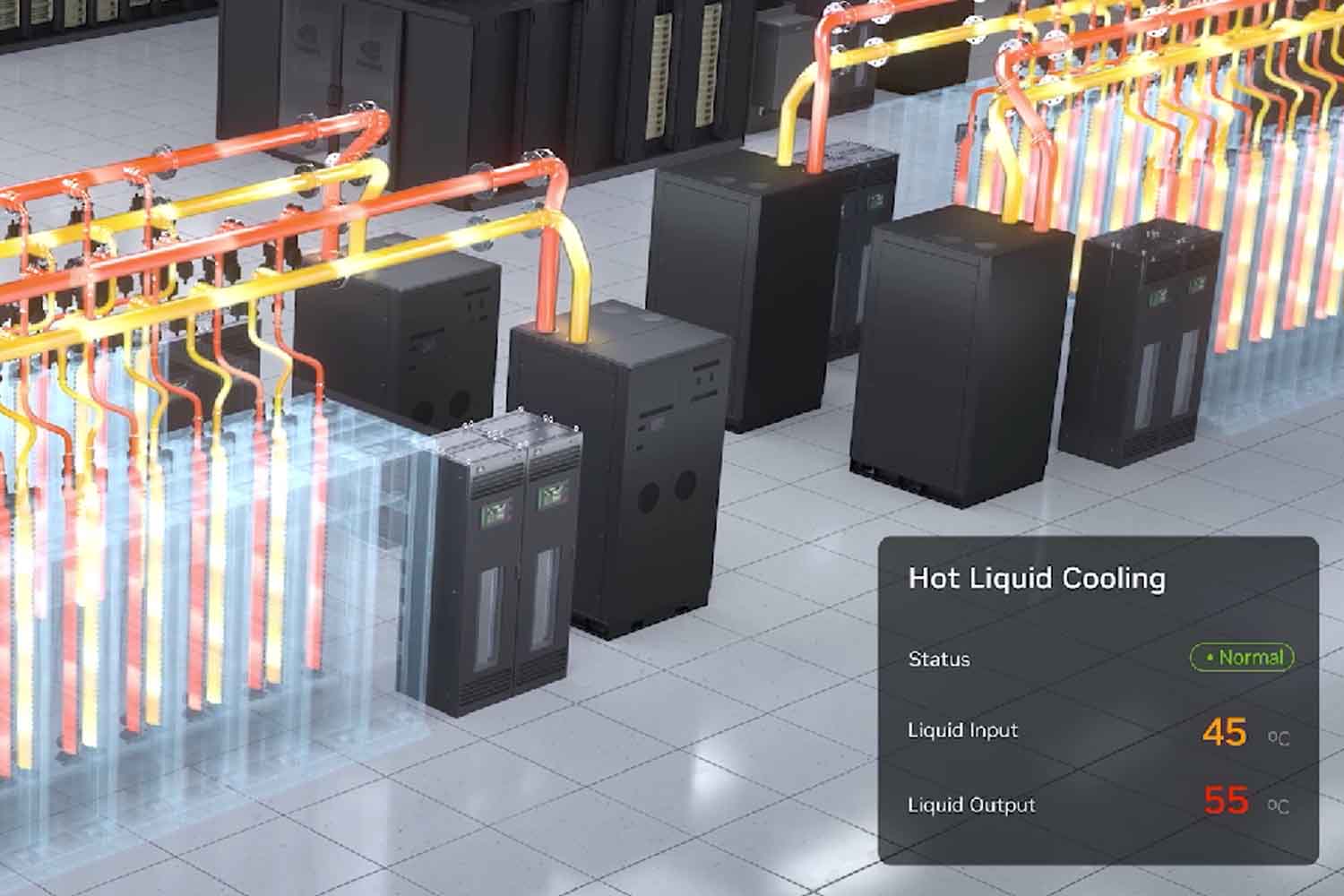
The new step of Nvidia it goes in the opposite direction to the imaginary of the data center as cold as a cold room. With Rubin architecture, the company talks about 100% liquid-cooled AI infrastructures: chips, network components, system as a whole. The liquid enters directly where the heat originates, through plates placed on the processors, and takes it away without relying on the large carousel of cold air. The almost counterintuitive part lies in the temperature: the liquid can reach up to 45°Cwarmer than the water in many hot tubs, and still keep processors within validated operating limits.
The heat taken at the source
In the system described by Nvidia there is a mixture composed for the 75% water and 25% propylene glycola solution that passes through the cold plates, absorbs heat from the chips and transfers it outward. The circuit is filled once and remains closed for the entire life of the system; in favorable climates the heat can be dispersed with dry coolers, large external radiators, reducing or eliminating the use of mechanical chillers and evaporative towers.
Here the change of perspective weighs heavily. Evaporative towers consume water precisely because they evaporate it to carry away heat. Direct liquid cooling, on the other hand, tries to move the work inside a technical ring that continues to rotate. Nvidia estimates that, under suitable conditions, this architecture can bring cooling water consumption to around 2.6 million gallons per megawatt per yearAlmost 9.8 million litresto values close to zero. It is a company figure, therefore it should be read with the caution that is reserved for every industrial promise, but the technological leap remains notable.
The reason is simple, almost banal: cooling air requires enormous volumes, fans, spaces, corridors designed like a thermal choreography. Cooling the chip directly means removing a step, arriving at the exact point where the problem forms. Water, or rather the cooling fluid, becomes a much more efficient means of transporting heat than air. In a dense AI infrastructure, where each rack concentrates an amount of power that until a few years ago would have seemed excessive, this difference ceases to be a detail for engineers and becomes an environmental, economic, even urban planning issue.
The water that data centers drink
The water issue around data centers is already huge. Some large systems can consume up to 5 million gallons per dayabout 19 million litresan amount comparable to the water use of a small town. An average data center can reach approx 110 million gallons per yearbeyond 416 million litresfor cooling only. And as AI facilities expand, the pressure grows along with electricity, emissions and demand for new chips.
Energy photography adds another layer. THE’International Energy Agency predicts that global data center electricity consumption could more than double by 2030, to around 945 TWh. Artificial intelligence is cited as one of the main drivers of this growth, along with other digital services. Even when the cooling water drops, therefore, the entire energy front that powers servers, networks, calculation and infrastructures remains open.
For this reason, Nvidia’s AI cooling must be told for what it can be: a very concrete solution to part of the problem. The part of the water used on site, in the cooling systems, in the evaporative towers. Other heavyweights remain outside the perimeter: the water used to produce semiconductors, that linked to electricity generation, the impact of new buildings, the networks to be strengthened, the territories that suddenly find themselves hosting digital factories as large as industrial districts. The EESI report also reminds us that the water footprint of a data center includes direct consumption, water used by power plants and water used in the production of chips.
More efficiency, more hunger for AI
Then there is the less convenient part, the one that always comes when a technology becomes more efficient. If every single operation uses less water and less energy to cool, the industry can claim real progress. At the same time, lower costs and more manageable infrastructure can make it easier to build new data centers, train larger models, bring AI everywhere, even where it is barely needed.
Closed liquid cooling can avoid enormous waste, especially in areas where water is already contested between homes, agriculture, industry and increasingly frequent droughts. It can also reduce noise, fans, energy-intensive systems and reliance on chillers. In a sector that runs at a speed that is often greater than the ability of the territories to understand and govern it, this is good news. Good news with the condition tag still attached.
Because a better cooled AI still remains an AI to be powered, built, maintained, updated. The 45°C liquid can quench the thirst of data centers. Hunger, however, remains to be measured.
