
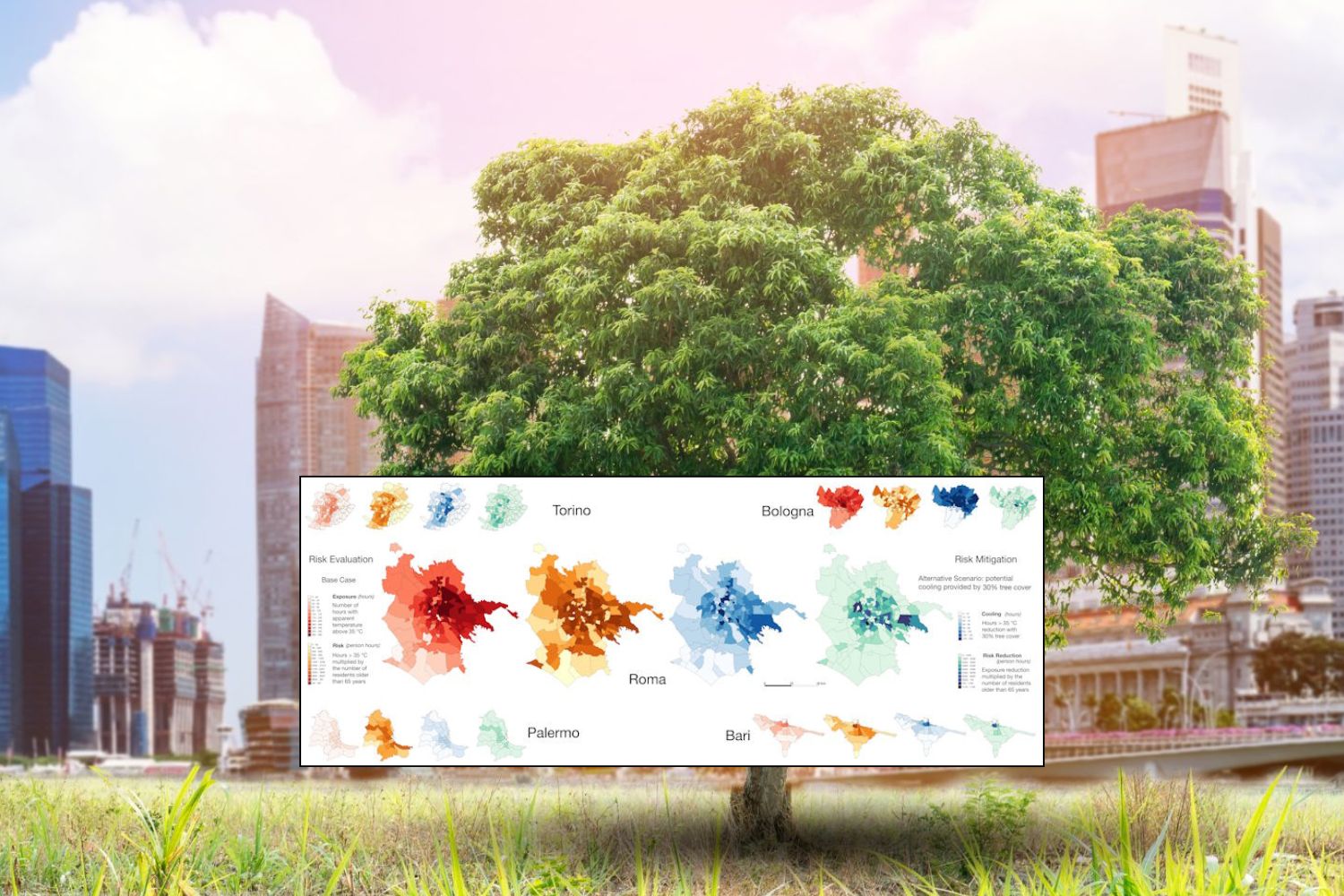
Having at least 30% tree cover in every urban neighborhood could significantly reduce the impact of heat waves in Italian cities.
This is what emerges from a study conducted by Cnr-Iret together with the College of Environmental Science and Forestry of the State University of New York, published in npj Urban Sustainability.
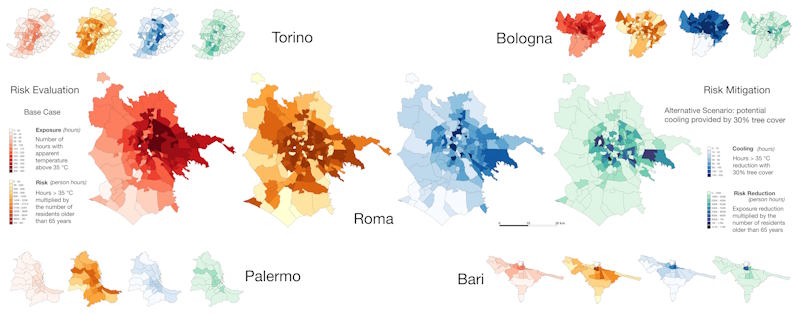
Under the magnifying glass, ten Italian cities – Bari, Bologna, Bolzano, Cagliari, Florence, Genoa, Palermo, Rome, Turin and Verona – and one assumption: what would have happened during the historic heat wave of summer 2003 if every neighborhood had had at least 30% trees?
The answer is clear: the impact of the heat, measured as excess heat-related mortality among those over 65, would have been reduced on average by around 36%.
What would happen in Italian cities
Trees in the city are not only used to “look beautiful”, but they also and above all cool the environment through shade and evapotranspiration, i.e. the release of water into the atmosphere, which helps to dissipate heat.
To estimate these effects, the researchers used the “i-Tree Cool Air” urban climate model, which combines data on temperature, humidity, land cover and vegetation. The greatest benefits emerge in the most concreted and densely populated neighbourhoods, where the urban heat island strikes most forcefully.
Bologna is the city where increasing tree cover to 30% would have the most marked effect: a reduction in exposure to heat waves by 84%. They follow:
@CNR
More limited, but still relevant, are the estimated values for:
The message is clear: planting trees where asphalt dominates today can become a real public health measure, especially for older people, who are more vulnerable to the effects of extreme heat.
@CNR
However, there is one point that is often ignored: increasing tree cover does not simply mean planting new plants and then forgetting about them. In Mediterranean climates, increasingly exposed to drought and extreme temperatures, trees need water, permeable soils and adequate management.
The researchers themselves point out that, to keep trees healthy without excessively increasing humidity, it will be necessary to integrate green infrastructure and efficient water management systems. In practice: less concrete, more draining surfaces, rainwater recovery and serious planning.
More trees, less pollution and more CO2 absorbed
The advantage isn’t just about the heat. The study also highlights other collateral benefits: reduction of air pollution, less rainwater runoff thanks to more permeable surfaces and greater absorption of CO2.
Overall, the increase in urban trees would be associated with ecosystem services estimated on average at 56 thousand dollars per year per square kilometer. Rome, by size, shows the highest overall value: 62.3 million dollars a year in additional ecosystem services.
Urban tree cover, therefore, can no longer be treated as an aesthetic detail or as an expendable item in municipal budgets. The 30% indicated by the study should become a minimum threshold from which to start to rethink Italian cities in the midst of the climate crisis.
Heat waves are no longer exceptional events, they are already here and especially affect the most fragile neighborhoods and transform the absence of greenery into a health risk factor. The solution would be to plant trees in the right places, take care of them, protect them and consider them for what they are: indispensable allies to make cities more liveable, cooler and fairer.
