
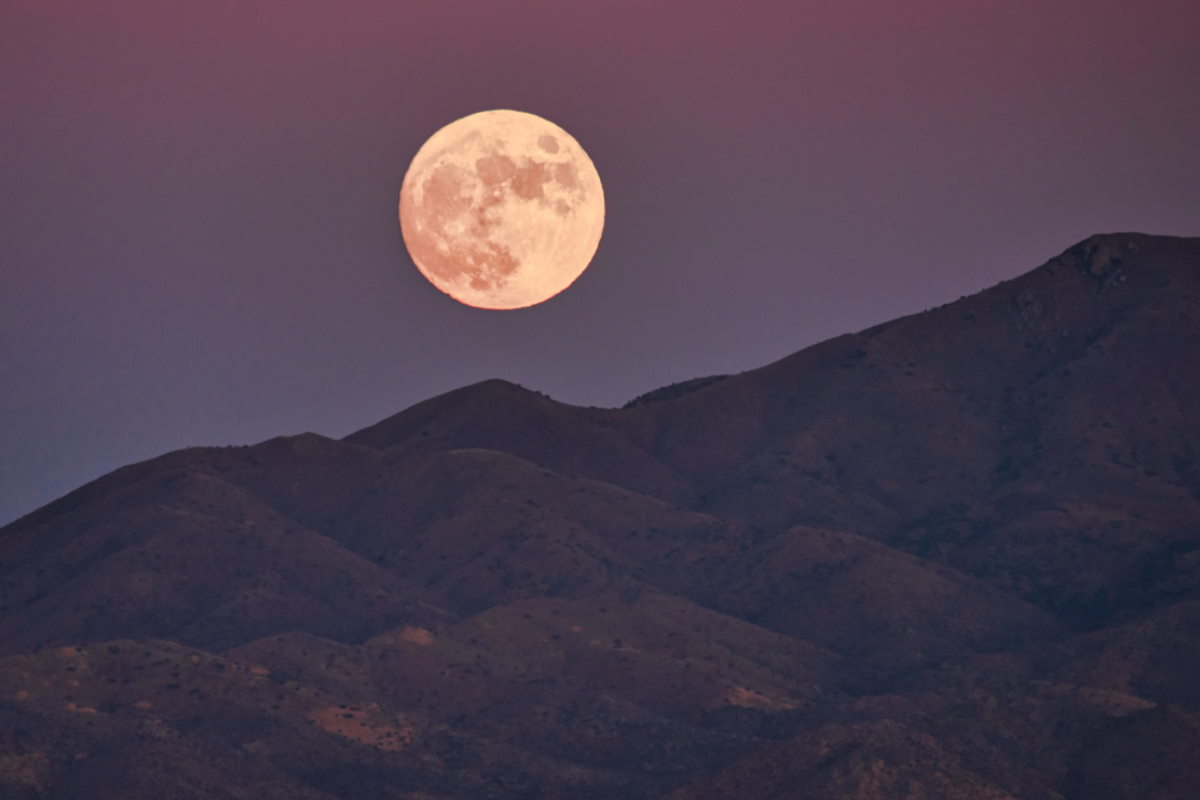
There Full Strawberry Moon is about to light up the summer sky, giving one of the most fascinating astronomical events of the year. In fact, on the night between 29 and 30 June 2026, our satellite will reach the full moon phase, taking on a particular characteristic: it will be a micromoon, appearing slightly smaller than a normal full moon.
A less flashy phenomenon than a Supermoon, but no less suggestive, especially because it will coincide with the first full Moon of the summer that has just begun.
Because the Full Strawberry Moon will be a micromoon
The full Moon on June 30 will occur when the satellite is near apogee, the point in its orbit farthest from Earth. For this reason it is commonly referred to as a “micromoon”.
On this occasion the distance between Earth and Moon will be approximately 405 thousand kilometres, well above the average distance that separates our planet from its natural satellite. As a result, the Moon will appear up to 14% smaller than a Supermoon and slightly dimmer than an average full Moon.
It should be noted that the term “micromoon”, like that of “supermoon”, does not represent an official astronomical definition, but is used to simply describe phenomena linked to the variable distance between the Earth and the Moon.
Why it’s called the Full Strawberry Moon
The name Full Strawberry Moon it has nothing to do with the color of our satellite. This name derives from the traditions of the Native American peoples, who associated the full moon in June with the beginning of the wild strawberry harvesting season in North America.
Over the centuries, the same full moon has taken on different names in various parts of the world. In Europe it was often known as the “Honeymoon”, “Hot Moon” or “Hay Moon”, names linked to agricultural cycles and popular traditions.
The expression “Honeymoon”, still used today to indicate the journey of the newlyweds, derives from an ancient custom according to which newly married couples were given a supply of mead sufficient for an entire lunar month, a drink considered a good omen for fertility and family prosperity.
When to observe the Full Strawberry Moon
The full moon phase will technically occur at 1:56 am on June 30, 2026, but the show will be visible throughout the night between June 29 and 30.
To observe the Full Strawberry Moon just look towards the south-southeast horizon, where the Moon will rise near the constellation of Sagittarius. As always, weather conditions will be crucial for good observation.
Those who want to enjoy the phenomenon as best as possible should choose places away from the artificial lights of the cities, favoring rural areas, beaches or mountain areas with low light pollution.
A Full Moon particularly low in the sky
This full moon has another interesting feature. Being the first following the summer solstice, the Moon will follow a very low path above the horizon throughout the night.
The phenomenon is linked to the position of the Sun, which at this time of year reaches the highest point of its apparent path in the sky. The full Moon, always being on the opposite side to the Sun, instead follows a lower trajectory, creating a particularly suggestive visual effect.
This position can also accentuate the satellite’s warm, golden hues during moonrise and moonset.
How to photograph the Full Strawberry Moon
To immortalize the Full Strawberry Moon it is not necessary to have professional equipment. Many modern smartphones also allow you to obtain good results, especially using the night mode.
The best time to take photographs is immediately after moonrise, when it is still close to the horizon and can take on orange or reddish hues. To make the image more impactful, it is advisable to include landscape elements such as trees, historic buildings, mountains or monuments, creating an interesting perspective effect.
An event not to be missed
The night between 29 and 30 June will therefore offer a double spectacle: the first full moon of the summer and a rare micromoon. Although its small size may make it less flashy than the famous Supermoons, the Full Strawberry Moon remains one of the most anticipated astronomical events of the year, capable of combining sky observation, popular traditions and landscape photography in a single experience under the stars.
