
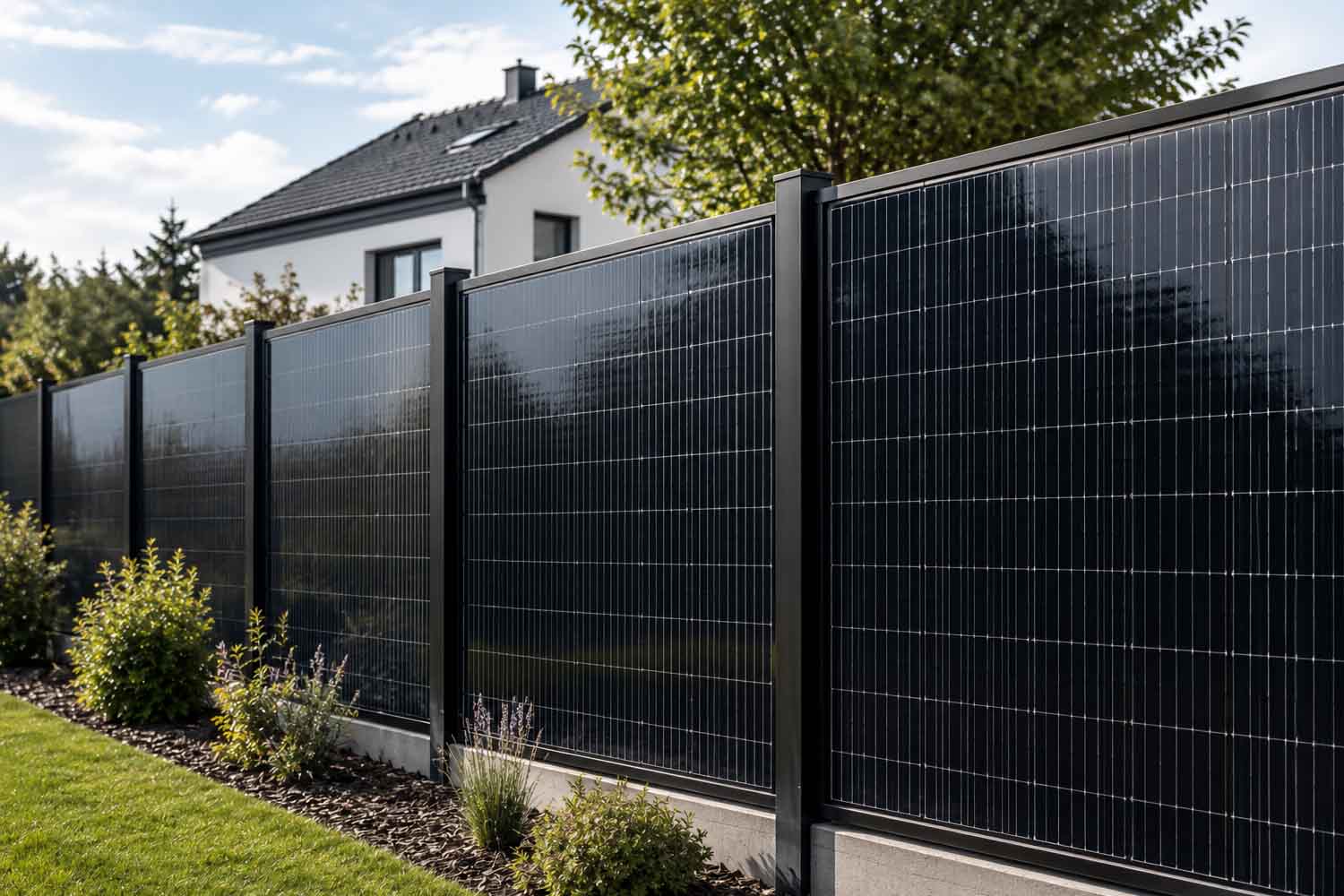
A piece of garden, a gate, the blind side of a property. For years they were only borders: they separated the house from the street, the lawn from the neighbor, the courtyard from the rest of the world. Now in several European countries they are also starting to do another job: producing electricity.
Solar fences, or photovoltaic fences, are born from this very practical idea: using existing surfaces, often long and unused, to install vertical panels and transform a domestic edge into a small source of energy.
The push comes at a time when European solar has long ceased to be a conference promise. According to SolarPower Europe, the Union’s photovoltaic production has already avoided billions of euros in gas imports since the start of the war in the Middle East. At the same time, however, more than 100 billion euros of wind, solar and battery projects remain stuck in grid connection queues in several European countries. The paradox is quite clear: the panels cost less, interest grows, the network struggles to keep up.
How solar fences work
The solar fence works more simply than it seems. Instead of mounting the panels only on the roof, they are integrated into a vertical barrier, often with double-sided modules, capable of capturing light from both sides.
The advantage lies entirely in the use of space: no new land occupied, no roof to be redone, no scaffolding to climb to heights. A British manufacturer offers fence panels of 415 W each, 1.83 meters wide, which can then be connected to the inverter and electrical system by a qualified installer. In short, no flying extension next to the barbecue.
The yield depends on orientation, shadows, available length, quality of modules and hours of sunshine. The vertical position loses something compared to a well-sloped roof, especially in the central hours of the day. On the other hand, bifacial systems can work better in the morning and evening, when the sun reaches lower.
Next2Sun, a German company specialized in vertical photovoltaics, describes a system that can also be oriented along the east-west axis, precisely to distribute production in the lateral bands of the day.
A ten meter long fence, in the best conditions, can approximately reach a power in the order of 1-1.5 kW. With a good five hours of sunshine, that means around 5-7.5 kWh on a good day. It is energy that can reduce daily consumption: efficient refrigerator, lights, television, small appliances, recharges, part of the daytime loads.
When the roof isn’t enough
The roof continues to be the most natural position for domestic photovoltaics, when exposure, structure and constraints allow it. Solar fences come into play where the roof is small, shaded, poorly oriented, already occupied or difficult to use.
They also apply to houses with gardens, farms, warehouses, schools, utilities, airports, logistics areas and commercial parks, where the perimeters already exist and often remain energetically silent. The cost varies greatly based on length, foundations, modules, aesthetics and electrical connection. Next2Sun indicates for some configurations a starting point of around 250 euros per metre, with costs that increase when looking for more refined or integrated solutions in the landscape.
The company itself speaks of amortization within eight years in some conditions, a horizon close to that of many traditional installations. These are numbers to always read with a pencil in hand: location, electricity price, self-consumption and bureaucracy decide a large part of the result.
Balconies, gardens and small systems
The topic becomes even more interesting if you connect it to the boom in small domestic systems. In the UK the government has announced plug-in panels will arrive in shops within months, with chains such as Lidl and Iceland involved in working to bring them to market alongside manufacturers such as EcoFlow. London also cites the German case, where plug-in devices are already widespread, with around half a million new units a year.
In Italy, “plug and play” photovoltaics already exists within a specific framework. ARERA has simplified the connections for small systems under 800 W, providing Single Communication to the distributor. Within this category, however, the real plug & play is the one up to 350 W, designed for direct connection via a dedicated socket. For systems between 350 and 800 W, additional technical documents are required, such as a declaration of conformity, electrical diagram and operating regulations.
E-Distribuzione explains that these systems can also be placed on balconies, windows or in the garden, respecting technical requirements and connection methods. A more structured photovoltaic fence, however, changes scale and requires different assessments: electrical safety, stability, landscape constraints, municipal regulations, condominium, any authorizations, connection to the grid. The sun is free, the system is not.
Where it makes sense
Solar fences have a fairly rare advantage: they transform a banal function into a double function. They close a perimeter and produce energy. In the countryside they can coexist with pastures and crops, offering partial shade and separation of spaces. In companies they can follow already fenced borders.
In warehouses and logistics centers they can help cover a portion of daytime consumption, when offices, lights, security systems and charging are working at full capacity. In schools or public buildings they can also become an educational object, because energy stops being an abstract item on the bill and becomes something that can be seen from the courtyard.
The limits remain concrete. A fence receives shadows from trees, hedges, walls, parked cars, nearby buildings. It is closer to people, so it must withstand impacts, wind, rain, maintenance, wear and possible vandalism. In busy areas, glare, safety, cabling and accessibility for technicians also count.
The more public or commercial the installation, the more design with clear standards and transparent controls is needed. The growth of these solutions tells us something rather simple: photovoltaics is moving beyond just the imagination of the roof. It slips into balconies, facades, car parks, shelters, fences and agricultural edges. Every surface is looked at with a new suspicion: can it do something besides stay there?
You might also be interested in:
