
In Herculaneum, death may have arrived before the large mass of volcanic material that sealed houses, streets, objects, beds and bodies. Before the actual burial, before the layers that archaeologists today read as a mineral chronicle, there would have been a much more rapid passage: a diluted cloud of ash and gas, hot enough to kill in a few moments and short enough to leave behind only a few centimeters of deposit.
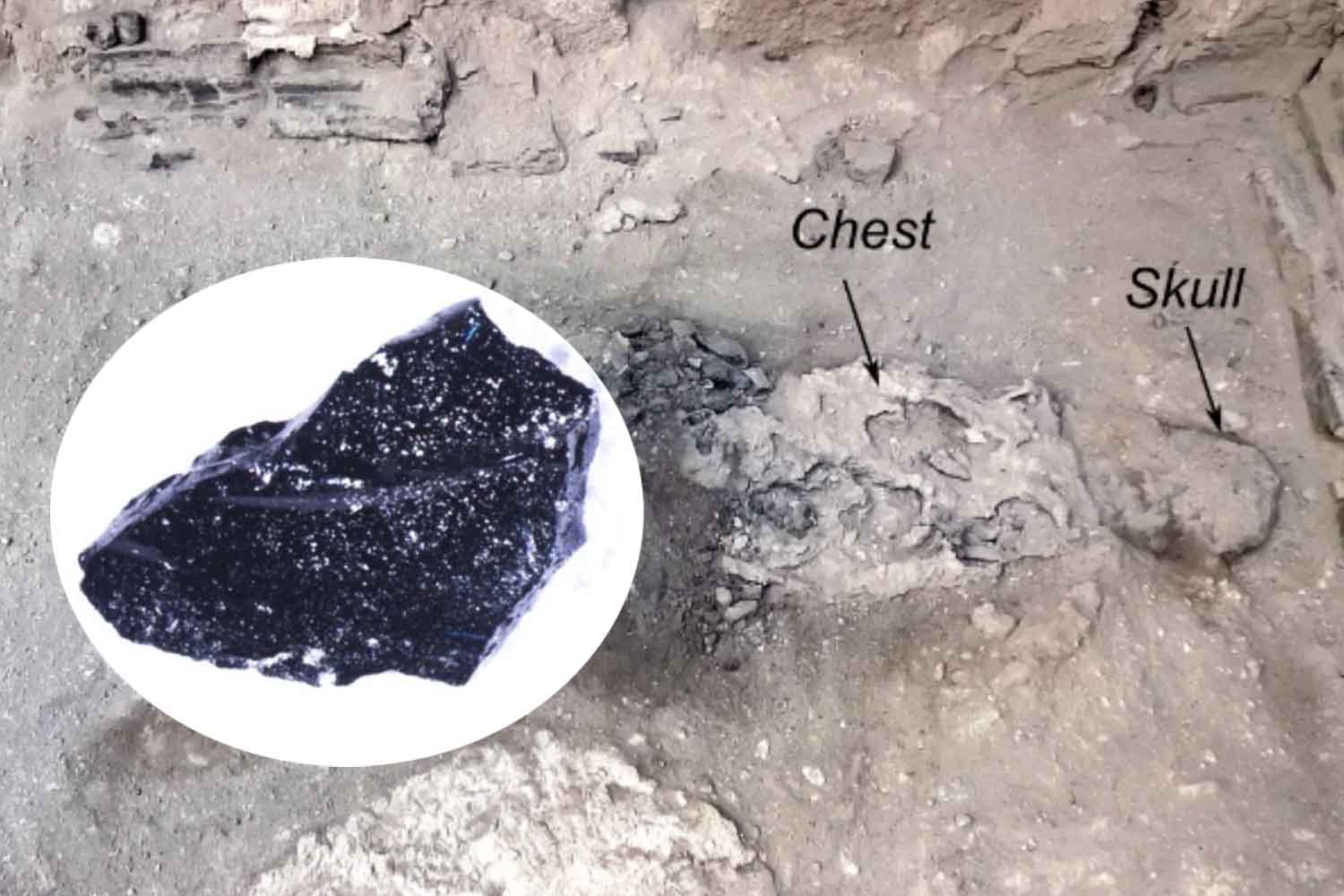
We had already talked about the brain transformed into glass by the boiling cloud of Vesuvius: the case concerns a young man who died during the eruption of 79 AD, found in Collegium Augustaliumthe public building linked to the cult of the emperor Augustus, along the Decumanus Maximus of the ancient city. His body, unearthed in the 1960s, was lying on a bed of charred wood. The most recent analyzes add an important piece: those black and shiny fragments found in the skull and spinal cord would be remains of vitrified braintransformed into a kind of organic glass by a very rare combination of extreme heat and very rapid cooling.
The cloud before the burial
The new part concerns the sequence of events. The pyroclastic flows that then buried Herculaneum had already very high temperatures, between approximately 315 and 465 °C, but they would have cooled the body too slowly to explain the formation of glass. To obtain vitrification a different step is needed: very violent heating, material made unstable, abrupt cooling.
In the study published on Scientific Reportsresearchers indicate a temperature higher than 510°C and a very rapid thermal decrease immediately after the passage of the cloud. The glass, in this case, would have formed because the brain tissue would have reached a very high temperature and then would have cooled so quickly as to prevent an orderly, crystalline structure.
The reconstruction is connected to a previous work, again on Herculaneum, which had identified a first very diluted pyroclastic current, a sort of cloud of hot ashwith temperatures estimated between 555 and 495 °C. After that first event, other flows would arrive, denser and heavier, with lower temperatures, capable of progressively burying the city and preserving it to this day.
In simple words: lava has very little to do with it here. In Herculaneum the dirty work was done by ash, gas, heat and pyroclastic currents. The hottest cloud would have crossed the city, hit the inhabitants and then dispersed quickly enough to allow a sudden cooling. In that very short interval, according to the authors of the study, some parts of the young man’s brain would have turned into glass.
Why exactly that body
The most difficult detail to explain remains precisely this: among the victims of the Vesuvian area, this is indicated as the only known case of vitrified human tissue. The rarity would depend on an almost impossible combination of conditions: the body was in a closed environment, the skull and spinal column would have partially protected the nervous system from complete destruction, the cloud would have heated the tissue above 510 °C and then vanished leaving the body almost exposed to the air, before the arrival of the subsequent deposits.
The analyzed fragments are tiny, dark, shiny, with an obsidian-like appearance. The investigations used electron microscopy, microtomography, Raman spectroscopy and calorimetry to understand the structure, composition and thermal history of the material. According to the authors, the presence of proteins typical of the human brain, fatty acids compatible with brain tissue and hair, as well as microstructures interpreted as neurons and axons, would strengthen the identification of the material as brain remnant.
What remains is an almost impossible scene to keep together: a boy of around twenty, probably the building’s custodian, hit by an extreme thermal event while still in his bed. The cloud would have destroyed the exposed soft tissues, while some parts of the brain, protected by the bone, would have survived long enough to achieve that very brief and anomalous transformation.
Scientists remain cautious
This case should be told with some caution. The definition of “brain transformed into glass” is powerful, almost cinematic, but within the scientific community the debate exists. Already after the first publications, some scholars had called for caution, recalling that ancient brain tissue can be preserved more often than imagined and asking for more accessible data to better compare proteins, degradation of materials and vitrification hypotheses.
The main criticism concerns precisely the exceptional nature of the mechanism. Organic tissues are rich in water and, in modern conservation processes, vitrification is associated above all with very controlled conditions. Here, however, we are talking about an opposite and very rare path: an organic glass preserved after extremely violent heating, followed by almost immediate cooling. The authors present it as a unique case in the archaeological and geological record, while other researchers ask for independent confirmations on the samples.
The strength of the research, however, also lies in changing the perspective on the eruption. The young man from Herculaneum becomes a kind of extreme thermometer, a body transformed into a physical archive. If the reconstruction is correct, the first threat to the inhabitants was a very high temperature, rapid, thin cloud, much less visible in the deposits than the flows that arrived later. An event capable of killing before the city was even covered.
A lesson that is still relevant today
The authors of the 2023 work also underline an aspect that comes out of archeology and concerns modern volcanic risk: clouds of hot and diluted ash can leave minimal geological traces, therefore being underestimated in reconstructions of the past and in danger scenarios. Their duration can be short, their footprint in the soil thin, their impact on the human body devastating.
For this reason the case of vitrified brain of Herculaneum it tells much more than an ancient and unrepeatable death. It tells how an eruption can act in phases, with different events, different temperatures, different times. First the thermal shock. Then the burial. Then the centuries.
