
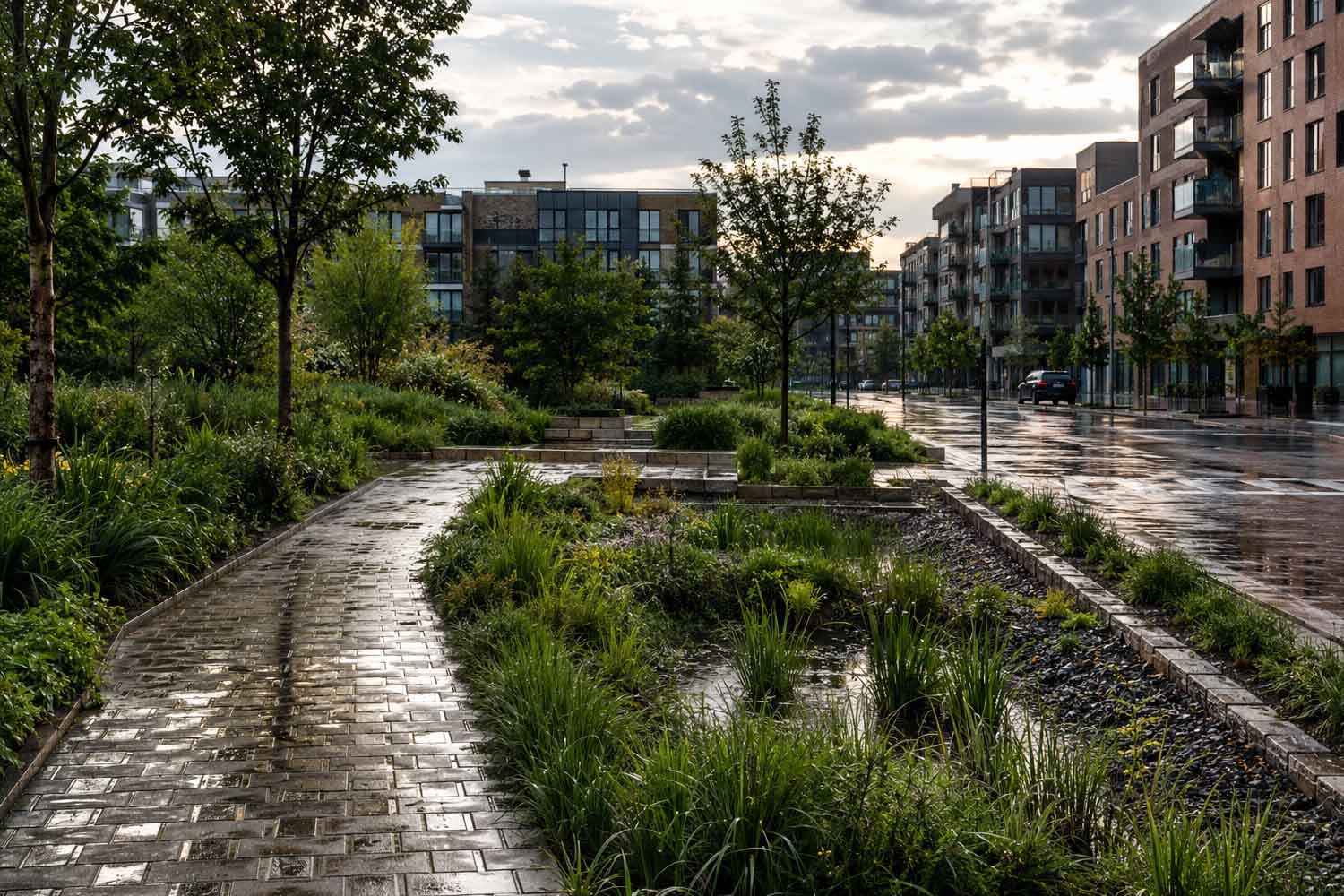
An intense storm, a manhole that doesn’t hold up, the water running on the asphalt and reaching the garages, underpasses, and entrances. We’re used to thinking of flooding as a sewer problem, but a huge part of the issue lies first: in the way we built cities.
For decades we have covered the ground with concrete, waterproof parking lots, roads, squares. Thus the rainwater no longer enters the ground: it slips, accelerates, concentrates all together and causes the drainage network to fail. The logic of sponge cities starts from here: giving back space to the ground, greenery, trees and natural solutions capable of absorbing and slowing down water.
This is not a suggestion from urban planners. It is a request that also comes from citizens. According to the Ipsos-Legacoop survey presented at the national meeting of the Observatory on the ecological transition in cities, 89% of those interviewed ask for more greenery and less land consumption, while 85% consider climate adaptation measures important to reduce the risks linked to flooding and heat waves. The most interesting point: one interviewee in two considers the redevelopment of public spaces with natural solutions to reduce soil waterproofing to be very important.
What “sponge city” really means
A sponge city is not a city full of decorative flowerbeds. It’s a city designed to hold water where it falls, rather than dumping it as quickly as possible elsewhere.
It means transforming schoolyards, car parks, squares, abandoned areas, traffic islands and public gardens into small green infrastructures. Not monumental works, but widespread interventions: draining pavements, rain gardens, green ditches, trees, green roofs, temporary collection basins, floodable parks, depaved soils.
The European Commission recalls that well-designed urban green spaces can contribute together to multiple objectives: protecting biodiversity, cooling cities, reducing the risk of flooding and improving the well-being of those who live in neighbourhoods.
The garden under the house can count for more than we think
The most useful part of the sponge city concept is that it’s not just about big parks. It also concerns the garden next door, the public courtyard left dry, the asphalted area in front of a school, the neighborhood car park which becomes a hot plate in summer and a water slope in winter.
When these spaces are redeveloped with permeable soil, trees and vegetation, they do three things together: they absorb some of the rain, slow runoff to the streets and reduce the heat accumulated by artificial surfaces.
This is where the ecological transition stops being a big, distant formula and becomes a very concrete thing: less water in the garages, less heat under the house, more shade, more living soil.
Concrete continues to weigh on Italian cities
The problem, however, is that free land continues to shrink. According to ISPRA, in 2024 Italian cities lost over 3,750 hectares of natural areas. The same report also highlights the increase in land consumption in the areas at risk: +1,303 hectares in the areas with medium hydraulic danger and +600 hectares in those with landslide danger.
Translated: we continue to waterproof even where it would be more prudent to leave the territory a natural capacity to absorb, drain and breathe.
And it is precisely here that the sponge city becomes a climate adaptation measure, not an urban beautification. Because greenery doesn’t just serve to “make a street more beautiful”. It helps the city function better when more intense rains, hotter summers and more frequent extreme phenomena arrive.
It’s not enough to plant trees at random
However, there is a risk: transforming the sponge city into yet another slogan good for a rendering. Planting a few trees is not enough if everything around them remains waterproof. A draining floor is not enough if it is not maintained. A garden is not enough if the soil is compacted and does not absorb.
Natural solutions work when they are designed well, integrated into urban planning and followed over time. The European Environment Agency also underlines that nature-based solutions must be scaled up and replicated, but that monitoring, standards and solid evaluations are needed to understand where they really work and how to bring them to a larger scale.
The sponge city, therefore, does not replace everything else: it does not eliminate the need for efficient water networks, maintenance, emergency plans, risk mapping and stopping land consumption. But it adds an essential piece that for years we have treated as secondary: the ability of the urban territory to behave like an ecosystem again.
The Italians have understood this, the cities must catch up
The Ipsos-Legacoop survey also shows a clear gap between what citizens consider important and what they perceive as already done. If 89% ask for more greenery and less land consumption, only 47% say they are very or quite satisfied with the interventions on green areas in their city. And on the climate adaptation and mitigation front, satisfaction drops to 38%.
The message is quite clear: people are not just asking for “more nature” in a generic sense. They ask for more livable and better prepared cities. They ask for public spaces that are not just surfaces to be crossed, but widespread climate infrastructures.
The sponge city starts with small interventions, but cannot remain small
A draining flowerbed alone does not save a neighborhood. A floodable park is not enough if in the meantime we continue to build on fragile soil. A green roof doesn’t make up for acres of new concrete.
But the point is precisely this: sponge cities work when many small interventions become a single strategy. Defloor where possible. Recover abandoned areas. Increase trees and permeable soils. Use public gardens as absorption spaces. Design squares and parking lots to retain water instead of repelling it.
Floods in Europe are already considered by the European Commission to be among the most common and costly natural disasters, and the risk is set to increase in the coming decades. Risk management, Brussels reminds us, must also focus on sustainable water management and measures that strengthen the resilience of nature and society to extreme events.
The difference, then, lies in deciding whether to continue treating water as an enemy to be expelled or as a resource to be managed better. Because the sponge city is not a city that promises to never flood. It’s a city that stops making the problem worse every time it rains.
You might also be interested in:
