
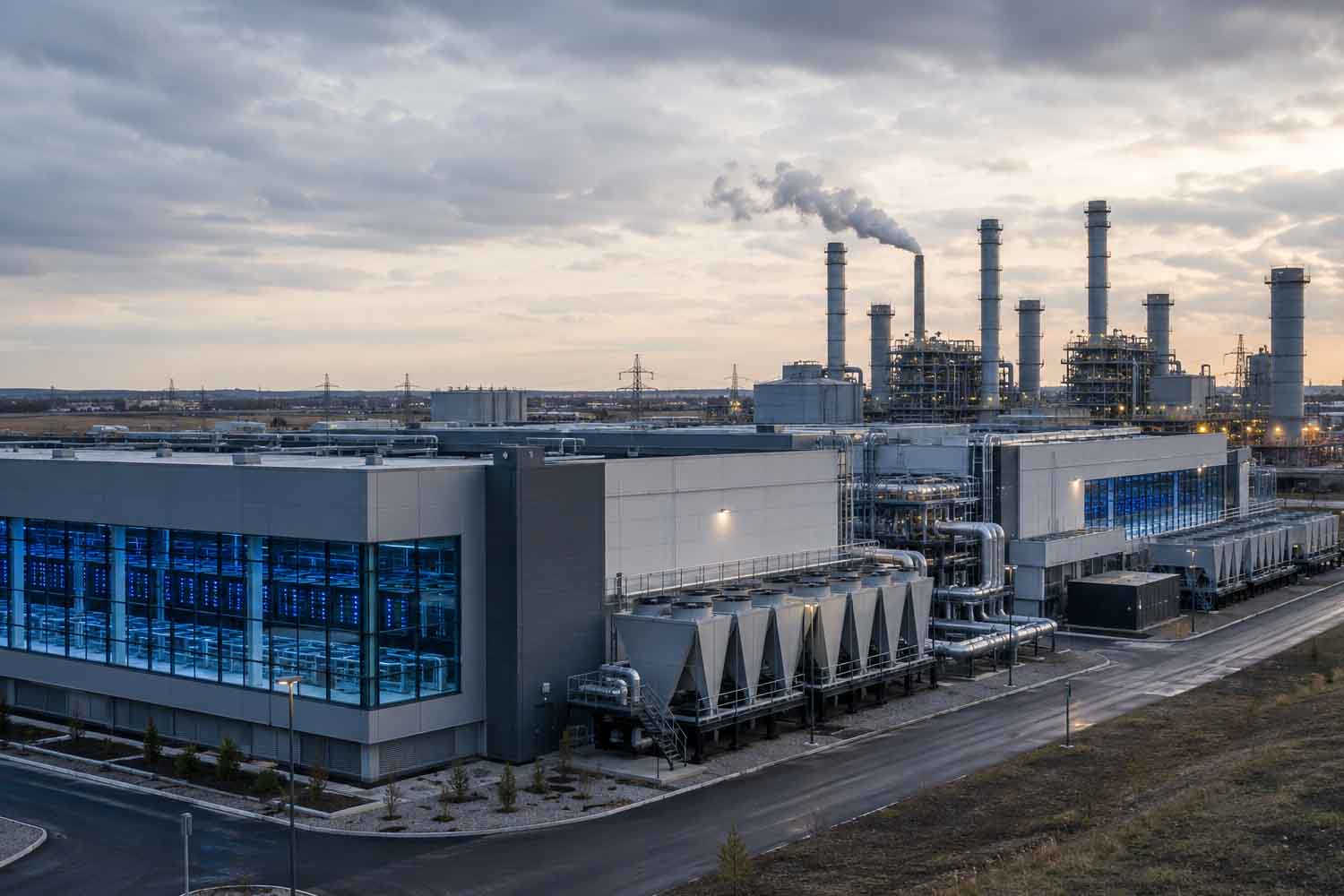
The AI only seems light as long as it stays inside a screen. Then you look behind that tiny gesture and the data center warehouses appear, the servers turned on day and night, the water to cool them, the electricity to keep them alive. And, increasingly, gas.
In the United States, AI’s energy hunger is driving a new rush to gas-fired power plants for data centers. According to a report from the Environmental Integrity Project, at least 74 gas-fired plants of 100 megawatts or more are proposed or already in the permitting process to provide energy directly to large data centers. The number is already impressive. It does so even more when you get to the map: almost half, 32 power plants, are concentrated in Texas.
The technical formula is that of “behind the meter” systems. In practice, power plants designed to serve private customers, often without going through the normal connection path to the public electricity grid. For companies it means speed, control, less waiting. For those who live near the plants it often means less time to understand what is coming, less space to intervene, less margin to ask for an account of the impact on air, noise, water and territory.
The heavy side of the cloud
The word cloud has done a lot of damage to the imagination. It makes you think of something that floats, that doesn’t take up space, that doesn’t get dirty. Data centers, on the other hand, are physical, enormous, energy-intensive places. Generative AI is making them even hungrier, because every model trained, every service launched, every new platform requires continuous computing power.
The power plants identified by the report would overall have around 143 gigawatts of capacity. Potential emissions would be close to 662 million tonnes of greenhouse gases per year, a volume comparable to the annual emissions of large economies such as Australia or France. A figure that takes the discussion out of the rhetoric of innovation and brings it back to earth, where tons of CO2 do not enter press releases with the same elegance as promises on efficiency.
The contradiction is not small: a technology described as the future risks being fueled by fuels from the past. We are talking about increasingly advanced models, tools capable of automating complex jobs, systems that should help us better manage the climate crisis. Then, to keep them turned on, new fossil power plants are built.
Technology companies often talk about renewables, purchases of clean energy, more efficient cooling systems, projects to reduce water consumption. All of this matters. But a new wave of gas dedicated to data centers changes the weight of the conversation. This isn’t just about optimizing what already exists. It’s about producing more fossil energy to support demand that is growing faster than the times of the transition.
Texas is the laboratory of running
Texas is taking the brunt of this game. An earlier Texas Tribune analysis had already identified hundreds of data center projects in the state. According to reported estimates, Texas power plants alone could emit over 287 million tons of greenhouse gases every year, as much as tens of millions of gasoline cars on the road for twelve months.
To these emissions would be added thousands of tons of fine particulate matter, nitrogen oxides and volatile organic compounds, substances associated with respiratory problems, worsening of air quality and cardiovascular risks. The problem, for local communities, does not remain closed within the word climate. It also comes in the form of heavier air, construction traffic, noise, pressure on the network, doubts about bills. The energy produced can end up inside a private digital campus. The effects, however, are spreading. The air knows no corporate gates.
Texas leads the map, but the map doesn’t stop there. The report notes additional facilities in the Ohio Valley, with 10 projects in Ohio, 6 in western Pennsylvania and 4 in West Virginia. The end customer changes, the lexicon changes, the logo on presentations to investors changes, but combustion remains combustion.
The AI runs, the authorizations too
The real issue lies in speed. Large plants that ask to connect to the public electricity grid must face a long journey, made up of studies, checks, opinions, opposition, federal and local steps. Facilities built to directly serve a private customer can move much more quickly. Sometimes in a few weeks, sometimes in a few months.
This speed is sold as efficiency. In part it is, from the companies’ point of view. From a public point of view, however, it risks becoming a way to move huge decisions into more opaque spaces. A gas power plant built for a data center is not a technical detail. It is an infrastructure that changes consumption, emissions, territory and the health of the people who live around it.
In the United States, the construction of data centers has now entered the language of geopolitical competition. The Trump administration has repeatedly linked the development of artificial intelligence to the challenge with China, treating energy, authorization simplification and computing capacity as pieces of the same national dossier. The EPA, the federal environmental protection agency, has also linked data centers, air quality, resources and energy in an increasingly urgent public discussion.
For the technology industry the request is brutal in its simplicity: energy is needed immediately. Gas offers a ready, modular response, close to the sites. It allows you to get around some network bottlenecks and guarantee continuity for structures that cannot afford interruptions. This works great for urgency logic. It works much worse for the climate crisis.
The bill reaches the communities
Back in January, Global Energy Monitor reported that the United States led the world in new gas-fired power plant projects, with nearly a quarter of the global pipeline. More than a third of the new capacity was intended to power on-site data centers, i.e. built next to or close to large digital hubs. In Texas, nearly 40 gigawatts of planned gas-fired capacity was tied to data center demand.
Meanwhile, public consensus is creaking. A 2026 Gallup poll found that seven in ten Americans would oppose building an AI data center in their area. The concerns are very concrete: water and energy consumption, noise, traffic, impact on the landscape, air quality, indirect costs.
It’s a distance that can be seen clearly. On the one hand there is the glittering narrative of artificial intelligence, on the other there are people who look at land near their home and discover that a huge infrastructure could be built there to power servers that companies on the other side of the country will perhaps use.
The question becomes uncomfortable: who really benefits from this energy? Who bears the burden? Data centers serve a global digital economy. The power plants, however, are in a specific place. Local emissions have nearby addresses, streets, schools, houses. CO2 escapes into the atmosphere, nitrogen oxides and particulate matter start somewhere.
The future is not light just because it is digital
The growth of AI brings with it enormous promise and equally enormous problems. It’s not about stopping technology, nor pretending that data centers can disappear, but about deciding what energy to power them with, what rules to build them with, with what transparency to authorize them and with what respect for those who live in the territories chosen to make everything else run.
A digital transition that relies on new fossil power plants risks becoming a strange shortcut: faster for companies, heavier on the climate, more opaque for communities. AI may also seem intangible when responding from a screen. Behind that screen are servers. Behind the servers, more and more often, there are gas power plants. At that point the digital cloud stops floating. And it comes back down, with all its weight.
You might also be interested in:
