
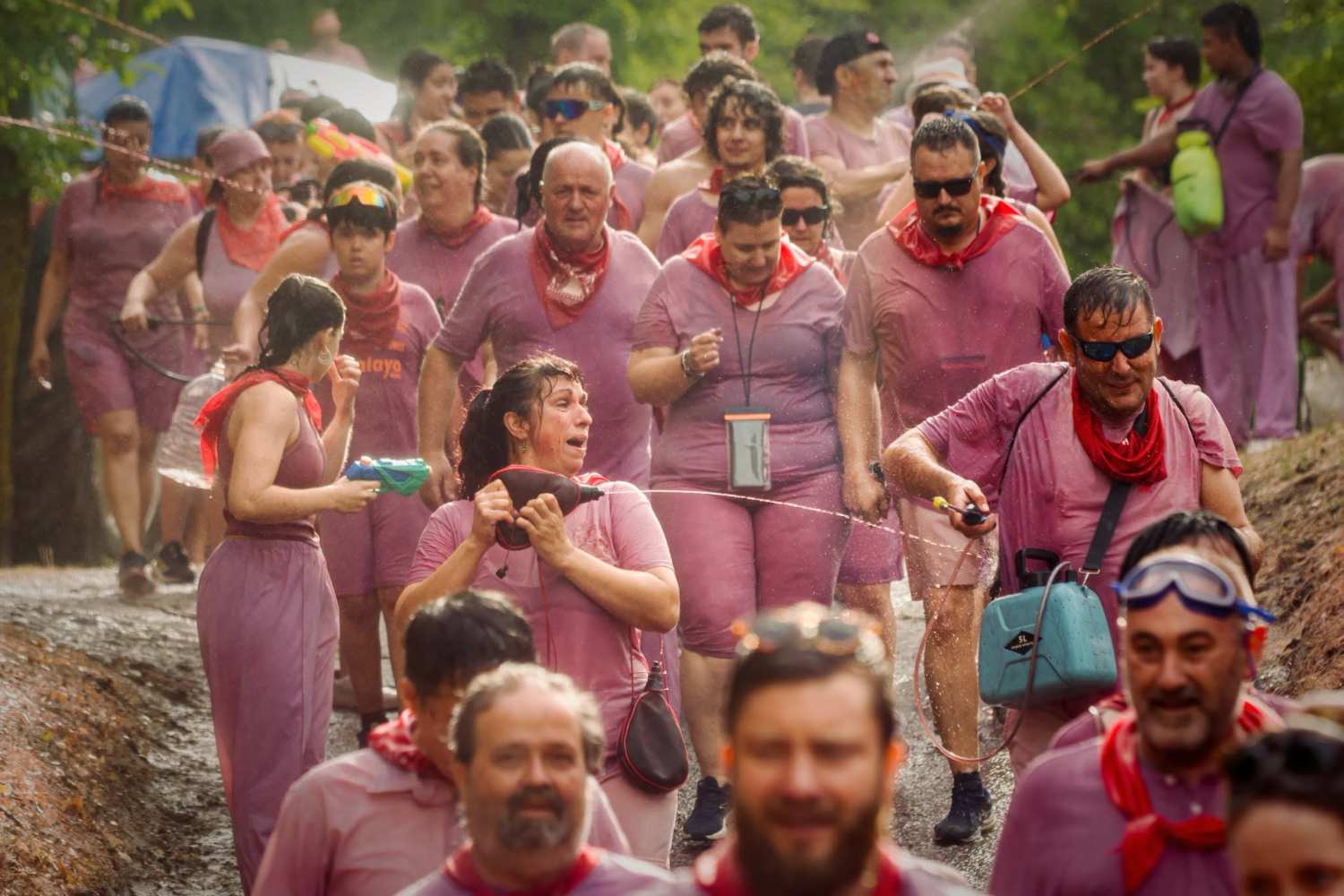
Every year, as punctual as the summer solstice, the small Spanish town of Haro is transformed into the theater of one of the most spectacular and fun-loving events on the planet. The 2026 edition of the famous Batalla del Vino saw over 6,000 people gather from every corner of the world to start a colossal peaceful war with crushed grapes. The stage of the event was the evocative Riscos de Bilibio, rocky cliffs located a few kilometers from the city center, which for a day abandoned their natural colors to be entirely tinged with a vivid purple shade.
In the early hours of the day, a human tide rigorously dressed in white t-shirts and trousers climbed the hills to begin the ritual, consuming more than 30,000 liters of red wine in a decidedly unorthodox way. Between music, songs and laughter, the crowd relentlessly targeted each other using every means available, from traditional buckets to modern water guns and spray bottles. Although the event attracts an enormous mass of visitors and is recognized as a festival of national tourist interest, the enormous volume of liquid used does not fail to cyclically raise criticism and perplexity on the part of those who see in this ancient custom an excessive and anachronistic waste of food resources.
From the territorial dispute of the thirteenth century to the first baptisms of the late nineteenth century
The roots of this incredible event lie in a remote past and are connected to the figure of San Felices de Bilibio, a saint who lived in the 6th century whose remains were buried inside a cave located on the cliffs. Initially the local faithful organized disorganized pilgrimages in this inaccessible area but, around the fifteenth century, the Council of Haro decided to officially structure the processions in honor of the patron saint during the anniversaries of San Juan and San Pedro, on 29 June. Furthermore, in the 13th century, the area was at the center of a harsh territorial dispute with Miranda de Ebro, and the annual march served precisely to claim the sovereignty of the town of Haro over those rocky borders.
With the construction of the first hermitage in the eighteenth century, the cult and the subsequent breakfasts based on local products took root further, but the real pagan turning point occurred just before the twentieth century. It was in that period that the first wine baptisms were born, an evolution documented even by the newspaper reports of 1898, which ironically described the emptying of the cellars in favor of the clothes of the participants. From that moment on, the red of the Rioja region became the official ammunition of the festival, forever uniting religious sentiment with popular fun.
The ritual of the morning battle and the triumphal return to the Plaza de la Paz
The functioning of the festival follows a rigid ceremony which is repeated unchanged at sunrise, when the jarreros people and tourists march compactly towards the hermitage. After the celebration of the traditional morning mass, the accumulated tension melts away and a real melee breaks out among the crowd. The rules of engagement are non-existent and, as the participants themselves say, the only solution to survive the purple grip is to accept the collective bath and enjoy the moment to the fullest.
The colossal drenching continues unabated until midday, when the ammunition runs out and the initial white shirt has now given way to a uniform completely soaked in must. At the end of the dispute over the Riscos de Bilibio, the crowd flows again towards the historic city center, gathering in the main square, the Plaza de la Paz. Here the day continues until the evening with dances, traditional songs and tasting the rich local food and wine offering, closing a thousand-year circle of devotion, identity pride and pure summer madness.
You might also be interested in:
