
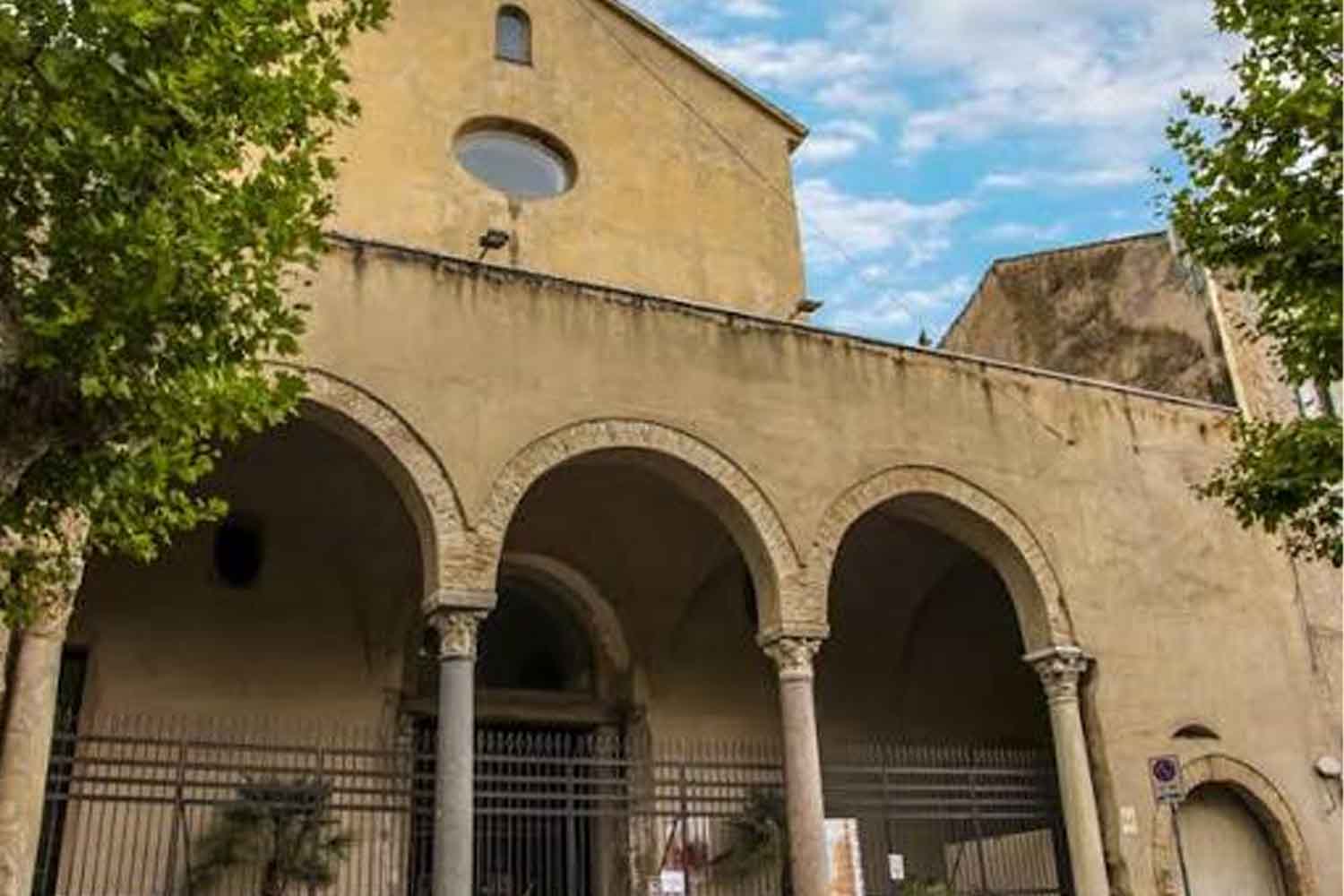
TO Salerno history has chosen one of its favorite places to complicate things: the underground. Under the Church of San Benedettoin the historic center, among walls read in one way for years and then looked at with different eyes, the remains of the ancient Roman theatre of the city. A building searched for for a long time, imagined by scholars, pursued within hypotheses and reconstructions, which has so far remained without a certain location.
The discovery comes from the underground levels of the San Benedetto complex, where some semicircular wall structures had in the past been interpreted as part of a baptistery. The new investigations, conducted by a research group fromUniversity of Salernohave instead made it possible to recognize in those walls the cavea, that is, the area of the steps intended for spectators. The archaeologist led the work Rosa Fiorillowith the contribution of the architects Simona Talenti and Sara Antinozzi, involved in the three-dimensional surveys of the complex.
The auditorium under the church
Those curved architectures, which remained in the basement of the church, told something different than what had been thought. The work on 3D reliefstogether with the stratigraphic analysis, made it possible to distinguish the construction phases, separate the subsequent interventions and recognize the original layout of the theater building. In between, as often happens in places crossed by centuries of life, there were also terracotta canalizations and ducts inserted in later periods, capable of confusing the interpretation of the site.
The detail changes a lot. The presence of the auditorium gives Salerno an important piece of its Roman topography, because an ancient theater always speaks of the urban form, of the routes, of the public spaces, of the relationship between architecture and collective life. Here the data weighs even more, because it is located under one of the most stratified places in the city, in an area where the Roman, Lombard and medieval pasts overlapped without asking permission from anyone.
San Benedetto, layer after layer
The San Benedetto complex has a long and rather eventful history. It is located in the area of the ancient Orto Magno, in a strategic area of the city, also linked to the aqueduct. The church is rebuilt between the 7th and 9th centuries and was probably enlarged in the 11th century, when Alfanoabbot of San Benedetto, became archbishop of Salerno in 1057. The atrium of the monastery and Castel Terracena rest on the Lombard fortifications of Arechi II, from the second half of the 8th century.
Then the story continued to change the function of the spaces, like one changes rooms when the house becomes narrow. In 1807 the monastery was suppressed and transformed into barracks. A few years later the church became San Gioacchino theatre and then, between 1815 and 1845, Real Teatro di San Matteo. The short circuit is almost perfect: a church that was used as a theater in the nineteenth century and which today reveals, beneath it, the traces of a much older theatre.
Recent investigations have also opened other leads. In the basement, still little-known environments have been reported, a long tunnel behind the apse, traces of frescoes preserved on some walls and portions of terracotta riggiole flooring. All elements that indicate a long series of reuses, adaptations and transformations. The Roman theater of Salerno therefore re-emerges within a dense plot, made up of walls that continued to serve different purposes, even when their first meaning had now become invisible.
The city brought back into focus
For urban archaeology, discoveries of this type have particular value. They rarely deliver a clean scene, ready to photograph and archive. More often they force us to revisit the mental map of a city, to understand how an ancient building has been incorporated, cut, reused, misunderstood. This is exactly what happens in Salerno: the recognition of the auditorium offers a new key to reading the Roman structure and the way in which subsequent eras built above, next to, inside.
The role of the three-dimensional surveys was central because it allowed the progression of the walls and the relationship between the different levels to be observed more precisely. Technology, in this case, did something very concrete: it removed dust from a form. It helped to see a curve for what it might have been, to separate a later addition from an older structure, to transform a hypothesis into a more solid archaeological reading.
Now the longest job remains, the least conspicuous: studying, protecting, making understandable. The Roman theater of Salerno reappears under a church that alone would be enough to tell the story centuries of transformations. The city, meanwhile, discovers that a part of its most ancient scene was still there, underfoot, patient and crooked as things left in the dark for too long can be.
