
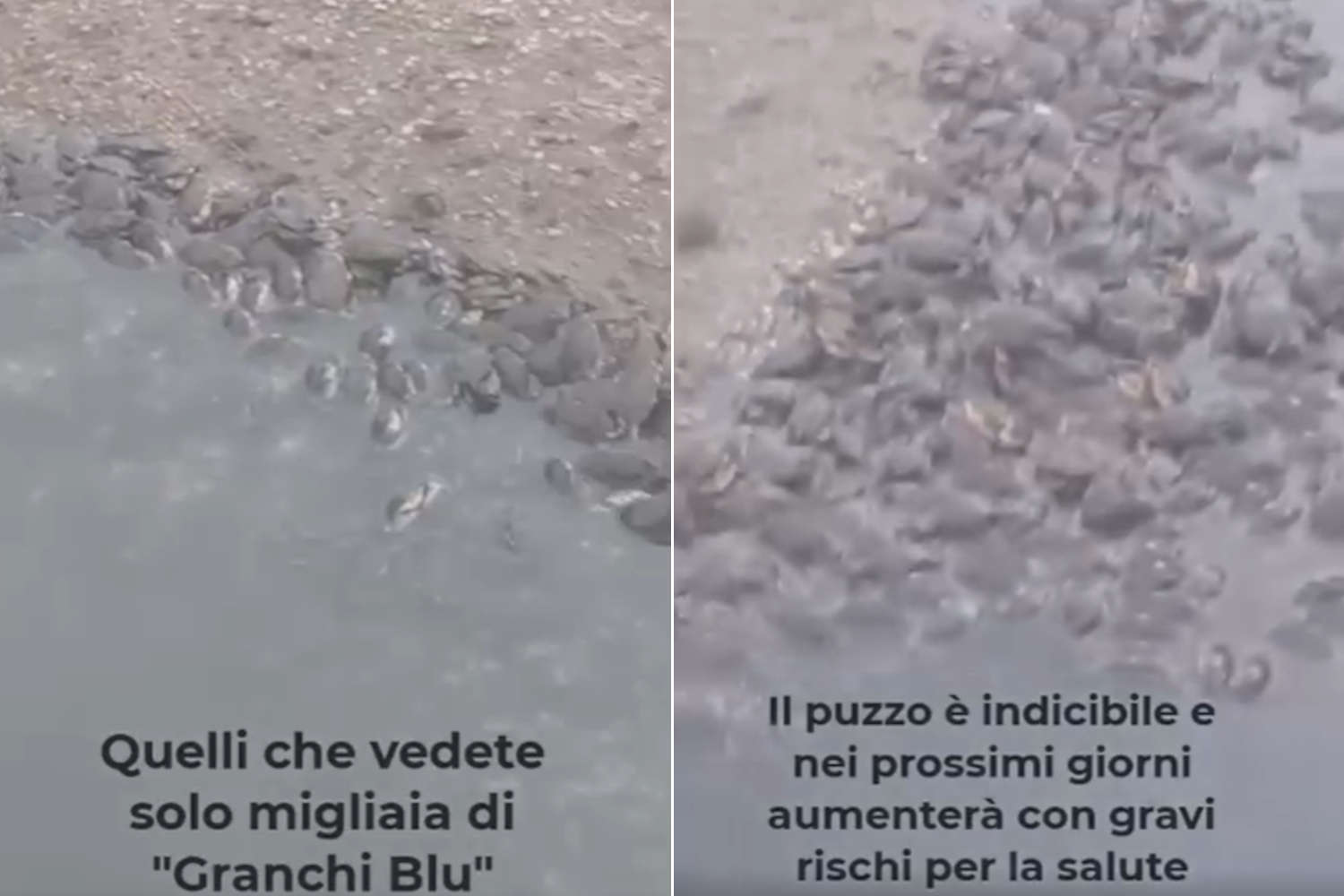
A very serious environmental crisis is affecting the ecosystem of Lake Fogliano, one of the most important brackish basins located in the heart of the Pontine plain. For several days the banks and areas surrounding the canal-port of Rio Martino have been invaded by thousands of blue crab carcasses. What at first glance might seem like positive news, given that it is a highly invasive and voracious alien species originating from the American continent, actually represents the macroscopic symptom of an imminent ecological collapse which risks rapidly spreading to the local fish fauna.
The primary cause of this massive mortality is not linked to eradication plans, but to a severe phenomenon of water anoxia. The cyclic silting of the canal located at the Foce del Duca has interrupted the natural exchange with sea water. Without this constant water ventilation, the basin is undergoing a rapid process of eutrophication: the uncontrolled proliferation of algae consumes the oxygen present, causing the suffocation of crustaceans. Scientists warn that unless urgent action is taken, fish will be the next victims of this environmental asphyxiation.
The silent invasion of the alien species and institutional delays in maintenance
The phenomenon also highlights the impressive population density reached by this crustacean within the Lazio wetland area. Originally introduced by man for mere commercial purposes, these animals destroy the biodiversity of coastal lakes by preying on bivalves, mussels, clams and juvenile local fish. The ongoing die-off, although numerically visible on the small beaches that emerged due to the summer drought, will not be sufficient to eradicate the species from the protected area of the Circeo National Park, making targeted long-term management plans necessary.
The management of the emergency has raised a complex debate regarding the administrative competences of the relief channels. Through an official note, the leaders of the Park Authority have specified that the ordinary maintenance of the mouths is not part of their direct institutional duties. However, given the criticality of the situation, the institution has decided to take on the technical and administrative leadership of the operations to break the bureaucratic deadlock and prevent the decomposition of the biomass, which is already releasing a strong odor into the surrounding air.
The start of emergency works in collaboration with the Biodiversity Carabinieri
The action plan includes close collaboration with the Biodiversity Group of the Carabinieri to speed up excavation operations. The immediate objective is the removal of debris and sand accumulated at the mouth to allow the entry of marine flows before the definitive rise in summer temperatures. The institution is currently finalizing the awarding of the works with an emergency procedure.
The formal hope is that the construction sites for the unblocking of the mouths can start in the next few days to restore the correct chemistry of the waters. This structural intervention will buffer the acute anoxia crisis, but the complex ecological challenge linked to the presence of blue crabs will remain open, whose uncontrolled proliferation continues to threaten the biological balance of one of the richest and most protected wetlands of the entire Italian peninsula.
You might also be interested in:
