
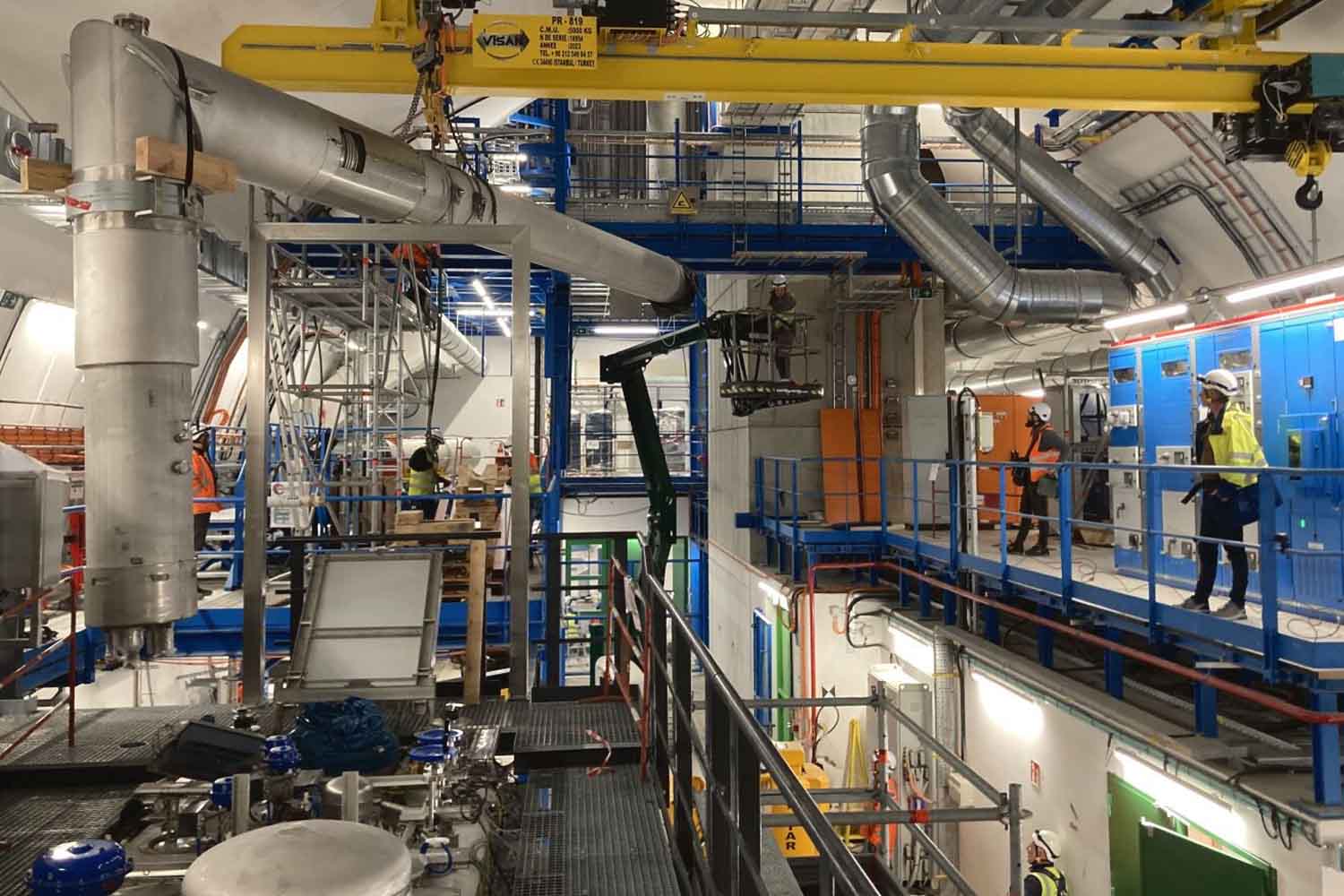
In the tunnel of Large Hadron Collider silence has something strange. For years, under the border between Switzerland and France, the most powerful machine in particle physics has circulated protons, collected data, forced thousands of researchers to chase tiny signals inside mountains of numbers. Now that invisible noise stops. CERN shut down the LHC after the last data collection phase and opened the Long Shutdown 3the long period of work that will transform the accelerator into its high-luminosity version, the High-Luminosity Large Hadron Collider.
A long, very concrete pause
Four years, in particle physics, can seem like a kind of operational eternity. In this case, however, the pause has the heavy pace of construction sites: magnets to be removed, components to be replaced, new cryogenic lines, technical tunnels, electrical systems, detectors to be updated. In the LHC alone they will be dismantled and replaced approximately 1.2 kilometers of elementsinside a 27 kilometer long ring which already seems like engineering madness told with Swiss calm.
The calendar points to 2030, with the start-up of the HL-LHC scheduled for June of that year. The name, as usual, seems designed to discourage anyone with a social life, but the concept is quite direct: increasing brightness means increasing the number of useful collisions, therefore producing more data and making the observation of very rare phenomena more likely. The new setup should achieve an integrated luminosity approximately ten times higher than the original LHC design.
In practice, CERN is preparing a machine capable of looking better where today it is barely visible. With the HL-LHC, physicists will be able to study the Higgs boson with greater precision, look for subtle deviations from the Standard Model and chase clues about everything that still remains outside the known frame: dark matter, antimatter, unknown particles, processes so rare that they almost seem like a background disturbance until someone manages to isolate them.
The LHC we knew
The Large Hadron Collider fired its first beams in September 2008 and produced its first proton collisions in 2009. Since then it has gone through three major periods of activity, accumulating a huge amount of data for CERN experiments. His most famous achievement remains the discovery of Higgs bosonannounced on July 4, 2012 by the ATLAS and CMS collaborations, a step that confirmed a theoretical mechanism that had been awaited for almost half a century.
That discovery received the media buzz of great occasions, with theoretical physics even entering the bar conversation for a few days, between those who pronounced “boson” with great confidence and those who were just trying to understand why a particle could deserve so much attention. The scientific point remains enormous: the LHC has given experimental consistency to a decisive piece of the Standard Model, the theory that describes fundamental particles and their interactions, at least as far as we can go today.
After Higgs, however, the machine continued to work. CERN recalls hundreds of advances, over 85 hadrons discovered, studies on the imbalance between matter and antimatter, research on new particles, measurements on quark and gluon plasma, i.e. the state of matter that helps to reconstruct conditions very close to those of the primordial Universe. It is a slow physics, often ungrateful for those looking for a twist, made of patience, exclusions, margins of error, signals that appear and disappear.
More collisions, more noise, more possibilities
The new phase will be busier. At the points where the proton beams cross, the ATLAS and CMS experiments will have to manage between 140 and 200 proton-proton collisions for each crossing of the particle packets, compared to around 60 in the last operational period of the LHC. Translated out of the laboratory lexicon: detectors will have to choose interesting events in frightening traffic, with over five billion interactions per second.
To withstand this leap, ATLAS and CMS will be thoroughly renewed. Trigger systems will change, i.e. those that decide which collisions deserve to be saved and analyzed. New silicon trackers will arrive, detectors with billions of reading channels, timing instruments capable of working on scales of a few picoseconds, calorimeters capable of operating at very high frequencies. Physics, here, depends on something very unromantic and very decisive: distinguishing the right signal in a screaming crowd.
The stated goal is to collect much more data. CERN estimates that the HL-LHC can produce, over its operational life, approximately 380 million Higgs bosonsagainst the approximately 55 million produced by the LHC since the beginning of its activities. This difference changes the types of questions you can ask. An already discovered particle can become an even more refined laboratory, almost a lens through which to look for microscopic cracks in the theory.
The search continues even without beams
The shutdown of the LHC, therefore, sounds more like a construction site than a lowered shutter. During these years the particle beams will remain stationary, while scientific work will continue on the data already collected. Thousands of researchers will analyze what the collider has produced so far, and in the meantime they will prepare software, detectors, procedures, models and instruments for the new season. The machine is silent, physics remains awake.
There is also an almost domestic aspect, if we can say that when talking about superconducting magnets and underground tunnels. Large scientific infrastructures age, they need maintenance, consolidation, security and updates. Long Shutdown 3 will also serve to intervene on other parts of the accelerator complex, from experimental structures to technical systems, up to safety systems and electrical networks.
When the complex gradually begins to restart, from 2028, the transition towards 2030 will open a new phase for high energy physics. The wait will be long, and perhaps even a little frustrating for those who are always hoping for the next particle capable of changing the map. However, the LHC has already taught one simple thing: the Universe grants responses with an almost offensive slowness. We have to build huge machines to make them say half a word more.
