
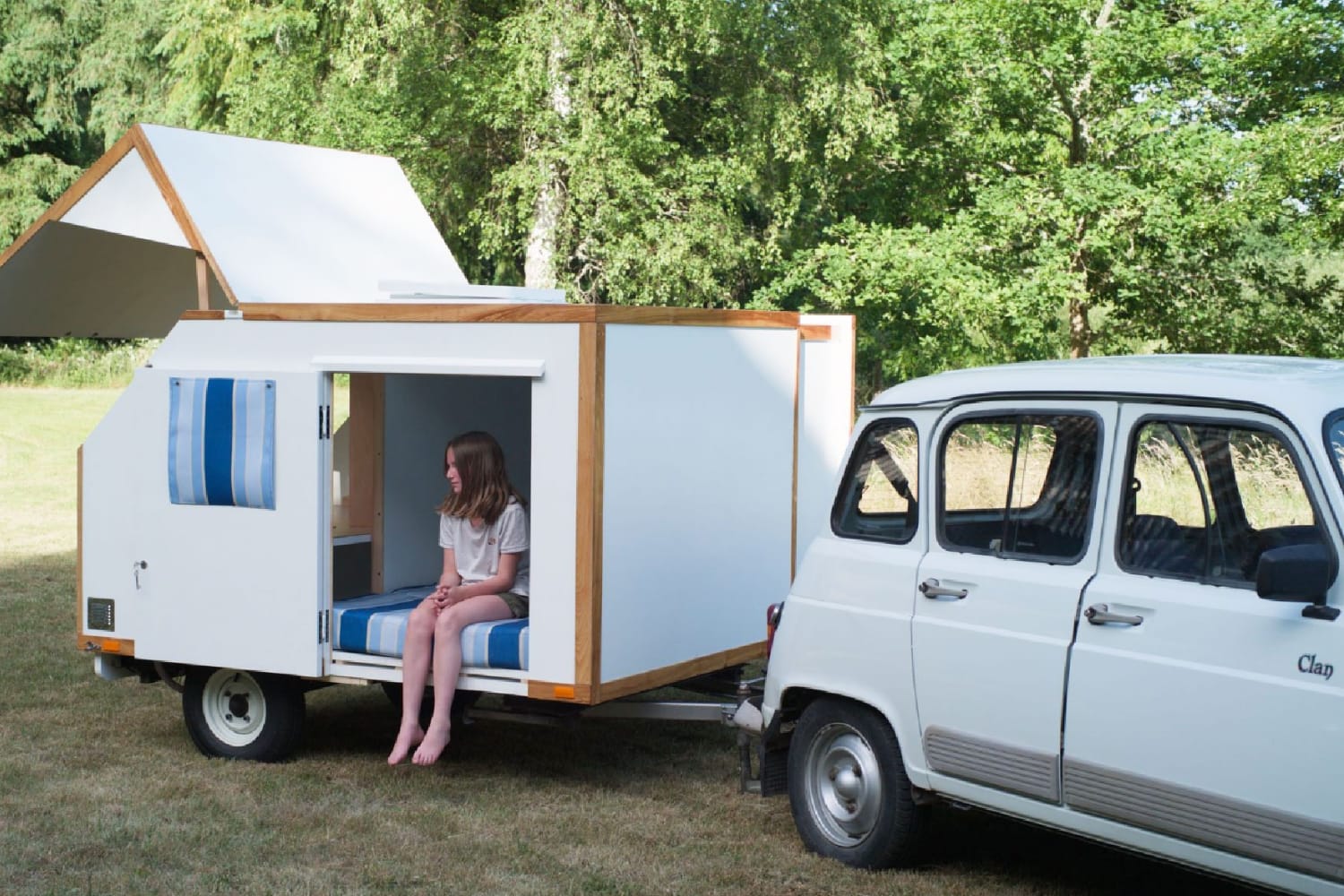
A caravan that extends when needed, remains compact during the journey and opens the rear door without motors, control units, batteries or remote controls. The Slidabox belongs to that category of objects that seem to have come out of a workshop full of pencils, clamps, sawdust and common sense: few promises, a lot of mechanics, a clear idea of space.
The project comes from Woodenwidget, a British company specialized in construction plans for micro-caravans, small boats, wooden bicycles and lightweight self-build solutions. The Slidabox is presented as an expandable caravan, small and simple to make, designed for those who prefer to build with their own hands instead of buying a ready-made vehicle, perhaps full of devices destined to break sooner or later.
The tailgate that works with gravity
The most interesting part is on the back. When the caravan arrives at the campsite, the rear module slides out like a large drawer. At that moment the tailgate support system comes into operation: a play of articulated arms, levers and geometries that uses weight and gravity to lift and keep the structure open.
No electric pistons, no buttons, no electronic components. The movement remains mechanical, legible, almost domestic. It’s the kind of solution that makes you want to look at it twice, because at first it seems too obvious. Then you understand that right there lies the intelligence of the project: remove everything that complicates, leaving only what is needed.
According to information released by piano retailer Duckworks, the rear system works thanks to “gravity and intelligent geometry”. The Slidabox, in the unloaded version, should weigh less than 300 kilos including the trailer, therefore remaining very light compared to traditional caravans. In Europe, under 500 kilos is considered a trailer, although the rules may change from country to country and must always be checked before setting off on the road.
Small when travelling, more liveable when stationary
The logic is simple: on the road the Slidebox remains compact, so it doesn’t add unnecessary bulk behind the car. Once arrived, the sliding module allows you to obtain an isolated bed approximately two meters long, while under the rear door there is space for a small kitchen area with storage compartments.
It is a solution designed for those who love essential camping, slow holidays, light vehicles and objects that can be understood by looking at them. The mini-caravan does not try to imitate a miniature camper. Work on another idea: carry with you the bare minimum, gain space only when needed, reduce weight and complexity.
A caravan to build, not just to buy
The Slidebox is not offered as a finished product to be picked up at the dealership. Woodenwidget primarily sells detailed PDF plans, with step-by-step instructions, photographs and material directions. The idea is to allow even those with little experience in woodworking to try their hand at construction, using common tools and relatively easily available materials.
The Slidabox metric plans, according to Duckworks, exceed 100 pages and include nearly 200 photographs. Inside there are indications on the choice of wood, tools, assembly and finishes. It takes time, it takes patience, it takes the desire to make some mistakes and fix it. But the meaning of the project is precisely this: bringing the journey back into a more manual, less packaged dimension.
When innovation makes no noise
In a sector where even free time often ends up filled with displays, apps and batteries, a caravan like the Slidabox has a somewhat stubborn charm. It doesn’t claim to revolutionize camping, nor to become the definitive answer for everyone. But remember something quite concrete: sometimes innovating means removing, lightening, simplifying.
A well-designed lever can do the work of a motor. A liftgate can remain open without becoming an electrical problem. A small caravan can become larger without turning into a traveling living room. The Slidebox is all here: in a sliding queue, in a bed that appears, in a piece of wood that does its job. And this, today, almost seems like a form of luxury.
You might also be interested in:
