
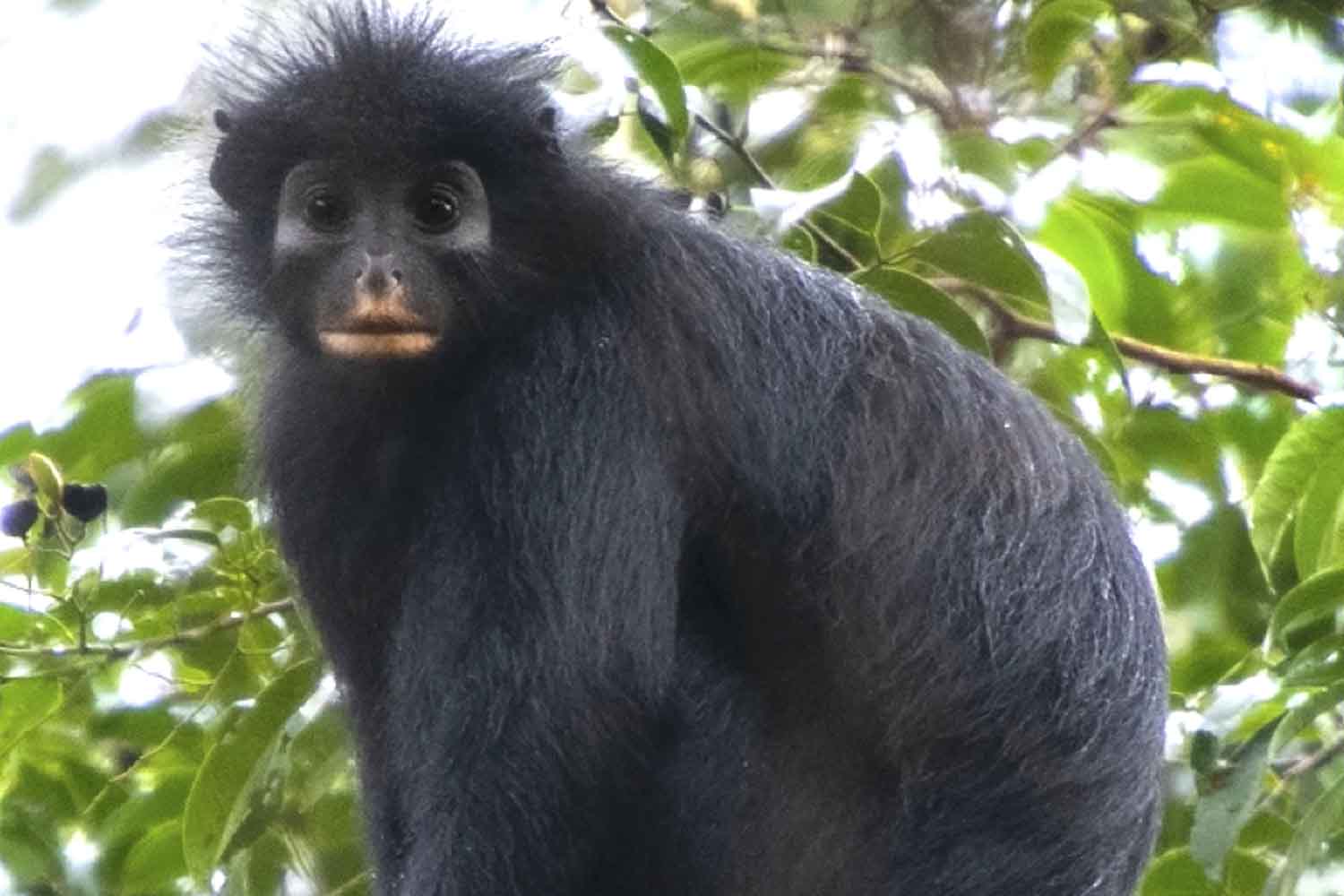
Likweli already lived among the foliage of the Democratic Republic of Congo and, for some local communities, even had two names. Science needed an incomplete photograph, ten years of silence, 114 surveys, three already dead specimens confiscated from hunters and thousands of kilometers traveled in the forest to add the scientific one: Colobus congoensis. The study published on PLOS ONE recognizes it as a new species of African monkey, just the fifth discovered in the last 75 years.
It has a shiny black coat, an orange-cream patch around its mouth and a call that alternates between roars and snorts. The orange lips will do their job in the photographs. The number to look at, however, is another: 1,700 square kilometers, the entire known range of the species.
It is such a small distribution that the authors are already proposing a provisional classification as Endangered. The official IUCN Red List assessment is yet to come. Likweli has just entered the zoology books and already brings with it a warning.
Ten years between two photographs
The first evidence dates back to 2008. Ashley Vosper and Bernard Ikembelo photographed an unknown monkey in the upper part of the forest, on the eastern bank of the Lomami River. Only a portion of the animal could be seen in the image: enough to raise doubt, too little to describe a species.
Then nothing for ten years. In November 2018, a patrol led by Congolese researcher Jean-Pierre Kapale photographed a small black monkey with a light area around its mouth and a white spot under its tail. Over the next few months, the team managed to document it seven more times.
Reexamining the archives, the researchers also found a photograph taken in August of the same year, 35 kilometers further north. The animal had already passed the camera, only it had been mistaken for another species. The monkey was in the right place. The label, decidedly less so.
Between 2018 and 2022, 114 surveys were collected, of which 89 were visual and 25 obtained through calls or contacts that were too short to observe the animals well. In more than 3,000 kilometers of land patrols carried out between 2020 and 2022, one of the methods employed resulted in just 29 encounters with Likweli. It is a data on the frequency of sightings, not a population census, but it gives a good idea.
Even in nearby villages the species seems little known. Only in eight of the 52 locations involved in the interviews was anyone able to recognize it and describe it precisely, an exception in communities accustomed to distinguishing forest fauna. Among the Balanga it was called “Likweli”. Some communities used Mituku instead kasaba nkoni“the one who shakes the branches”. For science it is a new species; for those who lived next to his forest it already had a place in the language.
The name congoensis it was proposed by the Congolese researcher Junior Amboko to recall the country’s biodiversity. According to what Florida Atlantic University explained, it could be the first primate expressly named in honor of the Democratic Republic of Congo.
The orange lips, then everything else
Likweli weighs about seven kilograms and is smaller than other colobus monkeys. It has an almost entirely black body and long tail, longer hair on the shoulders that appear to form a coat and a white area under the tail. Orange-cream skin surrounds the mouth and rises towards the nose, framed by long black facial hair.
To understand whether those colors really belonged to a distinct species, the researchers examined an already dead male and two females, confiscated from hunters in 2021 by the Congolese authorities. Skins, skeletons and fabrics were compared with specimens preserved in zoological collections. The three animals are now kept between Kisangani University and the Yale Peabody Museum.
Mitochondrial DNA places Colobus congoensis next to the black colobus, Colobus satanaswhich lives over 1,200 kilometers to the west. The two evolutionary lines separated between 4.1 and 5 million years ago, one of the oldest divisions reconstructed within the genus Colobus.
The date must still be written in pencil. It derives from a small sample of mitochondrial DNA and the authors themselves indicate the analysis of entire genomes as a necessary step to better reconstruct the separation.
Likweli’s voice also retains some resemblance to that of his distant relative. The calls have rapid pulses, high frequencies and often begin with a snort. The acoustic analysis is based on just three fairly clear recordings, so it adds a piece to the anatomical and genetic evidence.
The animals live mainly in the upper part of the forest, in average groups of about six individuals. They often travel together with other primate species: this happened in 45 of the 62 observations in which researchers were able to reconstruct the composition of the group. They rarely descend to the ground. In one case they did so while a crowned eagle attacked the group. Evidently even newly discovered species already know their priorities well.
©PLOS
A forest slightly larger than Rome
Likweli’s range extends between the provinces of Tshopo and Maniema, between the Lomami and the Lilo rivers. Its 1,700 square kilometers correspond to an area approximately one third larger than the entire municipality of Rome. The other species of the genus Colobus they generally occupy areas exceeding 60,000 square kilometers.
As many as 104 of the 114 detections are concentrated within ten kilometers of Lomami. To the west the great river hinders travel; eastward, seasonally flooded forests and poor sandy soils appear to further close the passage. The study does not calculate how many individuals exist overall. However, the few encounters, the small groups and the concentration of sightings in a narrow strip of forest suggest a small and very localized population.
Much of the known range falls within Lomami National Park. That’s the good news. The less good news is that Likweli depends on tall canopies and mature forests, while settlement expansion and land conversion continue in the buffer zone.
According to the testimonies collected, the species has not historically been a specific target of hunters. However, the presence of three confiscated specimens shows that it may end up in the wild meat trade. With such a limited range, even occasional pressure risks having a significant impact.
The authors indicate two priorities: protecting Lomami National Park and involving local communities in the conservation of the species. The same communities that, long before the study was published, already knew what to call it. It took science eighteen years to add a name to it. The forest on which it depends can disappear much more quickly.
