
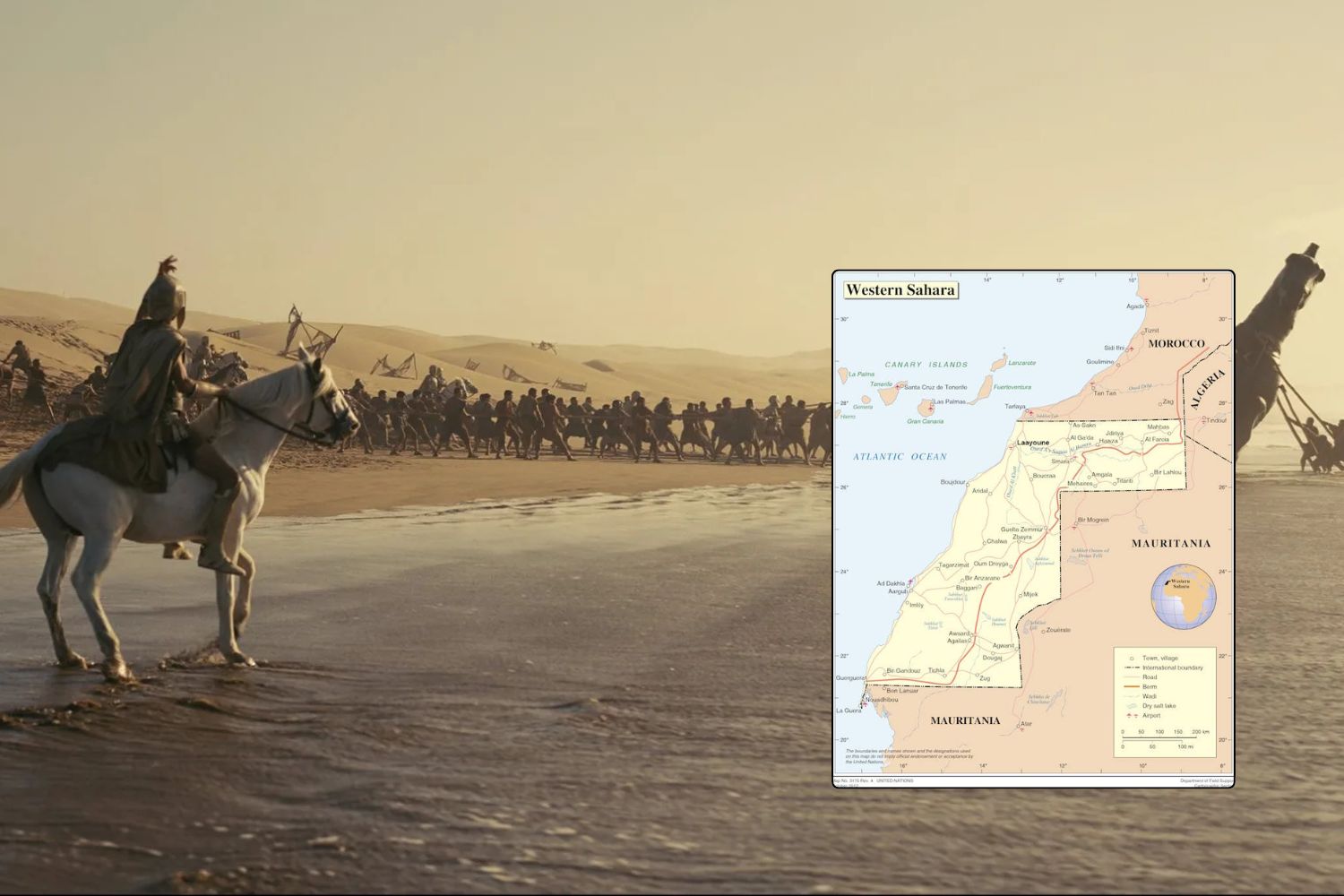
There is a very small detail that could go unnoticed, at the exact moment in which thousands are preparing to see The Odysseythe new blockbuster from Christopher Nolan (with Matt Damon, Tom Holland, Anne Hathaway and Charlize Theron, to name a few). Part of the film was shot in Dakhla, Western Sahara. So what?
What not everyone knows is that it is a territory that the United Nations continues to consider non-autonomous and whose status is at the center of one of the longest and most unresolved disputes in the world. In his latest report, the UN Secretary General highlighted that observers from the Office of the High Commissioner for Human Rights have not been able to access the area since 2015 and that reports of intimidation, surveillance and discrimination against the Sahrawi population, in particular those who support the right to self-determination, continue to arrive.
For this reason (the film was released in Italy on Thursday 16 July), Sahrawi filmmakers, artists and activists have already launched an appeal for a boycott for weeks, accusing the British director of having contributed – even if indirectly – to normalizing an occupation that has lasted for almost fifty years.
In fact, the spectacular dunes of Dakhla have become the perfect landscape to tell the story of Ulysses’ journey, but for the Sahrawi people that desert is a disputed land and certainly not a film set.
@UN
After Spain’s withdrawal in 1975, Morocco assumed control of most of Western Sahara, while Morocco Polisario Frontwhich claims the independence of the territory, administers part of it. Even today, the United Nations considers Western Sahara one of the last non-decolonized territories in the world and continues to support the right to self-determination of the Sahrawi people.
According to the organizers of FiSahara (the Western Sahara International Film Festival, also called “the Cannes of the desert”, whose aim is to use cinema to “entertain, transmit knowledge and empower refugees from Western Sahara”), shooting a film in an occupied territory without recognizing its political context risks transforming cinema itself into a tool for legitimizing the occupation. A position also shared by numerous artists and international personalities who asked the production to remove the scenes filmed in Dakhla.
View this post on Instagram
The role of Morocco and incentives for cinema
Dakhla’s choice would not have been just artistic. In recent years Morocco has invested heavily to attract large international productions, offering significant economic incentives and tax credits. According to various reconstructions, Odyssey would also have benefited from the support of the Moroccan national film fund, while the Government presented the set as an important cultural success. Precisely this, according to critics, makes the matter even more delicate: cinema risks becoming part of an international promotion strategy for a territory whose status remains the subject of an open controversy.
So far Christopher Nolan and Universal Pictures have not made public statements on the allegations nor responded to requests for comment made by several international media, including The Guardian. But it is certainly not the first time that a major film production has been called upon to deal with the political weight of its choices.
Making a film means choosing, of course, an evocative landscape, but also deciding which places to tell and which stories to make visible.
In the case of the Sahrawis, can a disputed territory simply become a spectacular backdrop, while the people who inhabit it continue to fight for their story to be heard? It is a question that concerns cinema, but also tourism, culture and our way of looking at the world. Since every landscape has a story, choosing to tell only one part of it inevitably means leaving out all the others.
