
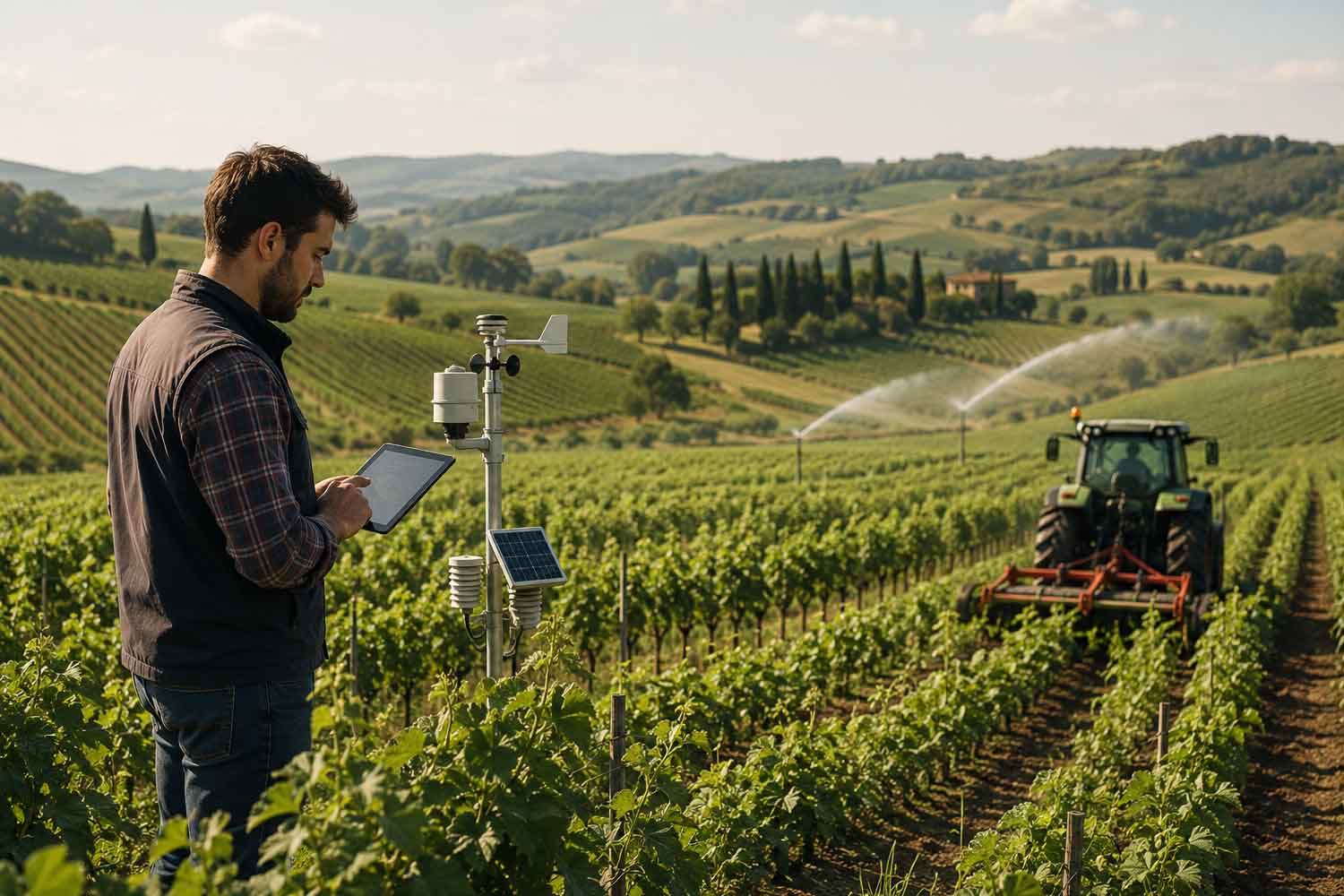
In some Italian fields, innovation is already a budget item, a skill to be sought and a strategy for the coming years. The rest, which is decidedly broader, remains something to be taken into consideration without too much haste. According to Istat’s 2026 annual report, just 18.1% of Italian agricultural companies have now integrated innovation into their corporate vision. 81.9% maintain a more conservative approach.
The data does not only reflect those who have purchased a new machine or adopted agriculture 4.0 technology. Istat has summarized 178 indicators relating to investments, expectations, problems, skills and strategies, integrating the 2024 multipurpose survey on agricultural companies with statistical registers, social security and tax sources. Five types of businesses emerge, from the almost immobile countryside to the one that considers innovation a condition for remaining on the market.
Almost half of companies are still “static”
The definition chosen by Istat does not leave much room for imagination: 49.4% of agricultural companies are “static”. It invests little, rarely uses new technologies and shows a weak propensity to change. Another 32.5% is “evolving”: innovation appears in strategies, but continues to lag behind other priorities. Together, these two groups bring together more than eight out of ten companies.
Then the photograph begins to move. 10.4% of companies are among the “moderate innovators”: they invest in agriculture 4.0 technologies, but are held back by the lack of financial resources or skills. 5% have already introduced specific tools and have entered a consolidation phase. At the top there remains a 2.7% of advanced innovative companies, with investments and strategic orientation much higher than average. They are those that also focus on innovation to improve competitiveness and sustainability in the medium and long term. A small avant-garde, in short. Very small.
This classification undermines the reassuring image of the “return to the land” made up of young entrepreneurs, applications and fields controlled remotely. The transformation exists, and it is already visible. The majority of companies still need to find the money, staff and operational space to support it.
Earth 4.0 needs hectares
Company size makes a huge difference. Innovative companies represent less than 15% of the smallest companies, rising to almost 27% of the medium-sized ones and almost 40% of the large ones. More land and a more solid economic structure evidently make it less risky to invest in technologies, training and new production processes. The crop remains exposed to the weather; at least the cost of innovation can be spread over more hectares.
Multifunctionality also matters. About a third of the companies that, in addition to cultivating or breeding, carry out activities such as product transformation, hospitality or the production of renewable energy are innovators. They are companies that have already expanded their range of action and have to manage more jobs, more skills and more sources of income. The old farm was filled with functions. With them came new systems, new skills and probably several passwords.
The divide also cuts across the territory. In the North, the companies belonging to the three innovative groups exceed 20%, with a particularly large presence of companies in the consolidation phase. According to Istat, this suggests that the processes started earlier than in the Center and the South. In the South and especially in the Islands, the share of advanced innovators is relatively higher, but within still modest overall numbers.
We need people capable of using technology
The change does not just come from the size of the land. In static companies the average age of employees is close to 63; among advanced innovators it drops below 52. The experience gained in the same company also decreases from almost 24 to just over 13 years. Istat reads these data within a mature sector, with still limited generational turnover.
Age, taken alone, explains little. What matters above all is what enters the company together with the people. In static companies, less than 7% of employees carry out qualified functions, including technical and specialized agricultural ones. Among the most advanced companies the share exceeds 25%. Education levels are also growing, although they remain low on average compared to the rest of the economy.
The 4.0 campaign, therefore, requires tractors, systems and digital tools, but also someone capable of choosing the right technology, interpreting the results and inserting it into daily management. Buying a device is relatively simple. Turning it into a useful decision for the company requires expertise that doesn’t come in the same box.
Innovative companies are looking at the harvest with more confidence
The relationship between innovation and future results should be read with caution. Istat does not measure an actual increase in production here: it collects farmers’ expectations. Yet, the distance is considerable. Among moderate innovative companies, 13.5% expect growth in agricultural or livestock production; among advanced ones the share exceeds 20%. In static and evolving companies it remains around 6%.
Innovating does not protect you from drought, hailstorms, low prices or production costs. However, it seems to be associated with a greater ability to imagine development, rather than simply defending what remains. It is a signal about expectations, not the promise of a more abundant harvest.
The survey also includes strategies related to sustainability, water use efficiency and drought management. Agriculture 4.0 described by Istat therefore has a broader scope than simple digitalisation: it concerns the way in which a company organizes resources, people, investments and responses to environmental changes.
The hoe has not disappeared and is unlikely to. Alongside this, capital, skills and a structure capable of absorbing the cost of change are needed. The return to Earth 4.0 has already begun; for now it grows mainly where there are enough hectares and resources to afford it.
