
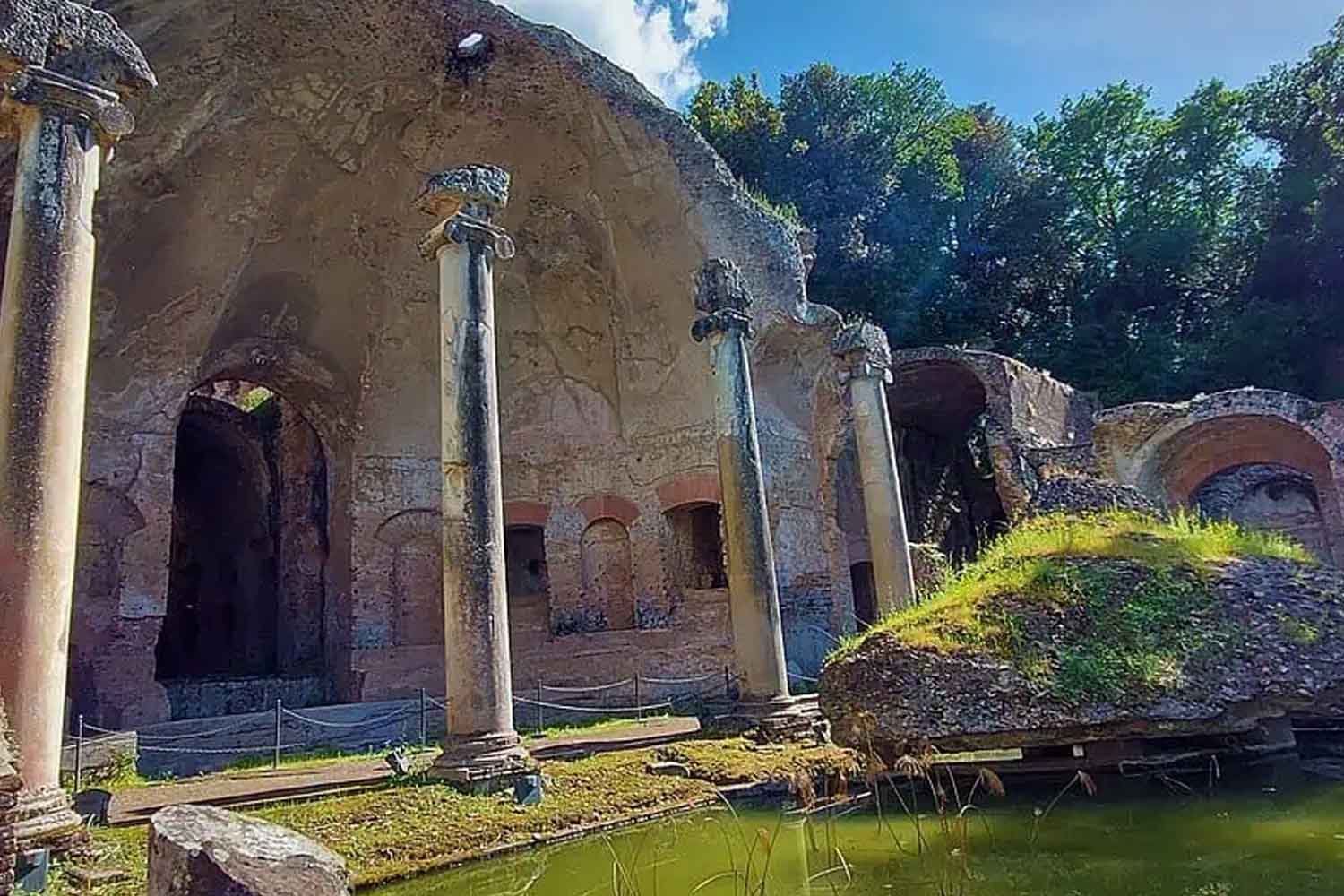
A fragment of concrete taken from the waste collector under the seats of a common latrine in Villa Adriana, a Tivolihas preserved a chemical history that is still in motion for almost 1,900 years. Inside the material, calcite filled pores and tiny fractures, making the structure more compact and contributing to its durability.
The discovery comes from a study published in Science Advances by an international group coordinated by Xiaohong Zhu and Paulo JM Monteiro, civil engineer from the University of California at Berkeley. Hadrian had spas, gardens, pavilions and monumental halls built in his imperial residence. Delivering one of the most useful details about Roman engineering was the bathroom.
Calcite made its way into pores and fractures
The sample came from the western structures of Canopus, the large complex inspired by the Egyptian city inserted into the 2nd century villa. The researchers observed it with three-dimensional X-ray tomography, electron microscopes and spectroscopic analyses, going from fragments visible to the naked eye to structures measurable in nanometers.
The concrete had been prepared by mixing fragments of volcanic lava, pozzolanic material, lime and a rather small quantity of waterwith a ratio between water and binder approximately between 0.4 and 0.45. The original blend, however, only tells part of its longevity. The rest happened later, much later.
Particles of calcium oxide remained in the material which, when they came into contact with humidity and carbon dioxide in the air, produced calcium carbonate, especially in the form of calcite. Crystals grew along the walls of the pores and into the fractures. Some have taken on a fibrous and radial structure, similar to small mineral barbs, progressively narrowing the empty spaces.
This process, called carbonationmade the concrete denser, limited the paths through which water could penetrate and helped close even the finest cracks. In fact, the authors speak of a potential capacity for self-repair: the sample shows the minerals deposited in the fractures, without transforming a Roman latrine into an indestructible material by archaeological decree.
Volcanic ash remains a decisive part of the recipe
The new research expands the traditional explanation of the duration of Roman concrete. Scientists have long known the importance of the pozzolanic reaction: volcanic ash reacts with lime and water to form cement compounds capable of binding the mixture.
Even in the Villa Adriana sample, small quantities of calcium, aluminum and silicon hydrates were found around the volcanic fragments. These compounds strengthened the contact areas between the mortar and the stones, one of the places where weaknesses can develop in concrete.
Calcite, however, occupied a much larger part of the material and was present in the pores and fractures. According to the authors, the carbonation that continued for centuries therefore worked together with pozzolanic reactions: the former filled the spaces left open, the latter consolidated the bonds around the aggregates.
The result links to a previous MIT study published in 2023. In that case the researchers had analyzed the white lumps of lime present in Roman concrete, long considered the result of inaccurate mixing. Experiments showed that they could function as calcium reserves: when water entered a crack, the material partially melted and recrystallized in the crack.
The work on Hadrian’s Villa observes the result of similar processes within a sample that has remained exposed to time for almost two millennia. In short, Roman mortar stopped being fresh; his chemistry kept working.
Modern bridges have an additional problem: steel
Copying the Roman mixture as it is would be of little use. Much contemporary infrastructure uses reinforced concrete, so it contains steel bars. The initially very alkaline environment of the cement protects the metal from corrosion; deep carbonation can lower the pH and promote rust. Corroded steel increases in volume, puts pressure on the surrounding material and can cause new cracks.
The study’s recommendations may be more useful for materials without metallic reinforcement, large massive concrete structures, conservation interventions or new mixtures designed to exploit controlled carbonation. The authors also look at cements with less clinker, the component whose production requires high temperatures and generates a large part of the sector’s emissions.
Times remain the most cumbersome limit. In the Roman sample, mineralization proceeded slowly, while carbon dioxide penetrated the material by diffusion. We are talking about centuries, even millennia: a pace unsuitable for transforming the phenomenon into a quick solution to absorb the emissions of modern buildings.
The study also concerns a sample from a single facility. Roman techniques changed depending on the eras, places, raw materials and the function of the buildings. The latrine of Villa Adriana documents a long-lasting mechanism with unusual precision; it does not provide the universal recipe used in every corner of the Empire.
However, a concrete indication comes from that exhaust manifold: the chemistry of the Roman concrete continued long after installation. Air, moisture and minerals continued the work. Above all time, an ingredient that modern construction sites use with a certain parsimony.
