
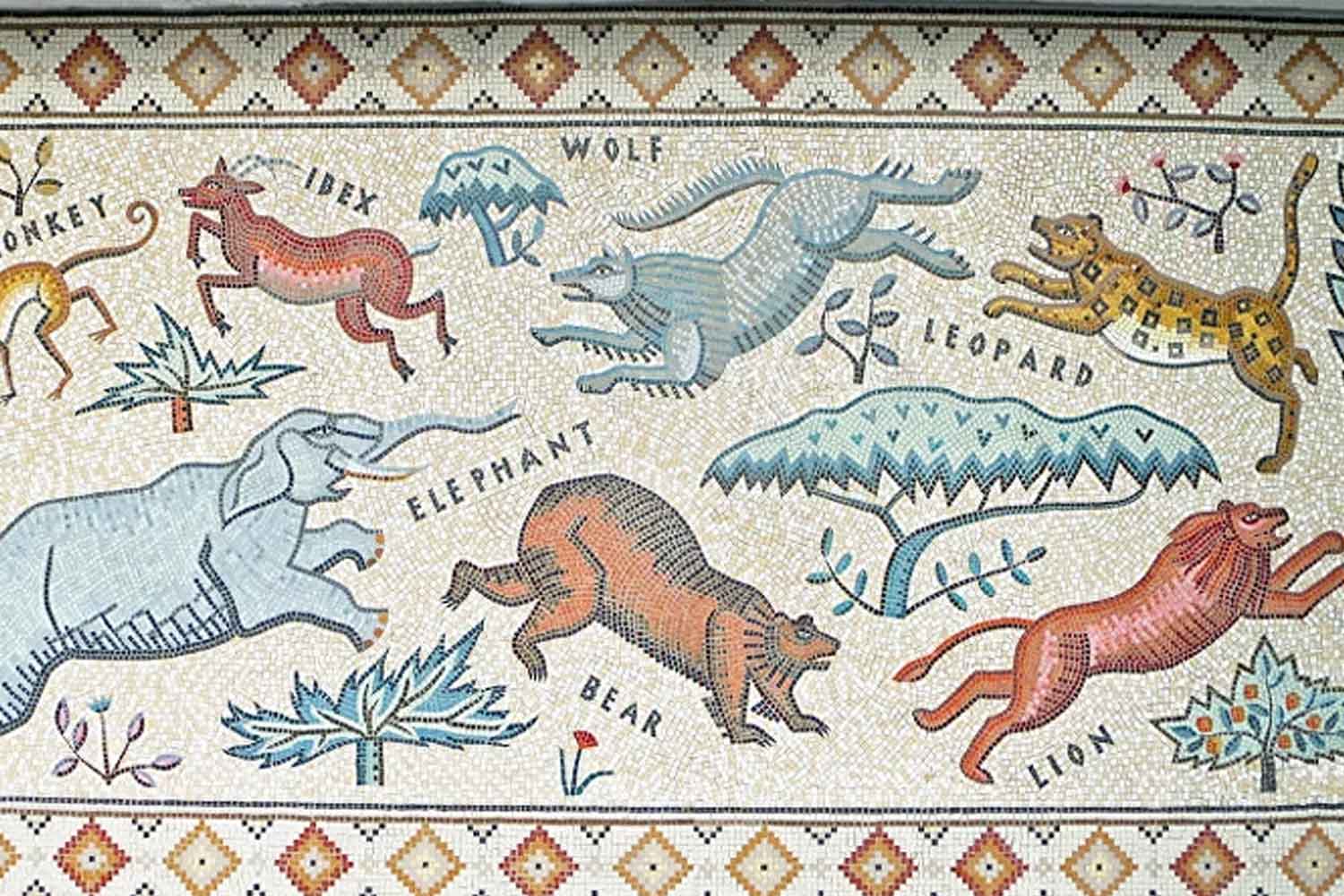
In east London there are corners where it pays to walk slowly. A wall, a bench, a stretch of floor, a brick column: at first glance they seem like simple pieces of the neighborhood, the kind you pass through while thinking about the shopping, the bus, the message left unanswered. Then you get closer and dogs, leaves, flowers, names, animals, mobile phones, details of parks, small scenes of everyday life begin to appear. They are therapeutic mosaics, public works created by different hands, many of which have experienced depression, post-traumatic stress disorder, addictions, mental fatigue. Hands that took broken fragments and put them back in order, one tile at a time.
Behind this work is the Hackney Mosaic Project, founded by Tessa Hunkin, an architect turned artist, now seventy-two years old. It all started with a chance meeting with a mental health recovery group in Westminster. From there came a simple and very concrete intuition: building a mosaic requires slowness, repetition, minute attention. You have to choose the pieces, cut the tiles, arrange glass and ceramic, press each tile into the mortar, stay within a precise gesture long enough to silence, at least for a while, the noise in your head.
For fifteen years that gesture has changed parts of London. The project brought mosaics to parks, alleys, in front of health centres, along canals, on walls and benches. It involved people with very different stories: children running around the tables, neighborhood residents, patients, people recovering from addictions, others struggling with even significant mental health problems. Everyone sitting in the same space, with the same material in front of them and an almost elementary instruction: choose a fragment, find the right point, add it to the others.
A break from your head
@Hackney-mosaic.co.uk/
Those who work with trauma, anxiety or chronic stress know well the weight of circular thoughts. The mind always returns there, to the same point, with the same obstinacy as a badly tuned radio. Something different happens in the mosaic workshops. Attention is captured by a concrete action, almost domestic in its repetition. It resembles embroidery, knitting, certain manual activities capable of creating a stable rhythm. The body remains busy, the eyes follow shapes and colors, the hand chooses, measures, corrects.
Tessa Hunkin described this effect with a very clean image: for those who participate, the mosaic can become a kind of vacation from their mind. A small holiday, of course, without suitcases and postcards, made of glue, tiles and dirty fingers. Yet it works precisely because it produces something visible. The time spent in front of it remains engraved on a wall, on a seat, on a floor. You can see where it went. For many fragile people, this thing weighs a lot: the daily gesture stops evaporating and becomes a trace.
The first important work was born in a hidden corner of Shepherdess Walk, in Hoxton, an area of East London near the City Road. Hackney is one of the London boroughs with the most parks, and precisely that presence of urban greenery has given visual material to many works. The large surfaces of Shepherdess Walk recall the layout of Roman mosaics: walls and floors covered with large compositions, full of details. There are local flora and fauna in different seasons, contemporary scenes, figures with smartphones, references to neighborhood parks. On one column, even the names of the artists and volunteers became part of the work, designed to fit the bricks.
This is perhaps the most beautiful part: the mosaic, by its nature, accepts fracture. It lives on separate, irregular, broken pieces. No piece is enough on its own, none must pretend to be whole. The meaning comes when it is placed next to the others. For those going through depression, trauma, addiction, the image risks seeming too obvious. But in front of those walls it works, because the symbol remains attached to the matter. He doesn’t preach. It’s there.
Benches, dogs and foxes
One of the most recent interventions started in 2023, after the hardest phase of the pandemic, with the aim of also helping healthcare workers and staff at the River Place Health Center to deal with burnout and accumulated tiredness. The center is located in Islington, not far from Essex Road, in an urban area crossed by daily life, clinics, patients, traffic, families. Here a large mural was created with the name of the structure, surrounded by plants and animals: ducks, cats, a fox. Simple details, almost like those of a neighborhood walk, shown on a healthcare wall after years in which hospitals, clinics and medical centers were places of continuous pressure.
In a second phase, the external concrete benches were also transformed. They were grey, functional, not very welcoming objects. Through weekly workshops also open to the center’s patients, they have become colorful seats, covered with floral motifs. More than one hundred local people participated in the work, including people in mental health recovery. The work was inaugurated a year ago and today welcomes those who enter, those who wait, those who stop outside for a few minutes. A bench remains a bench. With the work of a hundred hands on top, however, he changes his posture.
In Hackney Downs Park, however, the project took a more tender and very London turn: the neighborhood dogs. “The Hounds of Hackney Downs” is a large mural composition with fifty portraits of local dogs, all different, all recognizable in their funny seriousness as family pets. Next to it are mosaics dedicated to the park’s wildflowers. Circular benches designed by Hunkin and hand-covered by volunteers also appear in the same space, with lively surfaces that transform concrete and brick into a meeting point.
The work continues elsewhere too. At Canalside Square, along Arlington Avenue, a large circular mosaic with animals has been inserted into the pavement, near the benches and play area next to the canal. In Hoxton, small circular markers have appeared among the cobblestones of the pavements, outside the Shoreditch Library and Hoxton Hall, the neighborhood’s historic theater and cultural centre. They are less flashy interventions, almost signs to be discovered by lowering one’s gaze. And perhaps for this very reason they convey the idea of the project well: care can also be found in a small thing, as long as someone has done it with presence.
The workshops are usually held on Wednesdays and Fridays from 2pm to 5pm, with some alternating Saturday afternoons. This year the organization is going through a more uncertain phase, because the space used in the Pavilion at Hackney Downs could be destined to become a café. This too, in its own way, says something about the fragility of community projects: to stay alive they need places, times, tables, chairs, deposits, keys, permits. Public beauty always has an administrative part, much less poetic than colored tiles.
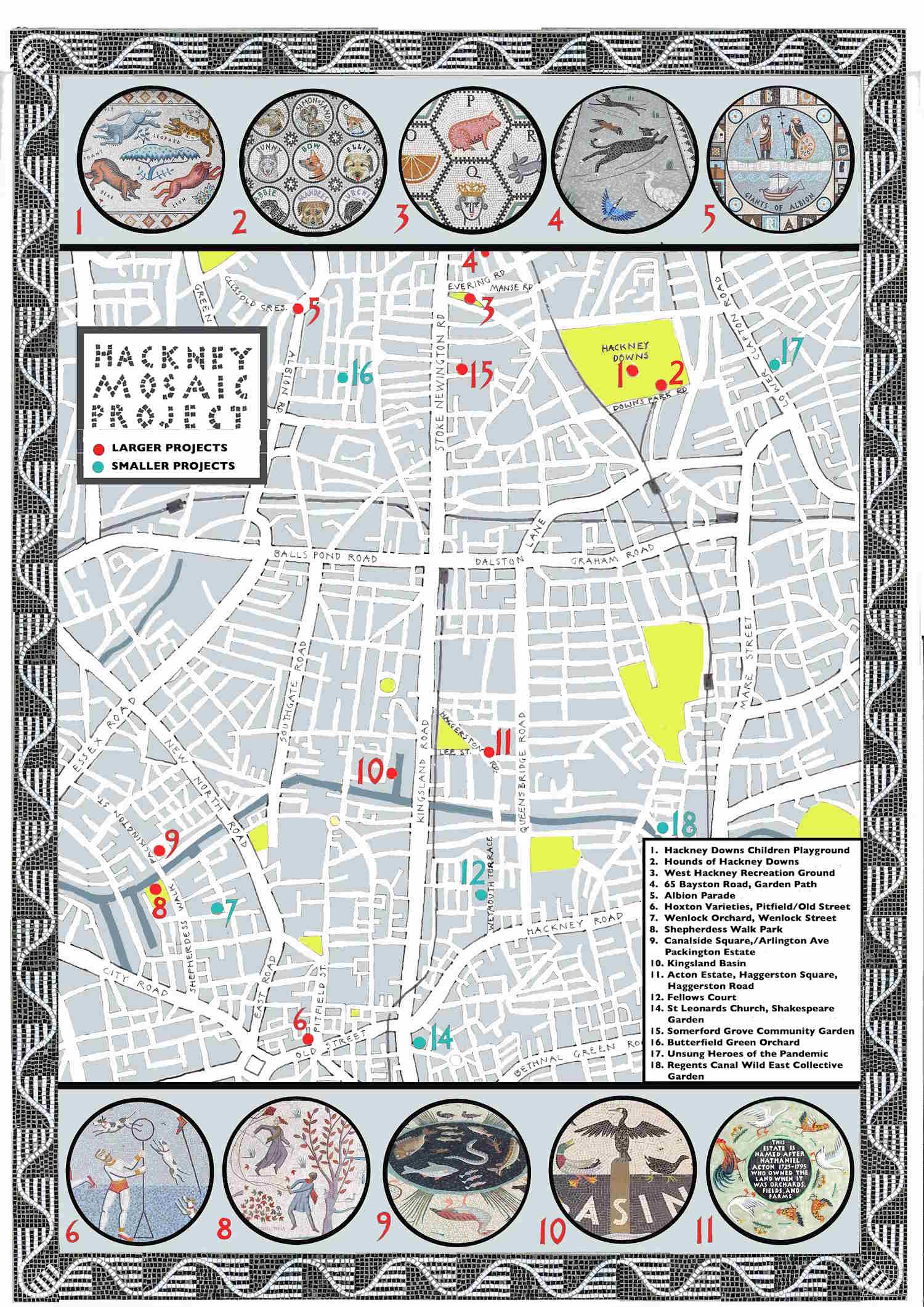
A map of the installations is available on the Hackney Mosaic Project website, useful for those who want to look for them one by one. But the strongest thing remains another: these mosaics are public works and, at the same time, documents of passage. They tell an idea of art that leaves the museum, gets its hands dirty, enters the neighborhoods, works with people who are often told only through diagnoses, fragility, medical records, falls. Here they leave a dog on a wall, a flower on a bench, their name inside a column.
