
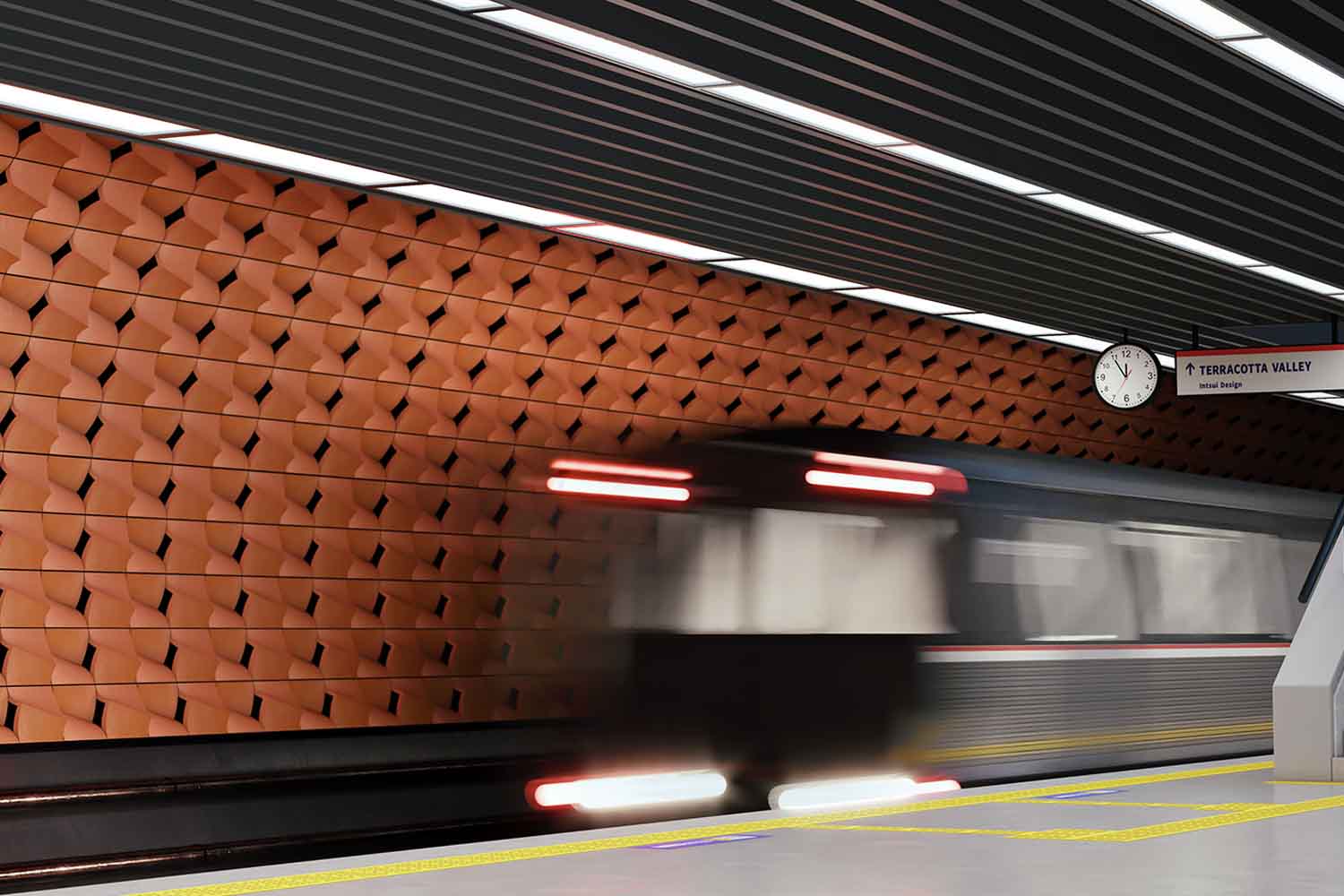
In certain subway stations the heat comes from below, from the walls, from the platforms, from the people crowded together waiting. It arrives even when the day outside still seems manageable. Underground the air changes consistency, stops, takes on the heat of the trains, the systems, the lights, the bodies. Anyone who has waited for a subway in the middle of summer knows that sensation: the noise of the line approaching, the sudden gust, the relief of a few seconds and then the heavy air upon you again.
Terracotta Valley Wind was born from this very concrete scene, a concept designed to transform that gust into something useful. The idea is to use terracotta in the subway as an active surface, capable of absorbing water and slowly releasing it through evaporation, while the wind generated by the trains passes through the modules and brings cooler air towards the platforms. The project, awarded as part of the Red Dot Award: Design Concept 2022, is described as a passive cooling system for the stations during the summer, designed to reduce the use of traditional air conditioning and energy consumption.
The wind is already there
The most interesting part of this system lies in its material simplicity. Each train entering or leaving a station displaces large volumes of air. Usually that wind is perceived as a nuisance, a dirty and hot gust that raises hair, newspapers, fine dust and commuters’ patience. Here it becomes an already available resource. No machine added to produce movement, no energy-intensive mechanism placed on top of a problem already full of consumption. The convoys pass anyway. The project tries to exploit precisely that passage.
The modules are composed of terracotta tiles, steel frames, rubber elements and floating valves. The water remains inside small channels and reaches the ceramic from below by capillarity. Terracotta, porous by nature, slowly distributes it throughout the mass of the material. When the air moved by the trains passes over the surface, the water evaporates and removes heat from the surrounding environment. The expected result is a less warm airflow, directed towards the dock area.
Seen in this way, terracotta ceases to be just a beautiful covering to photograph. It becomes a piece of climate infrastructure, with an almost domestic appearance and a very urban function. In the project images, a station like Santa Eulàlia, in Barcelona, gives a good idea: walls covered with warm, material elements, far from the shiny coldness of many underground surfaces. The practical point remains clear: the material must get wet, breathe, offer surface to the air and let it pass.
Terracotta works slowly
The physical principle is ancient. Evaporation cools because the water, passing into the state of steam, absorbs thermal energy. It’s the same reason why a wet floor seems cooler, or why water and ceramics have always played a specific role in many traditional architectures of hot climates. Here that logic is brought into a metro station, with a modular and controllable design.
The designers also worked on the shape of the tiles. The corrugated surface serves to guide the wind generated by the train and increase the contact area between air and wet material. The combination of positive and negative elements, i.e. modules with complementary reliefs and voids, aims to improve the exchange between heat and cold. Furthermore, the modular structure allows for simpler transport, assembly and replacement, a detail that is much less spectacular than the word “innovation”, but decisive when talking about real public transport.
Maintenance will be the real challenge. A subway station is a tough place: vibrations, dirt, humidity, continuous passages, shocks, cleaning, wear and tear. Such a system must remain accessible, washable and inspectable. It must handle water without creating mold, stagnation or slippery surfaces. It has to work in different conditions, with irregular air flows, varying train frequencies, temperatures that change from one city to another. The beauty of the idea only holds up if its less photogenic part also holds up.
The heat under the ground
European metros, including Italian ones, are well aware of the problem. The older lines were born in times when the urban summer had a different weight, air conditioning was less present and the crowd of passengers followed different rhythms. Today, many stations must absorb more intense heat waves, tourism, commuting, electrical systems and increasingly frequent convoys. A dock can become a small warm room with automatic doors.
The terracotta in the subway speaks precisely to this difficulty: finding less burdensome solutions, capable of helping where air conditioning costs, consumes and often comes with enormous technical complications. The project aims to cool without transforming each station into an even more energy-intensive machine. The conditional remains necessary, because an award-winning concept and a functioning transport network are two different worlds. Tests, balance sheets, certifications, materials, safety, public money and maintenance pass between the rendering and the construction site.
Yet intuition has a concrete force. Instead of just adding devices, work on three elements that are already present or easy to integrate: water, air and ceramic. The subway produces wind with each arrival. Terracotta lets moisture pass through. Evaporation lowers the perceived temperature. Three almost banal things, put together in a place where banality, if it works, is worth its weight in gold.
