
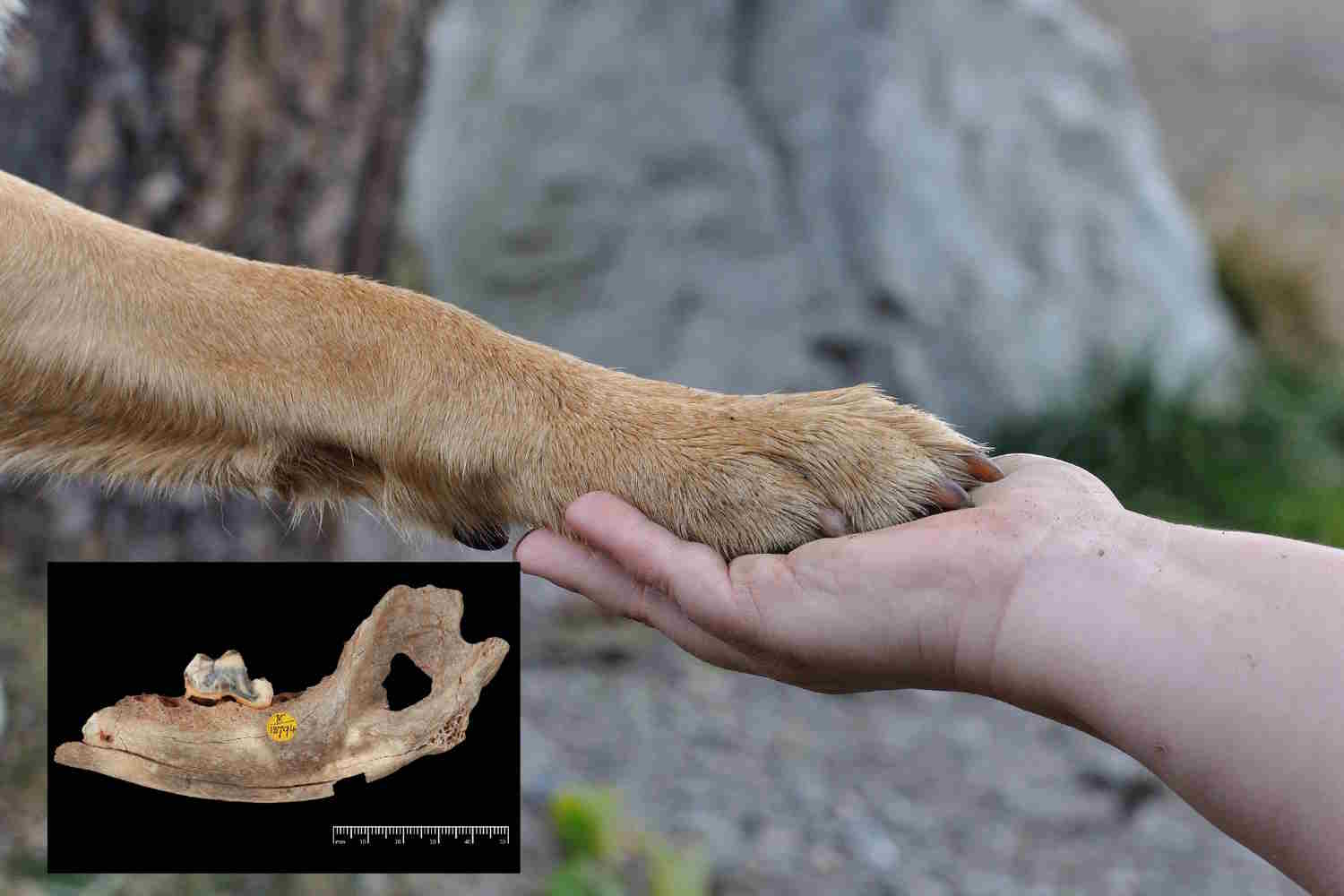
For years those fragments that emerged from caves and rock shelters across half of Eurasia remained hanging in stubborn doubt. Wolf or dog? Same structure, same margins of error, same difficulty in understanding when closeness to human beings had truly become something stable. Now that boundary is tightening a lot. Two studies published on Nature carry genetic proof of prehistoric dogs up to around 15,800 years ago and show that their presence alongside human groups was already well established over 14,000 years ago, at the height of the last ice age.
The jump is made by Ancient DNAwhich does a crucial thing here: it removes the ambiguity of the bones. The researchers analyzed 216 canid remains, mostly Paleolithic and Mesolithic, developing a technique capable of enriching the genetic material and reliably distinguishing dogs and wolves in 141 cases. It is a clear change of pace compared to old attempts based on very small DNA fragments or on the shape of the skeleton alone, a slippery slope when animals at the beginning of domestication resemble each other in almost every way.
Ancient DNA today forces us to move history back millennia
The find that really moves the clock comes from Pınarbaşı, in central Anatolia, in what is now Türkiye: around 15,800 years ago. Immediately afterwards, the mandible from Gough’s Cave, in English Somerset, appears, dated to around 14,300 years ago. At that point the picture stops seeming episodic. Remains attributable to dogs also emerge in Switzerland, Germany and Italy, a sign of an already widespread diffusion in western Eurasia long before cultivated fields, stable villages and any other animal domestication.
The most fascinating part of the work lies in the compactness of that ancient canine population. The dogs from Pınarbaşı and Gough’s Cave, although found at the eastern and western extremes of the studied area, are genetically very similar. According to the authors they belonged to a population that spread between approximately 18,500 and 14,000 years ago. And they lived alongside very different human groups, from the Magdalenians to the Epigravettians to the Anatolian hunter-gatherers. Men followed distinct cultural and genetic trajectories, while dogs also circulated between separate communities. Someone exchanged them, took them with them, recognized them as a precious resource.
This detail weighs a lot, because it tells a story that is more mobile and more concrete than the one imagined so far. The dog does not appear as a marginal presence on the edge of the scene. It enters into people’s movements, into contact networks, perhaps even into the passages of trust between groups that mixed their genes little. In practice, the dog traveled well even where humans remained further away from each other.
That dog already occupied a specific space within the community
©Nature
Coexistence also emerges from food, which often says more than words. In Pınarbaşı, isotopic analyzes show dogs having a diet rich in fish, very close to that of humans present in the same site. The authors explain it with caution, but the meaning remains very clear: those dogs received food from people. At Gough’s Cave the isotopic profile places dogs and humans on comparable dietary levels, with a similar omnivorous diet. Here the closeness stops seeming occasional and takes the form of a shared everyday life. They lived togetherand it shows.
But there’s more. At Gough’s Cave the dog remains show post-mortem changes similar to those observed on human remains at the site. In Pınarbaşı, young and newborn dogs were buried in the same area as contemporary human burials. All scientific caution remains necessary here, but the message gets through anyway: the dog already had a symbolic, emotional or ritual weight within those communities. He wasn’t off the field. It was within their order of things.
Before the cultivated fields there was already the dog
There is another element that broadens the scope of the discussion. The dog stays the only animal domesticated before agriculture. This precedence makes it special, because its history runs alongside that of hunter-gatherers and then crosses the great change of pace of the Neolithic. This is also seen in the genetic material studied by the authors: European Mesolithic dogs contributed substantially to Neolithic dogs and, in all likelihood, to a part of modern European dogs. There has been the arrival of new ancestries from south-western Asia, but with a smaller weight than that observed in humans.
The beauty of this discovery also lies in the questions it leaves open. The precise place of domestication continues to elude us, and the path by which dogs spread remains a hotbed of research. But one thing is clear now. Already 14,200 years ago, with the Kesslerloch dog in Switzerland, the genetic differentiation of European dogs was underway. The process had started earlier, had already picked up speed, had already built deep lines.
For years the original dog remained a blurry silhouette, almost an animal seen from behind in the smoke of a cave. Today that figure takes on clearer contours: before the barns, someone had already made room for a dog.
