
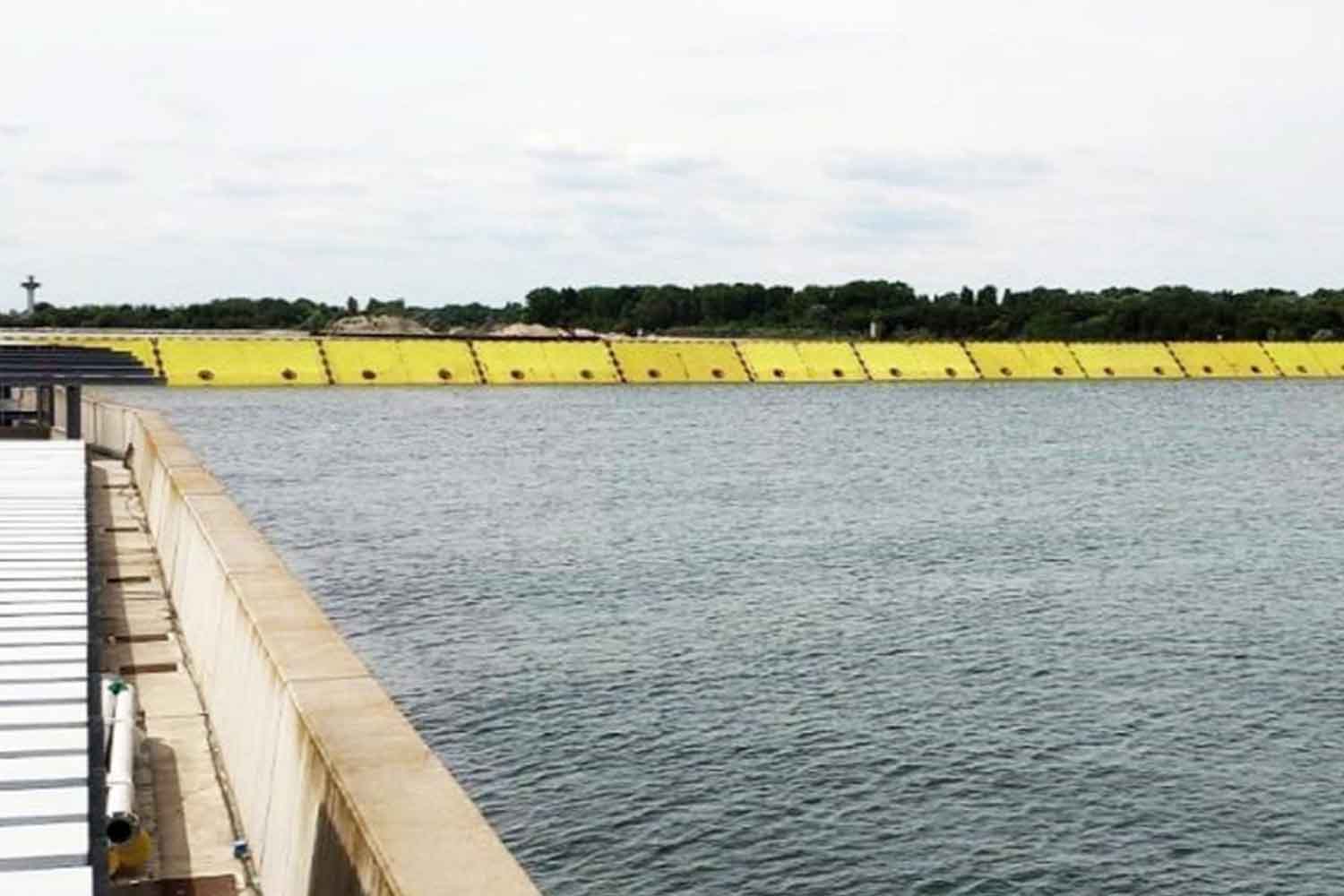
The floodgates rise, high water stays out and Venice remains dry. At the same time, the lagoon’s salt marshes receive less water and, above all, less sediment: the material that allows them to grow upwards as sea levels continue to rise. A new study published in Nature Water reconstructed through numerical models all 69 closures of the MOSE that occurred between 2020 and 2023. According to the simulations, around twenty could have been avoided without exceeding the safety thresholds set for Venice, Burano and Chioggia. The overall duration of the closures was also, on average, more than double that which was strictly necessary.
The research was coordinated by the Department of Geosciences of the University of Padua, with the participation of other departments of the university, ISPRA and the University of Southampton. The MOSE works and the study confirms it: the mobile barriers effectively reduce the risk of flooding in residential areas. The environmental bill emerges from the repeated and prudent use of flood gates, in a lagoon already poor in sediment and profoundly modified by centuries of human intervention.
When there is no water, the salt marshes also lack land
The salt marshes are those low expanses, crossed by channels and covered with salt-resistant vegetation, which emerge and disappear following the tides. They look like pieces of earth placed there with a certain distraction. Instead, they do quite serious work: they provide habitat for numerous species, store carbon, attenuate waves and currents and contribute to the stability of the entire lagoon.
To survive they must be periodically submerged. During storm surges, the water carries silt and other fine materials onto their surfaces. Layer after layer, these sediments allow the salt marshes to gain altitude and to accompany, at least in part, the rise of the sea.
The closures of the MOSE interrupt precisely this passage at the most important moments. Compared to the hypothetical scenario with the port inlets always open, the management adopted between 2020 and 2023 reduced the salt marsh surface reached by the water on average by 27.5%. In some events the decrease exceeded 75%. The average flood depth dropped by about 45%.
The researchers linked this data to a relationship between water depth and sedimentation already calibrated in the field in the Venetian lagoon. The simulations estimate a 32% reduction in sediment accumulation, equivalent to about 2.6 millimeters less vertical growth of salt marshes each year.
They are estimates obtained through hydrodynamic models, not direct measurements of every grain deposited during each closure. The model, however, was compared with observed water levels and uses an empirical relationship developed specifically for the Venice lagoon. Caution changes the weight of the number, not the direction of the phenomenon.
Those millimeters become particularly uncomfortable next to another fact: in the Venice area the relative sea level is rising by around 4-5 millimeters per year. A salt marsh that receives less sediment loses some of its ability to keep up. The problem is measured over decades, when millimeters stop seeming harmless.
Twenty out of 69 closures could have been avoided
The authors compared three scenarios. In the first, the mouths of the lagoon always remain open. In the second, the MOSE is operated as it actually happened between 2020 and 2023. In the third, AThOS comes into play, an adaptive strategy that calculates the opening and closing of the floodgates considering the safety thresholds of the different lagoon centres, the wind, the rainfall, the river outflow and the infiltrations through the barriers.
Applied retrospectively to the 69 events, AThOS would have avoided approximately 30% of closures. The salt marsh surface saved from flooding would have decreased by just 2.9%, compared to the 27.5% recorded in the real scenario. Sedimentation would have increased by 19% compared to actual management, recovering on average about 1.3 millimeters per year of vertical growth. Venice, Burano and Chioggia would have remained under the respective safety thresholds envisaged by the model.
The proposal therefore concerns management: fewer avoidable closures and flood gates raised for the necessary time. An apparently small difference, given that the MOSE remains active overall for only 1-2% of the year. The storm surges concentrated in those hours, however, transport a significant portion of the sediments that the salt marshes need. The calendar says a few days; the lagoon considers them working days.
The simulations know the past, those who manage the MOSE must predict the future
AThOS was tested with the benefit of hindsight: the researchers already knew water levels, wind and the progress of each event. The daily management of the MOSE must instead rely on forecasts, which can be wrong and require safety margins. A sudden change in wind is enough to move the water inside the lagoon, with different effects between Venice, Burano and Chioggia.
The study recognizes this limitation. In real operations some closures may need to start earlier or end later than the simulated ideal setup. However, the authors point to concrete tools to reduce uncertainty: better weather forecasts, comparisons between multiple models and data on water levels acquired in real time.
Even the management of the barriers, according to coordinator Andrea D’Alpaos, has already evolved with the experience accumulated in the first years. The results cover the initial period, from 2020 to 2023, and do not automatically capture every subsequent decision. However, they offer a measure of the available margin and the price paid by salt marshes when prudence is prolonged beyond what is necessary.
As the sea rises, the MOSE will be called upon to rise more and more often. Each closure defends stones, houses, shops and daily lives; every hour it takes away a part of its natural breath from the lagoon. Keeping Venice out of the water without leaving the salt marshes behind will require greater precision. The floodgates already know how to go up. Now it’s time to learn when to let them go down.
