
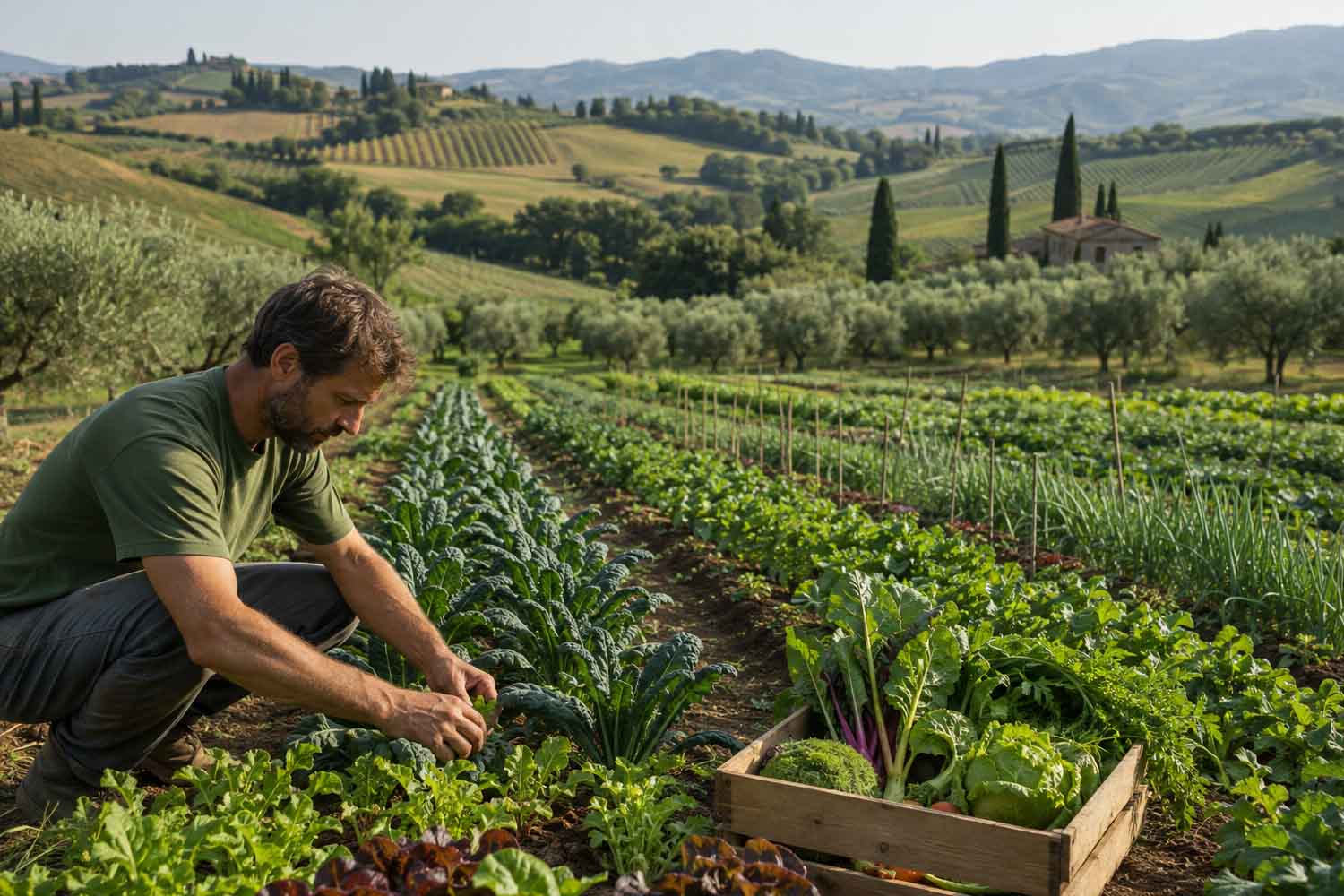
Out of one hundred hectares cultivated in Italy, just over twenty are now organic. In 2024, organic agriculture reached 20.5% of the used agricultural area, gaining 0.7 percentage points in one year and exceeding the 20% threshold for the first time. The data comes from SDGs Report 2026 of Istat, which places Italy among the European countries with the highest incidence of organic cultivation.
In the same sector, however, a much less reassuring number is growing. In 2023, the latest year available, non-regular workers in agriculture, forestry and fishing were 20.8% of the total: more than double the 10% estimated for the entire economy. The two data refer to different years and describe distinct phenomena, yet they almost end up mirroring each other: one hectare in five is organic, one worker in five is irregular.
Organic grows especially in the Center and the South
The spread of organic soils changes a lot along the Peninsula. In the Center it affects 27.7% of the agricultural area, although the share has decreased by almost two points compared to 2023. In the South it reaches 26.6%, with an increase of 2.5 points in twelve months.
The regional record belongs to the Aosta Valley, where organic farming covers 52.7% of the used agricultural area. Tuscany, Campania and Calabria are between 30 and 40%. The map published by Istat, however, shows decidedly lower percentages in much of the North, especially in areas where agriculture is more intensive.
Exceeding 20% has a concrete, as well as symbolic, value. The European Union aims to convert at least 25% of EU agricultural land to organic farming by 2030. It is an overall European objective, therefore not a mandatory quota assigned to each country. With 20.5%, Italy has covered a good part of the distance. The last five points, as is often the case, may be the least likely to move on their own. The European objective is contained in the Action Plan for organic production.
Being organic is not enough to measure sustainability
The biological surface is an important indicator, but it does not in itself summarize the environmental impact of agriculture. The certification concerns a precise production method; sustainability also includes water consumption, soil protection, use of fertilizers and pesticides, emissions, biodiversity and waste management.
To measure these aspects, in 2025 Istat conducted for the first time a multipurpose survey on over 42 thousand agricultural companies, then reporting the results to the universe of approximately 1.1 million active companies in 2024. Nine environmental practices were considered, built on the themes indicated by the FAO for monitoring sustainable agriculture.
70.3% of the Italian agricultural area is managed by companies that adopt at least one of the practices examined. However, the share run by companies classified as highly sustainable stops at 6%. Size also makes the difference: among companies with more than 50 hectares, the surfaces associated with at least one sustainable practice reach 80%; among those up to ten hectares they drop to 58.6%.
The most widespread actions are the reduction of the use of chemical pesticides and fertilizers, adopted by companies that manage just under 45% of the agricultural area. Strategies to use water better stop at 14.9%; The carbon farmingthat is, the set of practices designed to retain more carbon in the soil and in crops, reaches just 4.1%. The organic grows, while other pieces of the transition proceed with decidedly heavier shoes.
One in five agricultural workers remains irregular
On the labor front, the SDGs Report records a setback. In 2023, the share of non-regular workers in the agricultural sector rose to 20.8%, increasing by 0.6 points compared to the previous year after the slight decline observed in the two-year period 2021-2022.
In the South the rate reaches 27.9%, with a maximum of 33.3% in Sicily. In the last decade the most marked worsening occurred in the Centre, where the incidence went from 15% in 2013 to 18.4% in 2023. In Lazio it exceeds 30%. They are percentages that include work carried out without complete compliance with tax, social security or contractual obligations and which cannot be automatically superimposed on cases of gangmastering alone.
Favorable signals are also arriving from other environmental indicators. In 2024, ammonia emissions from agriculture decreased by 6.1% and fertilizer distribution was reduced by approximately 10%. In the same year, the quantity of plant protection products distributed increased by 1%, even if the trend observed in the medium term remains slowly decreasing.
Italy has therefore exceeded a threshold never reached before: 20.5% of the agricultural surface is cultivated organically. However, the other 20% remains in the fields, that of irregular workers. Two almost identical percentages, with very little to celebrate in the second.
