
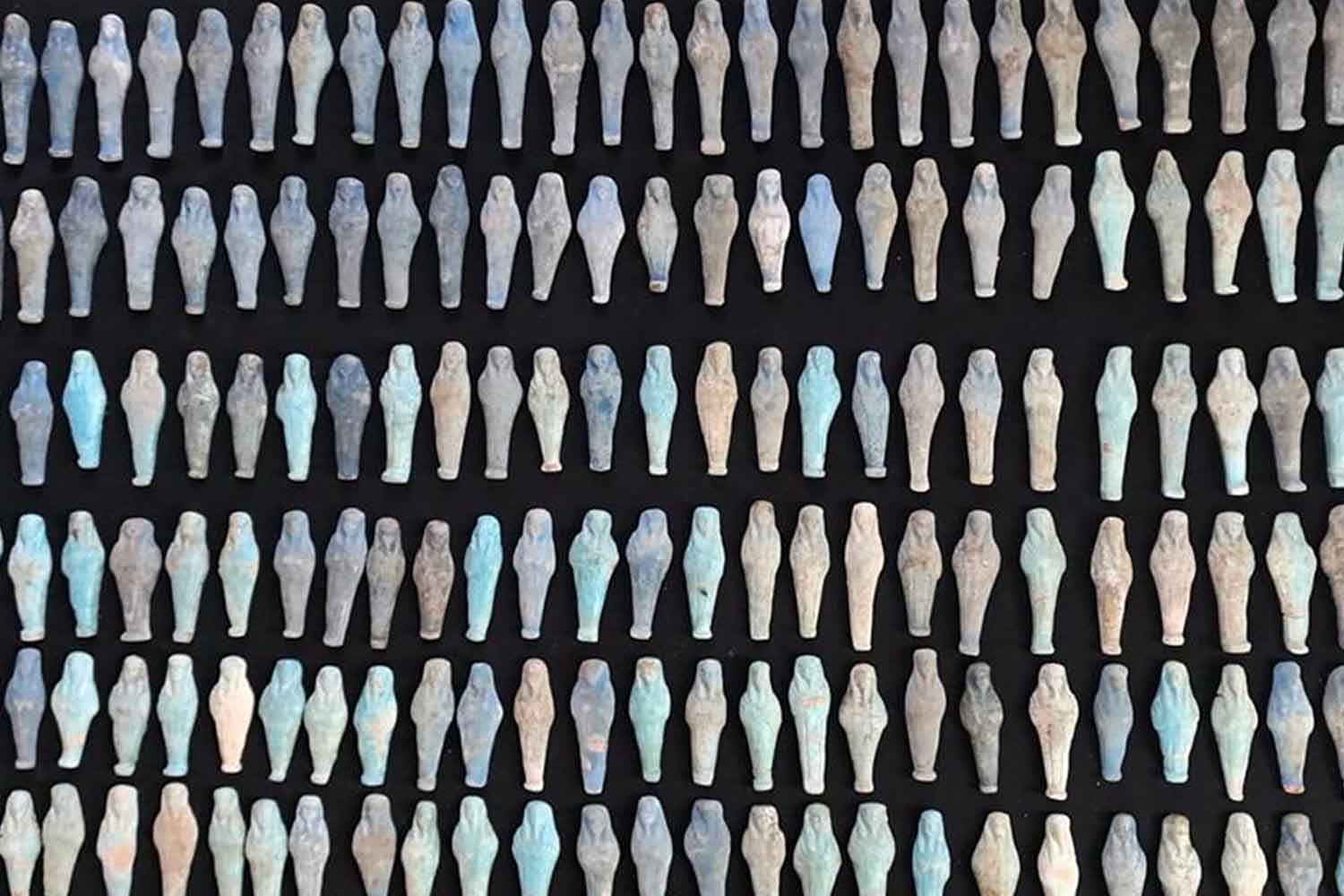
One plate under the crossed arms, another between the thighs. A little further on, inside a single burial chamber, 560 small faience figures they were still waiting to get to work in place of the dead. This is how the new funerary unit discovered in the necropolis of Tell Quesnain the Nile Delta. No history of Egypt to be rewritten overnight: the find adds something more useful, very concrete details about the funerary rituals and exchanges that linked this area to the Mediterranean.
The excavation is led by an Egyptian mission of the Supreme Council of Antiquities in the governorate of Menoufia, north of Cairo. Archaeologists have identified a main hall connected to several chambers through still preserved vaulted entrances. The rooms must also have had vaulted roofs: enough for scholars to reconstruct at least part of the original shape of the complex. The discovery was announced by the Egyptian Ministry of Tourism and Antiquities.
Inside the rooms several human burials were found, preserved in different conditions and arranged in the so-called Osiriac position, with arms crossed over the body. The Ministry connects the complex and its finds to the Late Period and Greco-Roman erawithout yet providing a precise dating for each deposition. The names of the deceased are also missing. The tomb yielded a lot, but not the captions.
The afterlife staff was numerous
In one of the rooms there were two large groups made up altogether of 560 ushabti. The statuettes, different in shape and size, reproduce the mummiform body associated with Osiris; some retain inscriptions taken from Book of the Dead. They are made of faience, a glassy material widely used in ancient Egypt and often recognizable by its blue or green shades.
The ushabti had a specific task: to replace the owner of the tomb if, in the afterlife, he was called to cultivate fields, irrigate the land or carry out other manual labor. Chapter 6 of Book of the Deadengraved on many specimens, served precisely to summon them. An otherworldly workforce ready for the call, without holidays or negotiations. The Metropolitan Museum of Art preserves several ushabti inscribed with this formula and describes their function as substitutes for the deceased.
Alongside the statuettes, amulets made from semi-precious stones emerged: a finger, the Eye wedjatalso known as the Eye of Horus, the Knot of Isis and small images of Egyptian deities. Objects related to protection, strength and rebirth. Archaeologists also recovered large quantities of blue and green faience beads, probably belonging to a net or funerary covering placed over one of the bodies. The original layout will have to be reconstructed.
©Ministry Tourism Antiquities
One plate under the arms, the other between the thighs
Among bowls, containers and two lamps, some ceramics had been placed directly on the tombs. A plate lay beneath the crossed arms of a body; a second had been placed between the thighs. The director of the mission, Nermin El-Morsi, defined these depositions as unusual funerary phenomena for the Tell Quesna necropolis and still under study.
Some containers retain residues of substances that may have been used during mummification or in rituals related to burial. At the moment this is a hypothesis put forward by archaeologists, awaiting analysis. Giving those plates a precise function immediately would make the scene tidier, with the small inconvenience of adding something to the tomb that the excavations have not yet revealed.
A vase from Rhodes also arrived inside the tomb
Among the local ceramics appears an object that has traveled much further: part of the handle of a container imported from the Greek island of Rhodeson which the manufacturer’s name is still legible. It is a material testimony of the commercial relations between Egypt and the Mediterranean during the Late Period and the Greco-Roman age.
A single fragment is not enough to design an entire route. However, it shows that Tell Quesna participated in exchange networks capable of bringing goods, containers and people from the eastern Mediterranean to the Delta. An object born hundreds of kilometers away had arrived in a private tomb, destined to accompany someone who should never have to travel again.
The Tell Quesna necropolis, discovered in 1991, contains funerary units belonging to later periods and is one of the main sites for the study of private burials in the central Delta. The excavations just announced still leave open the dating of the individual depositions, the identity of the deceased and the nature of the residues found in the vases.
