
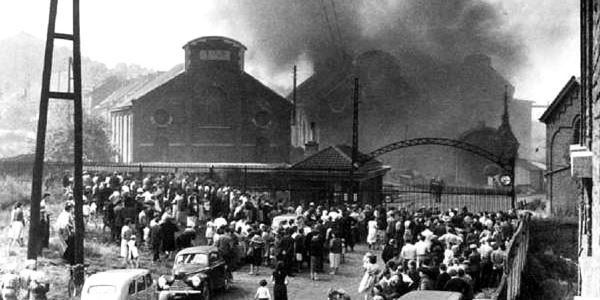
That 8 August 1956, on one of the rare sunny days at the Bois du Cazier, the old mine in the Charleroi district in Belgium, an accident almost a thousand meters deep sparked a terrible fire among the tunnels and tunnels.
262 people died, of which 136 Italians. Only 38 survived. On the anniversary of the massacre, the ringing of the bells, one for each victim, recalls this tragedy, defined by the President of the Republic Sergio Mattarella
symbol of the suffering and the courage and self-sacrifice of our fellow citizens who fought – through hard work – to lift themselves and their families from the devastation of the Second World War. I hope that the memory will be an incentive to improve safety conditions at work
The story of the miners was that of young immigrants of 12 different nationalities, who arrived from all over Europe in search of work. They had found it in that coal mine in Charleroi, hard and exhausting work, which however allowed their families to survive.
But at dawn on August 8, the sun was obscured by black smoke, cutting short the lives of those men far from home and housed in dilapidated barracks used in the past for prisoners of war.
“Rethinking how we were and lived strengthens our determination to welcome with a spirit of solidarity those who today are forced to migrate and have the right to international protection – said the former president of the Senate Pietro Grasso some time ago, at the site of the tragedy. – It is our duty to reduce the inequalities and marginalization that make our societies more vulnerable to fundamentalism and illegality. We owe the recognition of rights and guarantees to all workers in the European Union to the sacrifice of those men in Marcinelle. This is a place of pain, but increasingly also of hope because the process of European integration began here too, producing freedom and rights, ensuring the dignity and security of work as one of its main objectives”
According to reconstructions, the Marcinelle accident was due to carelessness: the lift had started at the wrong time, breaking the oil pipes, compressed air pipes and electrical cables, and causing the terrible underground fire. Added to this are slow rescue operations and practically non-existent escape routes.
Beyond the damage, however, there was also the insult, after the tragedy: the three trials sentenced the director of the mine to six months’ probation, while for the administrators and engineers responsible for the negligence and poor maintenance of the plants, as well as the inhumane exploitation of the workers, there was no punishment.
An interesting glimpse that documents the condition of emigrant miners is given by Déjà s’envole la fleur maigre, one of the best neorealistic films that tells of the cruelty of emigration and the eternal lie of social integration, exploitation, shame and continuous stigmatization.
The Belgian director Paul Meyer describes the terrible story of a worker forced to go to bed with her boss in the twenty merciless minutes of Klinkaart, that of a 17-year-old boy who dreams of returning home, of Italians often the object of ridicule (called black faces) and marginalization.
And seeing those faces again, of non-professional actors, we cannot help but remember that until recently we were the emigrants.
