
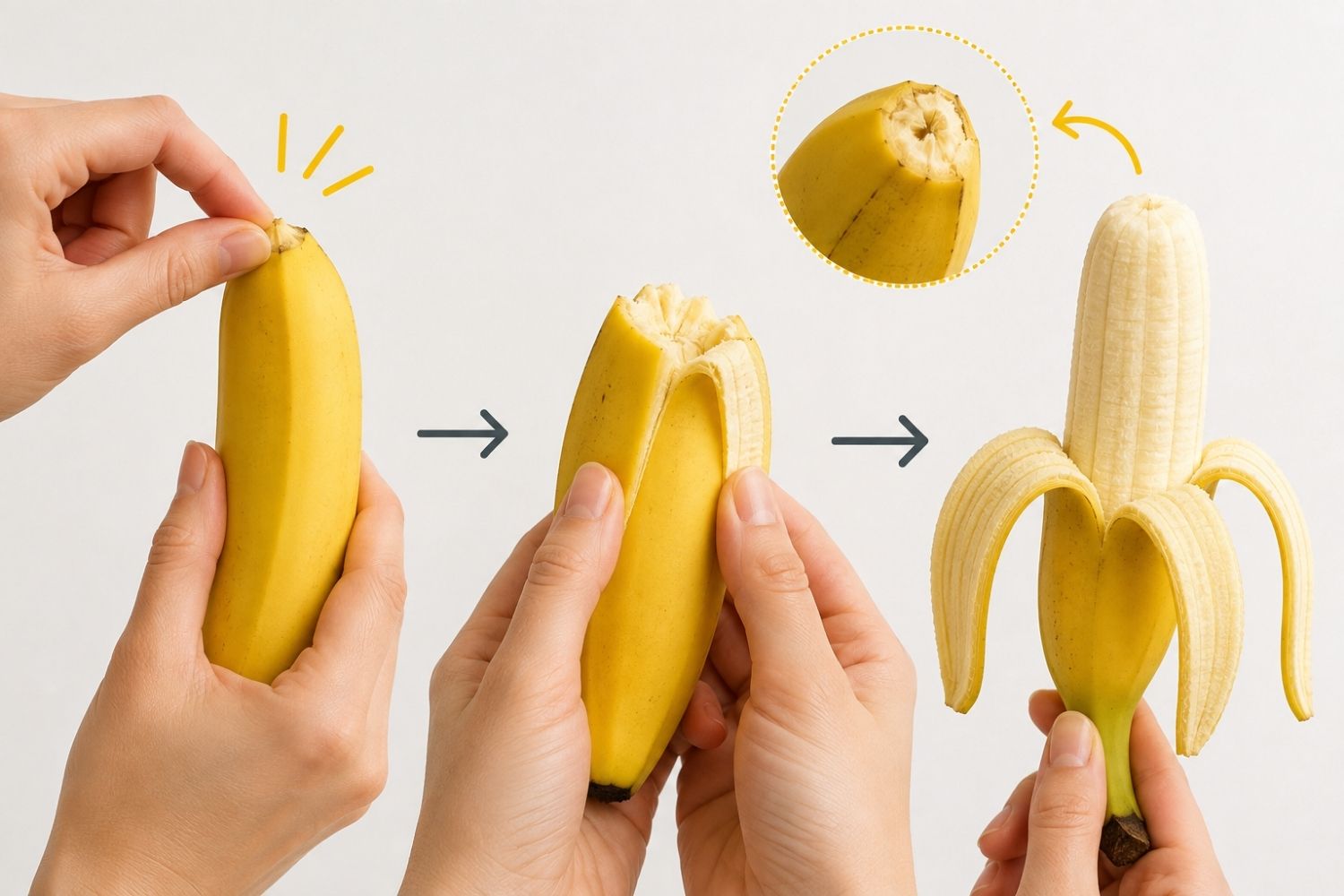
There is a small daily gesture that, it seems, most people do in the least efficient way possible. Taking a banana, grabbing the stem and pulling can result in a fruit that is a little bruised in the upper part, the part that is tightened to open the peel. For years, however, an alternative presented as the primate trick has been circulating online, in which you have to turn the banana upside down and open it from the other end, the rounded one without the stem.
How it works, in practice
The procedure is clearly described in a guide written by the American magazine The Kitchn: you need to turn the fruit upside down, identify the small tip at the end opposite the stalk and “pinch” it between thumb and forefinger. The peel is divided cleanly, without the need for force, and from there it comes off with the same ease as always. The stalk, at that point, becomes useful as a handle for holding the fruit while eating it. That it is more comfortable, in fact, is advocated by various sources, such as the British magazine Discover Wildlife, which observes that, once ripe, this end comes off with much less resistance than the petiole.
Does the “monkey method” really exist?
Here, however, the story becomes complicated, and it is worth telling it to the end. The label “monkey method” comes from the various videos of primates in captivity, taken from zoos and recovery centers and then becoming viral videos, which open the bananas starting from the end opposite the stem. The problem is that, in nature, this comparison makes little sense: interviewed by the scientific site IFLScience, primatologist Katharine Milton, professor at the University of California at Berkeley and expert in primate food ecology, defined the alleged link between wild monkeys and bananas as a “total invention”, because the cultivated banana we know is a domesticated plant that primates never encounter in the wild, except near human settlements. In short, the monkeys who peel bananas backwards do so because someone hands them to them, not because it is a habit. The fact remains, observed by multiple independent sources, that specimens captured in captivity actually open the fruit on that side. It is not an ancestral custom, therefore, but it is still an observed and documented behavior.
And what about the “less crushed” effect?
However, there are no specific studies comparing the two peeling techniques regarding whether this method reduces dents. There is academic research on the susceptibility of banana peel to impacts (such as the study published on Postharvest Biology and Technology who measured with a pendulum the energy needed to produce a visible dent) but they mainly concern falls and post-harvest transport phases, not the pressure of the fingers during breakfast. No one, evidently, has yet deemed it necessary to finance a comparative study on the two peeling techniques, and it is a real shame. Therefore, as there is no scientific evidence on this particular aspect, the doubt remains and it will be up to you, using an empirical method, to verify which of the two is actually the best.
