
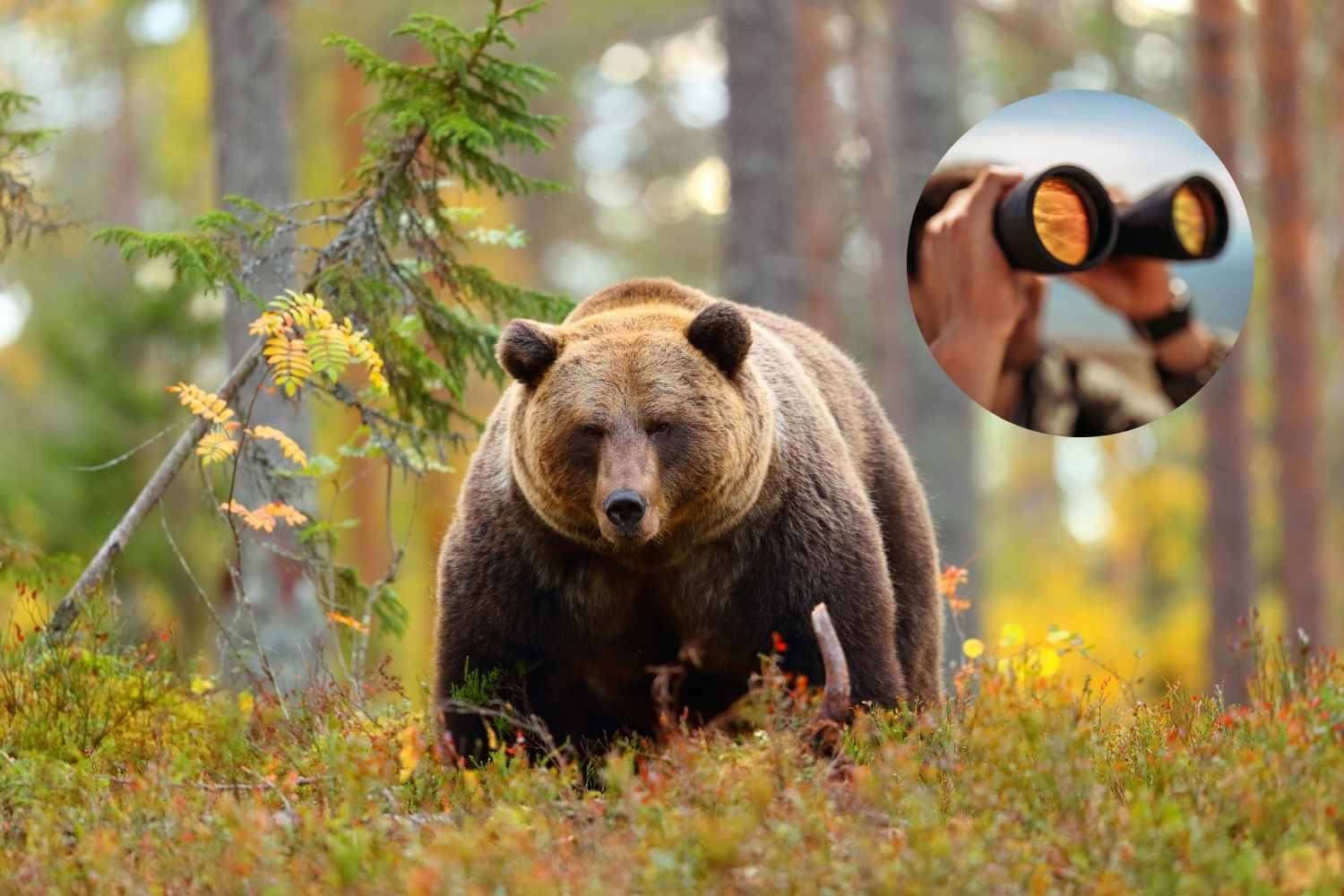
In the 1980s, when Lipu began to bring to Italy a word that no one could yet pronounce, birdwatching seemed like an Anglo-Saxon eccentricity. It only took a few years for bird watching to become a structured activity, with guides, courses, and an entire community of enthusiasts who get up at dawn to observe herons and storks. Today something similar happens with another animal, much bulkier, called the brown bear. In Trentino it is possible to organize two-day excursions, with a backpack on your shoulder and binoculars around your neck, with the declared objective, and almost never achieved, of seeing at least one.
A parallel that holds true
Bear watching borrows the pattern of birdwatching, made up of small groups, guides with proven experience, precise observation points and no close contact. With bears, obviously, the safety distances must change radically, because the stakes are too high: disturb a finch and it will fly away, do the same with a bear and maybe you will have some difficulty telling it. The excursions are carried out in the valleys where the presence of the species is documented (such as the Val d’Ambiez, the heart of the Brenta group and one of the most popular areas) and include overnight stays in refuges, warning signs at the entrance to the paths and a strict ban on leaving the group.
Because there are bears in Trentino
The presence of the brown bear in the central Alps is due to the policies implemented over time for its protection. In the nineties the local population was reduced to just three specimens, on the brink of extinction, therefore, between 1999 and 2002 the Adamello Brenta Natural Park, together with the Autonomous Province of Trento and the National Institute for Wildlife, released 9 bears (6 females and 3 males) from Slovenia as part of the Life Ursus project, financed by the European Union. The declared objective was to reach, in twenty or forty years, a self-sufficient population of 40-50 individuals. The challenge was won and today that goal has been largely exceeded: according to the 2025 Large Carnivore Report, edited by the Provincial Forestry and Wildlife Service, 118 bear specimens live in Trentino and the surrounding areas, with a confidence interval between 99 and 141. The daily management of the species, including the removal of individuals deemed dangerous, follows the rules of PACOBACE, the interregional action plan adopted by Trento, Bolzano and from the neighboring Alpine regions under the supervision of the Ministry of the Environment and ISPRA.
The rules for observing bears
Whoever organizes these outings repeats it like a mantra: bear watching is done in small groups, always with a guide who knows the area, never on your own. The logic is the same as for any close encounter with the animal, so distances must be maintained, one’s presence must be signaled by voice and one must never approach a female with puppies.
The Autonomous Province of Trento has published a real handbook of behavior for those who move in the mountains in these areas, from the basic rules (never run, do not leave food in the backpack) to those for the most critical situations. For all those who would like to hunt for shots with the help of a drone we have bad news: avoid, because you would only risk a fine, according to the dictates of Law 394/1991 (“Framework law on protected areas”, article 11, paragraph 3, letter h). Wildlife must be observed, not chased, and the Trentino forestry department does not give discounts to those who forget this.
A tourism that promises nothing
There is a substantial difference compared to plains birdwatching, where sightings are almost guaranteed, because in this case the bear, if it doesn’t want to be seen, simply… won’t be seen. An aspect well known by the guides and which is always communicated before departure to immediately make things clear.
