
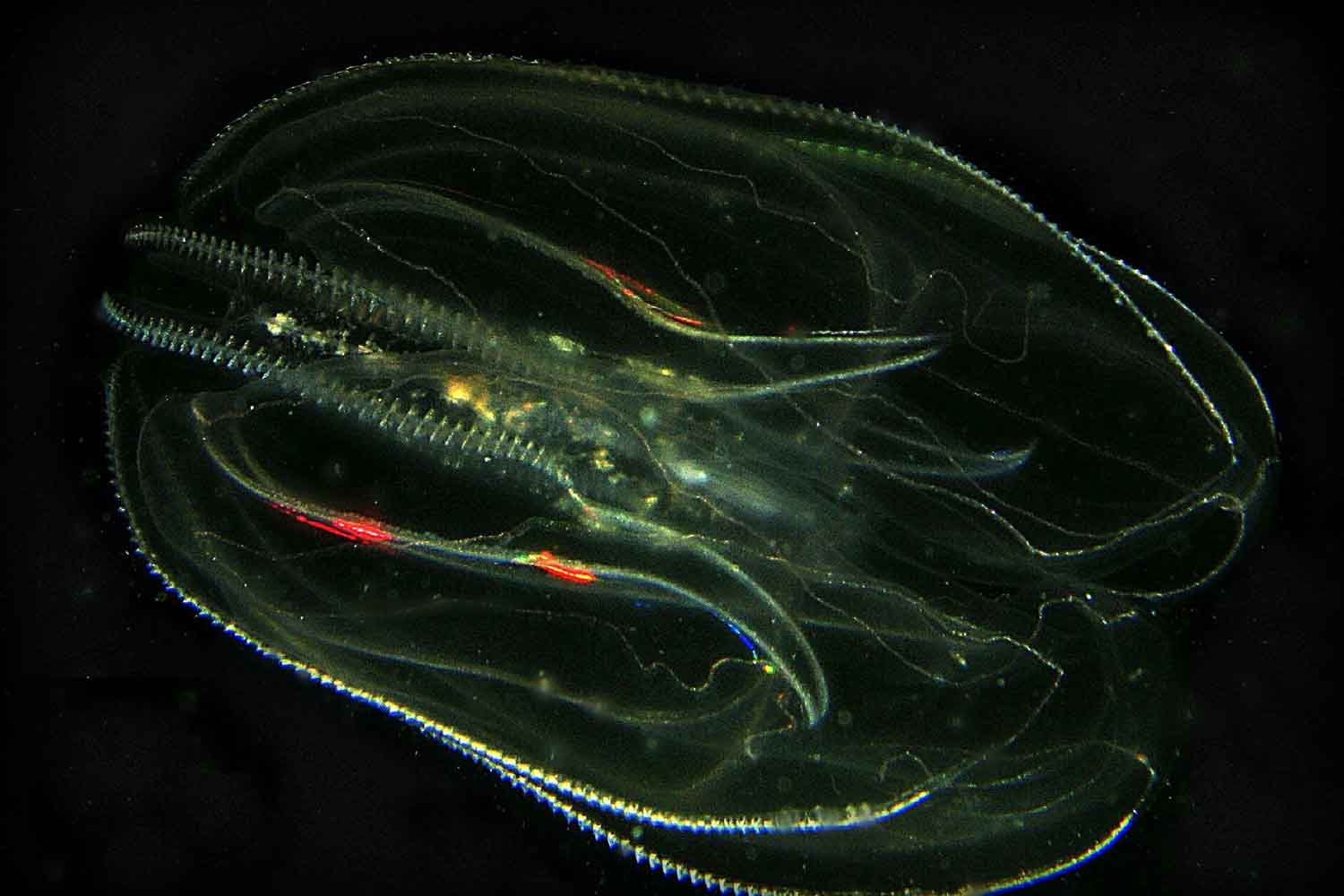
At the bottom of the Baltic Sea, oxygen decreases. A few meters higher, this lack also changes who manages to eat whom: when the saturation drops to 30%, the stickleback reduces predation on the stickleback larvae by 68%. Mnemiopsis leidyithe invasive ctenophore nicknamed “cannibal of the sea”.
This mechanism was measured by a study published in Journal of Plankton Research by a team led by the Technical University of Denmark. It is the first experimental proof that the three-spined stickleback, Gasterosteus aculeatuscan feed on the tiny larvae of Mnemiopsis leidyi. And it is also proof of how easily this free service can fail.
With little oxygen the stickleback leaves the table
The researchers worked in the laboratory with larvae about 400 micrometers large, less than half a millimeter. The sticklebacks were first observed in water with normal oxygen availability, then in water at 30% saturation: moderate hypoxia, therefore, far from the total absence of oxygen in the dead zones.
In the second case the consumption of the larvae of Mnemiopsis decreased by 68%. That of the copepod Acartia tonsaa small zooplankton crustacean, plummeted by 69%. The detail has a certain weight. Sticklebacks and ctenophores both eat these copepods: when the fish slows down, it leaves a larger portion of the same pantry to the adult specimens of the “sea cannibal”. Less predation on the larvae, less competition for food. A double courtesy that the stickleback hardly intended to do.
The study isolated a precise passage under controlled conditions. Of course, it doesn’t prove that Mnemiopsis leidyi is invading every corner of the Baltic nor is it directly measuring an increase in its population at sea. Temperature, salinity, currents, prey availability and oxygen concentrations change continuously. However, the lab showed what door hypoxia can open; to understand how many larvae actually manage to cross it, field observations will be needed.
Why do they call him “cannibal of the sea”
Mnemiopsis leidyi it looks like a small transparent jellyfish crossed by iridescent reflections. However, it belongs to the ctenophores and does not have the stinging cells typical of jellyfish. It is native to the American Atlantic coasts and has colonized numerous European waters, including the western Baltic, where it has been observed since the mid-2000s.
It eats zooplankton, fish eggs and larvae, grows rapidly and can produce large aggregations. Then there’s the matter that earned her the nickname.
A study published in Communications Biologybased on observations in the Kiel Fjord and laboratory tests, showed that adults can devour their own larvae when food becomes scarce. The large proliferations at the end of summer quickly consume the available prey; at that point the new generation can transform into a nutritional reserve for the previous one. Family, yes, as long as there is something left to eat.
This cannibalism helps adults accumulate resources and overcome adverse periods, including the winters of their more northern habitats. A particularly useful strategy for an organism without resistant eggs, cysts or other specialized stages to wait for better times on the seabed.
Herring and zooplankton inside the same net
The risk for native species comes above all from food. Mnemiopsis leidyi consumes copepods and other planktonic organisms also necessary for the larvae of many fish. Direct predation can be added to this competition.
In 2024, an experiment demonstrated that the ctenophore is able to capture and digest Baltic herring larvae still equipped with a yolk sac. The larger specimens were more efficient, while the herring became less vulnerable as they grew older. The authors specified that the effect on wild populations depends on the overlap, in the same place and at the same time, between large quantities of ctenophores and fish larvae. The risk exists; the fishing bill does not come from a laboratory tank.
In the Baltic, however, that overlap occurs within an ecosystem already weakened by eutrophication. Excessive inputs of nitrogen and phosphorus fuel the growth of algae and phytoplankton; when this organic matter decomposes, microorganisms consume oxygen. The particular stratification of the waters and the poor turnover of the deep basins do the rest.
According to HELCOM, the Commission for the Protection of the Baltic Sea, none of the assessed deep areas in the Baltic proper and in the Bornholm basin meet the thresholds for good environmental status. The “oxygen debt” has increased since the beginning of the twentieth century and the worsening has accelerated since the 1990s.
Hypoxia damages fish and bottom organisms, changes nutrient cycles and can release new phosphorus from sediments, further fueling eutrophication. We now know that it can also make stickleback predation on larvae less effective Mnemiopsis leidyi. The “cannibal of the sea” did not conquer the Baltic. The oxygen-poor water, however, is making room.
