
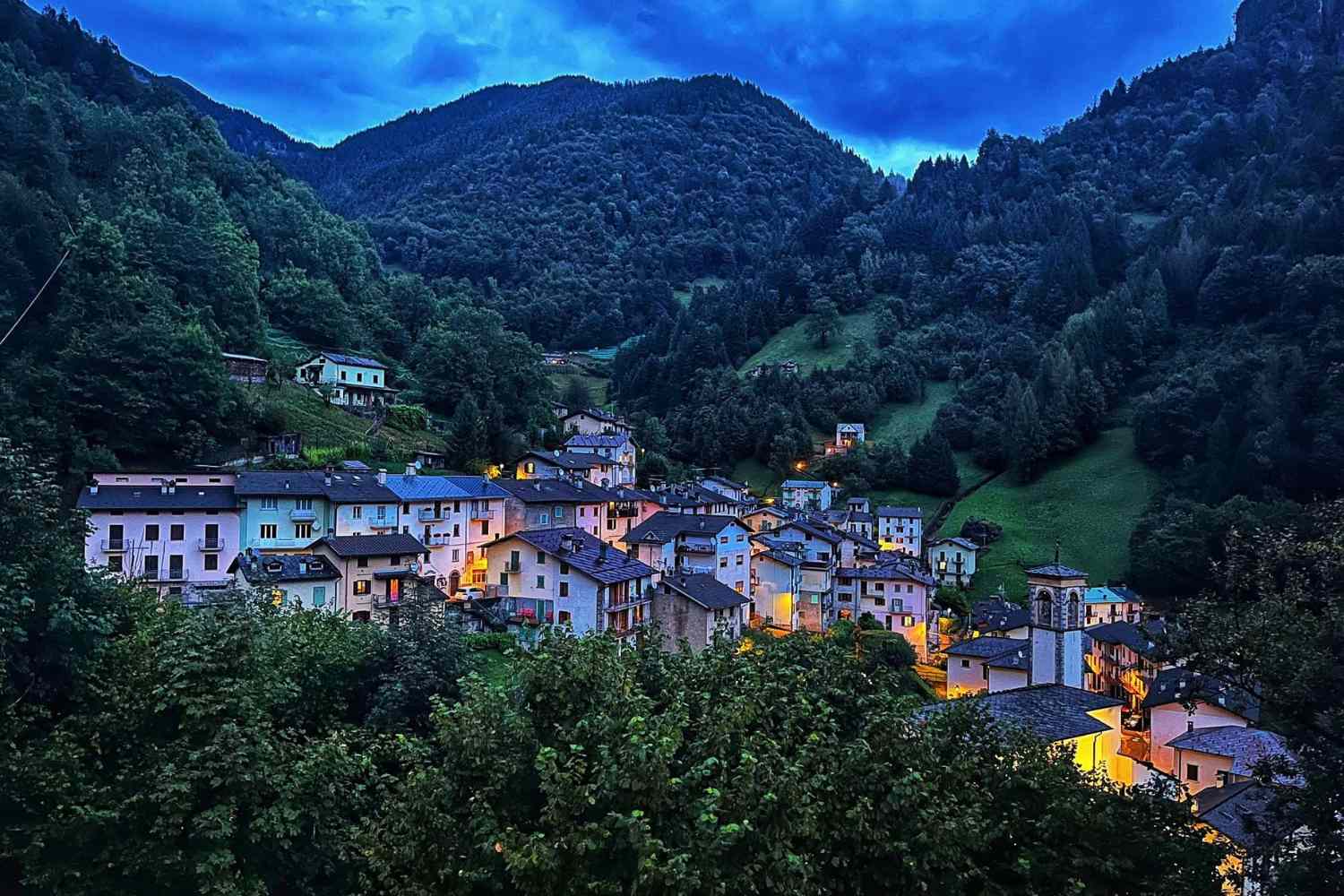
While the Lombardy plain fights against sultriness and increasingly higher temperatures in summer, there is a small town in the Alta Val Brembana where the climate changes face. It’s called Ornica, a village of just around 180 inhabitants nestled in the Bergamo mountains, at the foot of Pizzo dei Tre Signori (2,554 metres).
Here the coolness is not just a sensation: today, for example, the thermometer reads around 21°C during the day and 12°C at night, values that seem to belong to another season if compared with the heat of the cities and the plains. The altitude, around 900-950 metres, the woods and the presence of streams create an ideal microclimate for those looking for an escape from the scorching summer without going to the other side of the Alps.
A village where you have to arrive specifically
Ornica is not a place of passage, to reach it you have to go up along the Val Brembana and follow the road up to the Olmo valley, a side of the Val Stabina. Precisely this secluded position has allowed the town to retain an authentic soul: a few houses, stone streets, silence and a still strong relationship with the mountains.
The name Ornica could derive from the Latin “fraxinus ornus”, the minor ash tree, a plant that once covered the woods around the seven villages in the area. A reference to nature that still characterizes the area today.
From the iron mines to the Baschenis
For centuries Ornica has been a hard-working Alpine community. Iron working was widespread here: in the town there was a large forge where nails and cutting tools were produced, also fueled by the minerals extracted in the local mines.
The village was also connected to the neighboring territories through the Alpine passes, in particular the Salmurano Pass, a route used over the centuries by travellers, traders and artists.
The painters of the Baschenis family, protagonists of Lombard Alpine painting, also passed through these mountains. One of the most precious testimonies is found in the parish church: in the sacristy the frescoes created in 1485 by Angelo Baschenis are preserved, with the great Christ Pantocrator, the Assumption of the Virgin and the four Doctors of the Church.
What to see in Ornica
The parish church and the Baschenis frescoes
It is the small artistic treasure of the town, the sacristy houses a cycle of fifteenth-century frescoes of great value, a surprise for those arriving in such a small village.
The Sanctuary of the Madonna del Frassino
Built in the 17th century, it was born from a legend linked to a traveler saved by the Madonna along the road to the Salmurano pass. The sanctuary has decorations and frescoes that are still well preserved.
The ancient village
The upper part of the town is the most evocative: narrow alleys, stone paving and ancient houses where time seems to have stopped. It is a place to visit slowly, without rushing.
What to do: trekking, nature and slow life
Ornica is above all a gateway to the mountains, with numerous paths that allow excursions suitable for different levels of preparation. Among the most beautiful itineraries, that of the Valle d’Inferno stands out, which winds through woods, streams and typically Alpine landscapes, while other routes lead towards the pastures and mountains of the upper Val Brembana.
Those who are passionate about nature can also dedicate themselves to botanical walks to discover wild herbs linked to local tradition, or go higher along the trekking paths that lead to Pizzo dei Tre Signori, one of the symbolic mountains of the Orobie.
Here tourism is not made up of large numbers, but of experiences: walking, picking herbs, eating local products, listening to the stories of the inhabitants.
The village that has chosen to be reborn
One of the most interesting aspects of Ornica is the project created to combat depopulation. A group of 16 women from the town, together with the Municipality, created a cooperative, creating the first widespread hotel in Lombardy.
The idea is simple but innovative: recover traditional homes and transform them into hospitality, while keeping the community alive. Not a town transformed into a tourist village, but an inhabited village that opens its doors.
The cooperative has also recovered ancient knowledge: from cooking with wild herbs to the rediscovery of traditional recipes, up to the valorisation of crafts that were in danger of disappearing.
Ornica, fresh food near Milan
From Milan it takes about an hour and a half/two hours of travel, traffic permitting. It is not the closest village to the city, but this distance protects it from hit-and-run tourism.
Ornica represents one of the most interesting answers to the search for places to enjoy the summer better: a small town where the climate is milder, nature is the protagonist and the quality of life still passes through human rhythms.
A village where, on the hottest days of the year, in the evening you can still open the window and smell the scent of the forest instead of the heat of the asphalt.
