
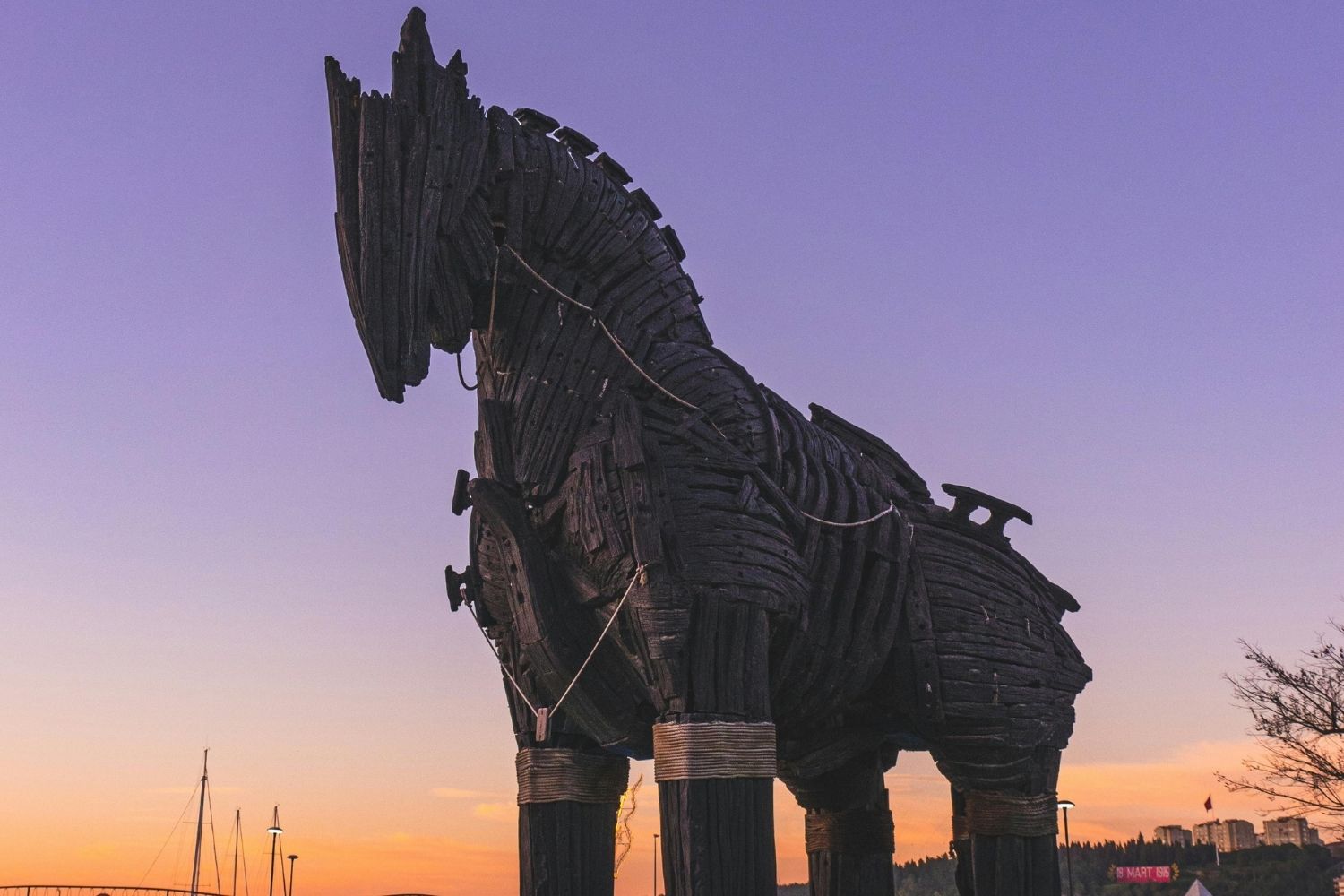
Was the Trojan Horse really a horse? Did the infamous trap orchestrated by the Achaeans to cross the gates of Ilium consist of a gigantic wooden horse, with an empty “belly” full of soldiers ready to strike? The issue has been debated for millennia, long before historian Alfonso Mañas talked about it on a Spanish radio program. The idea that the Trojan horse could be something other than a horse, in fact, already circulated in ancient Rome: Pliny the Elder, in Naturalis Historiareviews the inventors of every known war machine and among the siege devices inserts, without ceremony, the horse, today called the ram, the work of Epeus in Troy. No legend, much less a wooden belly hiding warriors, just a military tool with an unfortunate name. We can easily find the passage on the Attalus website, in paragraph 202 of book VII.
The radio interview
Let’s start from where the news comes from, because it is worth being precise: the statement from a few days ago reported by the press does not come from a paper or from a sector magazine, but from an interview given by the Spanish historian Alfonso Mañas, author of the book The Odisea. Reality through mythreleased July 29 to the program Herrera en COPE. The context is that of Christopher Nolan’s Odyssey, which has just arrived in theaters and has already ended up in the meat grinder of philological controversy. Mañas takes the opportunity to relaunch a thesis that is not his: the horse, he says, was in reality a Phoenician ship of the Hippos type, recognizable by the equine-headed figurehead, and the confusion arises from a misunderstanding of the Greek term hippos, which means both “horse” and, indeed, that type of vessel.
Pliny and Pausanias: doubt runs in the family
Here is the solid part of the story. The idea that behind the Homeric tale lies something other than a literal wooden horse is not a talk radio invention and was already circulating in the ancient world, in the form of a siege battering ram rather than a ship. In addition to Pliny, in the 2nd century AD Pausanias also dismissed the naive reading of the story: in the Periegesis of Greece he writes that Epeus’ work was an expedient to open a breach in the Trojan walls, and adds that only those who consider the Phrygians (the Trojans) to be a naive people can believe that they dragged a wooden horse into the walls without smelling the deception. The passage is found in book I, chapter 23, on the Perseus website. Two authors, one Latin and one Greek, who already two thousand years ago dismantled the legendary version, in favor, however, of the ram, and not the ship: on this point it is worth being clear, because it is easy, and often happens in summaries around the web, to confuse the two paths.
Homer’s “mares of the sea”.
The ship track, however, has a connection in the ancient text, even if more timid. Homer himself, in the Odyssey, calls ships “horses of the sea” (canto IV, lines 708-709), and after a few centuries Euripides compares the Trojan horse to the dark hull of a boat. They are poetic images, plays on words that combine the marine world with the equestrian world and not explicit theories that identify the horse with a real ship. It is the difference that separates a literary intuition from a philological hypothesis formulated as such.
The leap of Mañas: from Tiboni to Euphorione
And here comes the point that deserved more careful scrutiny. The hypothesis of the Hippos ship, formulated as it is today (horse-head figurehead, translation error, handed down to Virgil) is not Mañas’s invention: it was proposed in 2016-2017 by the naval archaeologist Francesco Tiboni, first in an article in Archaeologia Maritima Mediterranea and then in the book The capture of Troy. A deception that came from the searelying precisely on those Homeric references and on the archaeological evidence on Phoenician ships with equine figureheads. The Post had already discussed its merits and objections (including the Mykonos vase from 670 BC, which depicts warriors inside a real horse) in a 2017 article. Mañas goes a step further and attributes this reading to Euphorion of Chalcis, a Hellenistic poet and grammarian of the 3rd century BC. Euphorion probably only came to us through fragments dispersed in the commentaries on Homer and Lycophro, collected by philologists such as Powell; it may be that the fragment in question exists and that Mañas knows it from sources that I have not been able to verify, but at present it remains an unconfirmed statement by third parties.
What remains, once the noise has been removed
They remain two distinct things, and it is best not to let them collapse into one another. The first: the suspicion that the horse was not literally a horse really dates back to antiquity, with Pliny and Pausanias acting as direct witnesses, even if they spoke of a ram. The second: the theory of the Hippos-ship is a twentieth-century reconstruction, or rather two thousand sixteen-seventeen, which rests on genuine Homeric clues, while remaining a modern philological hypothesis, not a direct echo of a debate already closed in antiquity.
A little empirical verification
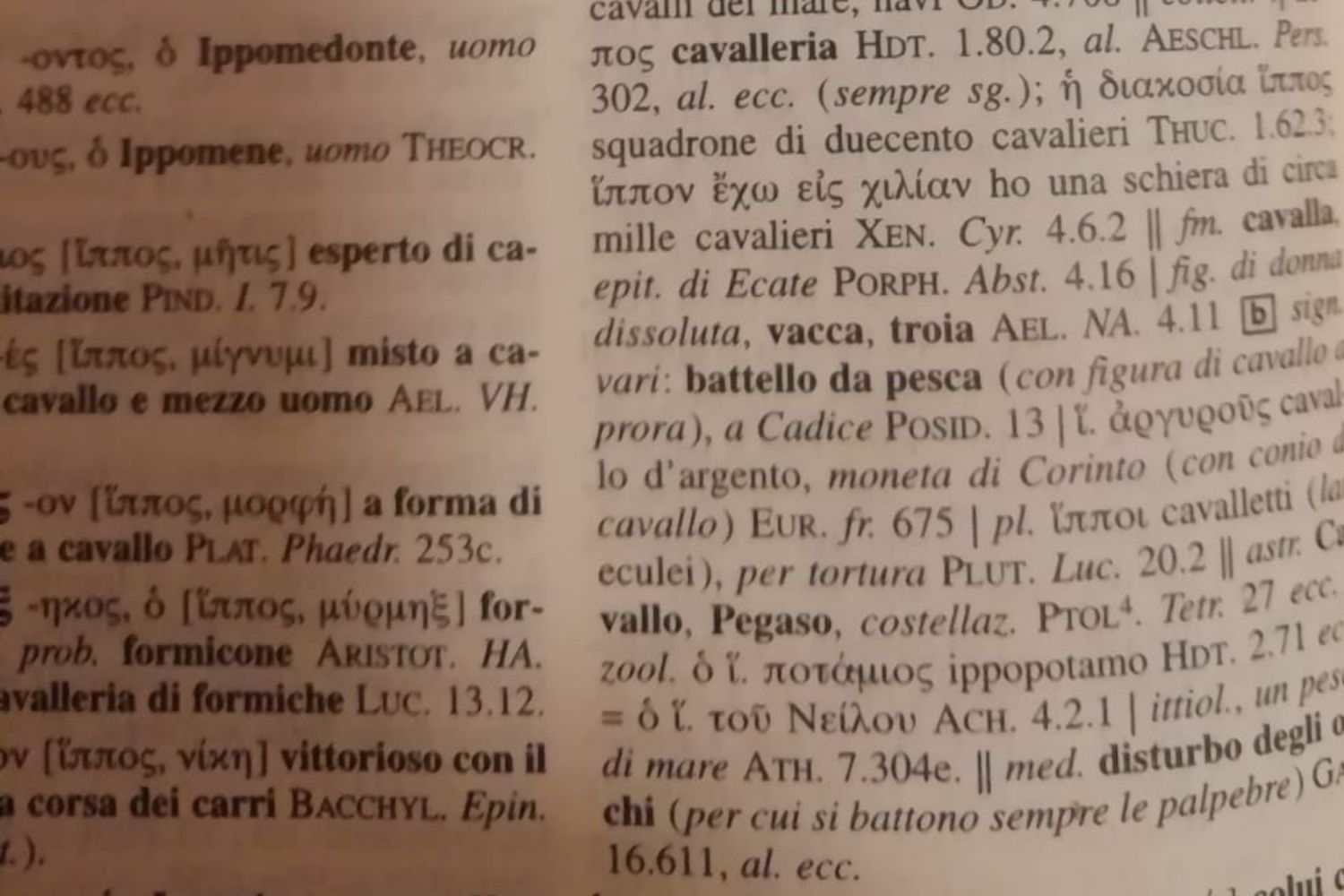
At this point I wanted to check it out in person, dictionary and Odyssey in hand. The term ἵπποςconsulted in Franco Montanari’s Vocabulary of the Greek Language, first of all reports the zoological meaning of horse (first image), but in a section dedicated to “various meanings” the term fishing boat with the figure of a horse on the prow also appears (second image) used in Cadiz (the source cited is Posidonius, a Stoic philosopher of the 1st century BC who stayed for a long time in the Phoenician colony of Gades to study the tides). Phoenician-Punic naval archeology confirms that the hippoi were royal boats, widespread in the Carthaginian world, which took their name from the horse-shaped figurehead on the bow. Here, however, precision is a must, because the dictionary does not connect this meaning to the feminine gender of the word, it simply places it as a specialized use in itself, a detail that does not detract from the discovery, but must be said precisely.
On the Odyssey, the control gives a sharper result. The Trojan horse appears in two passages: in book IV (vv. 235-284), during Menelaus’ story to Telemachus, and in book VIII (vv. 492-520), when the bard Demodochus sings it at the court of the Phaeacians. In the first case the Greek text (ἵππον… πεύκινονpine horse) does not allow us to establish the gender: the adjective πεύκινος has the same form for masculine and feminine, so the word remains grammatically ambiguous. In the second case, no: Homer writes δουράτεον μέγαν ἵππονAnd μέγαν it is an unmistakably masculine form (the feminine of μέγας is μεγάλην, not μέγαν). In short, for Homer, in Troy the horse was really a horse, at least grammatically. The question remains open, as Mañas also rightly asked, whether behind that lexical choice there isn’t an older source, now lost, capable of telling the story in other terms.
