
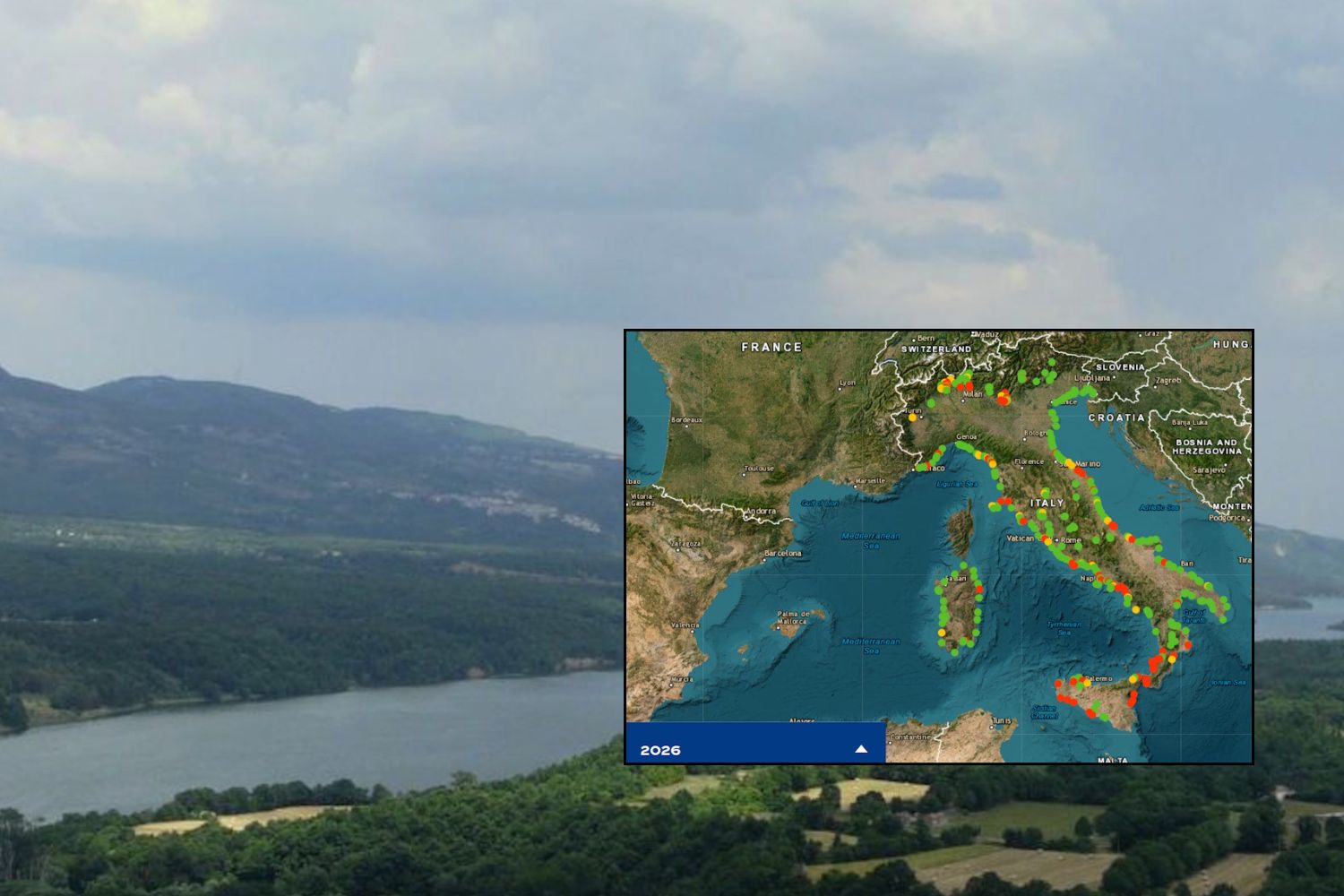
It is certainly not a reassuring photograph taken by Goletta Verde and Goletta dei Laghi in the summer of 2026: between the sea, rivers, canals and lake basins, more than one sample in three was found to be above the legal limits for pollution.
Out of 391 samplings carried out by Legambiente in 19 Italian regions, 34% were polluted or heavily polluted. A figure almost identical to that of last year and which, especially for the lakes, marks the worst result of the last seven years. Behind these numbers there are now structural problems: insufficient or malfunctioning purifiers, incorrectly treated wastewater, climate crisis, drought and increasingly higher temperatures.
According to data collected by Legambiente through the Ministry of the Environment and Energy Security, in Italy there are still 514 urban agglomerations, equivalent to over 14 million inhabitants, which discharge waste water in a non-compliant manner. And it is above all the mouths of rivers, streams and canals that show the most serious critical issues.
The balance of Legambiente’s two summer campaigns speaks clearly: 34% of the 391 samples analyzed in marine and lake waters exceeded the limits set by the law and the situation is particularly critical in the points where rivers, canals and streams flow into the sea or lakes.
Out of 188 foci sampled, 54% were polluted or heavily polluted. In practice, more than one in two mouths has levels of microbiological contamination above the limits. And not even the areas apparently far from the discharges can be said to be completely safe: 15% of the samples taken directly from the sea or lake waters were found to be beyond the limits, with 5% classified as polluted and 10% as heavily polluted.
@Legambiente
The most polluted areas
Among the most critical points and those that Legambiente now considers real chronic situations are:
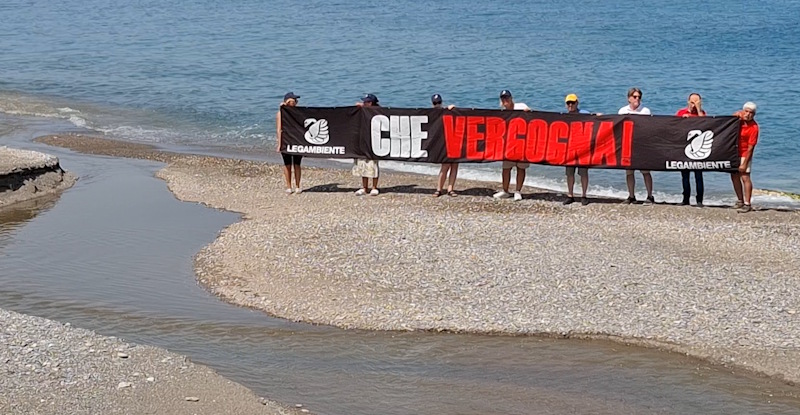
Aci Trezza/@Legambiente
Also worrying is the lack of information for those who frequent the beaches: in 70% of the mouths monitored by Goletta Verde there were no signs prohibiting bathing, despite these points often being among those with the greatest microbiological criticality.
The bad purification
For Legambiente the central issue remains that of waste water purification, a problem that continues to cost the country dearly, not only in environmental terms. In fact, Italy is still involved in four European infringement procedures for failure to comply with the directive on the treatment of urban waste water. The first two procedures have already cost over 200 million euros. And the situation could become even more challenging as new European wastewater requirements come into force.
Italy – comments Stefano Ciafani, national president of Legambiente – continues to pay tens of millions of euros in fines to Europe every six months for failure to comply with the European directive on waste water treatment in municipalities where 14 million equivalent inhabitants live, with public resources that we could use more usefully to create new sewerage and purification systems. This is unacceptable, considering that the first Italian law on purification, the so-called Merli, turns 50 this year. It is time to launch a national plan to make all Italian rivers suitable for swimming, as the Seine has become in Paris after the investments in purification made for the 2024 Olympics, and to approve the Presidential Decree on the reuse of purified waste water in agriculture to address the serious problem of drought, exacerbated by the acceleration of the climate crisis.
And, according to estimates cited by Legambiente, between 645 million and 1.5 billion euros could be needed just to adapt the larger plants.
Increasingly hotter Mediterranean and dry lakes
Next to pollution there is the other great emergency: the climate crisis. In the last six years, between 2020 and 2025, the average surface temperature of the Mediterranean in the months between May and September has never fallen below 24°C, according to data recalled by Legambiente.
A warmer sea means more vulnerable ecosystems, greater spread of alien species, coastal erosion and conditions favorable to the tropicalization of the Mediterranean.
Among the basins most affected by drought and high temperatures are some of the most important Italian lakes. Lake Iseo, between 12 June and 24 July, lost over 79% of its stored volume. Heavy reductions were also recorded for Lake Maggiore and Lake Como, with losses indicated at around 76%.
A sign of how the combination of lack of rainfall, high temperatures and growing pressure on aquatic ecosystems is also transforming the large lakes of Northern Italy.
The picture that emerges from Golette 2026 is therefore much broader than the simple quality of bathing water. The sea and lakes are becoming a real litmus test of Italian environmental fragility and what is needed is there for all to see: more resources for purification, more controls on discharges, a strengthening of information campaigns and a revision of the bathing directive.
Finally, Legambiente also asks to finally make the National Plan for Adaptation to Climate Change operational, to prepare a specific plan for coastal adaptation and to establish new marine and terrestrial protected areas. The reason? The health of seas and lakes depends not only on what we discharge into their waters, but also on how well we are able to adapt the country to a climate that is changing much faster than our infrastructure.
