
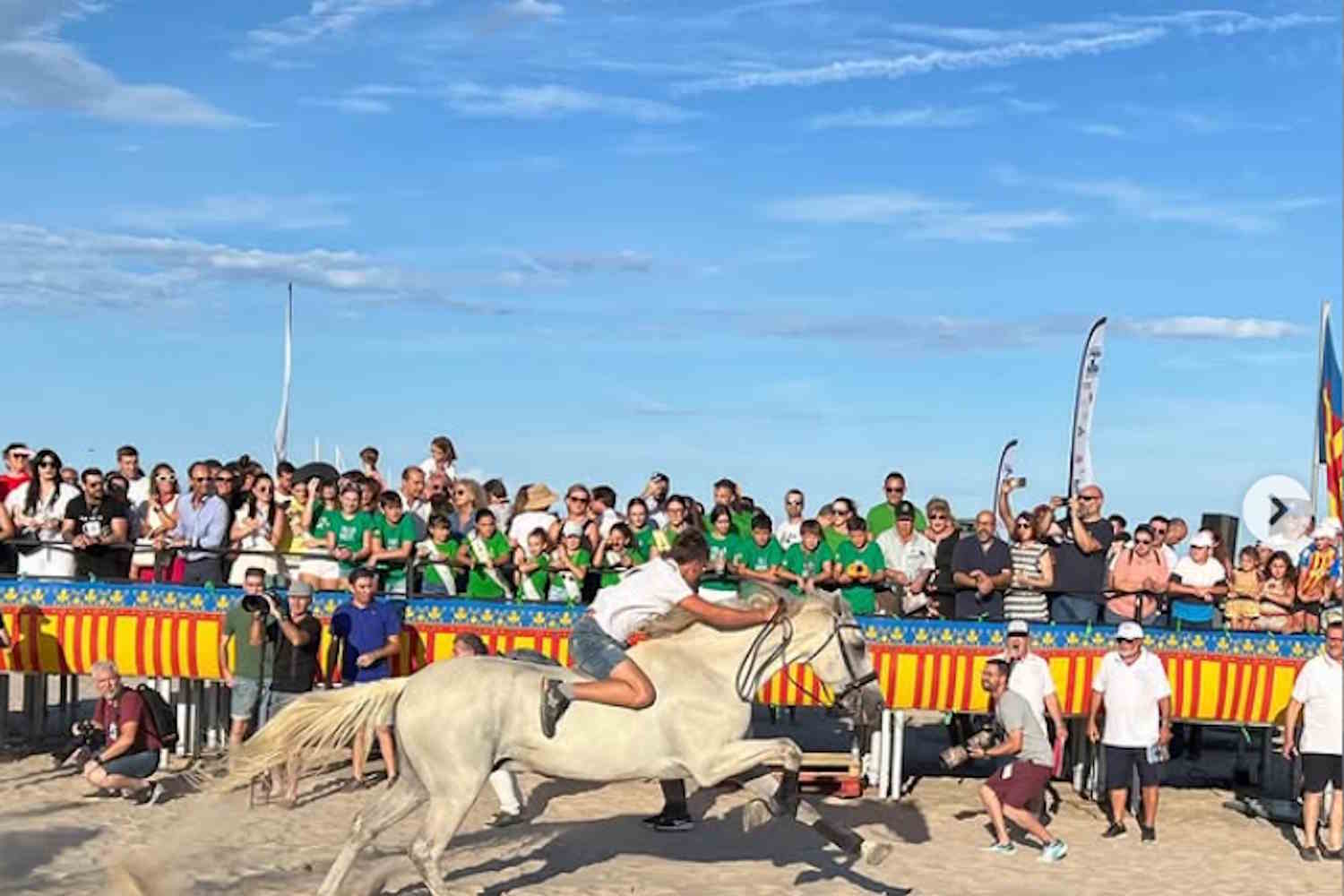
They returned to racing on the sand of Pinedo beach, in Valencia, riding bareback along a 700 meter track. The Corregudes de Joies will also be renewed in 2026, an equestrian event with over 180 years of history that continues to be defended in the name of tradition, but which raises questions that are increasingly difficult to ignore about the well-being of the horses involved.
Because behind the folkloristic image of a race on the beach there remains a very concrete fact: it is the animals that sustain the physical effort of the competition, launched at high speed on sandy ground, in the middle of August and in front of hundreds of spectators.
The first races of the 2026 edition will take place today, Tuesday 11 August, starting at 6pm, in the Creu de la Conca area. Tomorrow, however, the event will exceptionally stop for the total solar eclipse of August 12th, also visible from Valencia.
The coincidence between the astronomical phenomenon and the time of the competitions led the organizers to suspend the competition for one day for safety reasons related to participants, teams and the public. The races will resume on Thursday 13th August and will continue on Friday 14th, when the trophies will be awarded.
Horses thrown for 700 meters on the sand
The functioning of the Corregudes de Joies has remained almost unchanged over time. Knights and riders compete in pairs along approximately 700 meters of beach, riding horses bareback.
And it is precisely the terrain that represents one of the most controversial aspects of the event. Running on sand in fact means facing a surface other than a track and which can require greater effort from the animal’s limbs and muscles, especially when the speed increases.
Add to this the time of year, the potentially intense heat of August, the noise, the presence of the public and the pressure of the competition itself. All factors that make it difficult to reduce the issue of animal welfare to the simple presence of a veterinary visit before the race.
The prize that gives its name to the event is the joya silk handkerchief tied to a laurel wreath. According to tradition, the race was born among the farmers of the Valencian garden, who competed to demonstrate the speed of their work horses; whoever won won the joywhich he would then give to his loved one. That context, however, no longer exists.
Work horses have given way to animals used for competition and the challenge, from a practice linked to rural life, has become a public spectacle. However, the race on the sand remained, precisely the most spectacular element for the spectators and at the same time the one that deserves greater attention from the animals’ point of view.
Veterinary checks do not close the question
The 2026 edition began on Monday 10 August with the preparation of the track, the weighing of the horses, the veterinary inspection and the first training sessions.
The presence of health checks before the competition is certainly necessary, but it is not enough in itself to respond to the criticisms leveled at the event. Establishing that an animal is fit to race at a given time does not mean automatically eliminating the stress and physical load associated with racing.
The issue raised for years by animal rights associations concerns the very nature of the event: horses used in a high-speed competition, on the beach and in environmental conditions that can be particularly challenging in August.
The Corregudes are organized by the Associació Corregudes de Joies i Sant Antoni Abad de Pinedo, with the collaboration of the Ajuntament de València, the local administration and the Fundación Deportiva Municipal. They are part of the Big Party in honor of the Virgen del Rosario and every summer they attract numerous residents and visitors to the beach.
Over 180 years of history, but is tradition enough?
Valencian institutions present the Corregudes de Joies as one of the most characteristic traditions of Pinedo. The event has more than 180 years of history and since 2022 it has been recognized by the Generalitat Valenciana as Fiesta de Interés Turístico Provincial.
But it is precisely the reference to tradition that makes a question inevitable: is the fact that a practice has been repeated for generations sufficient to still consider it acceptable when it involves animals subjected to an effort for the entertainment of the public?
Over the years, animal protection associations have repeatedly contested the conditions of the races, drawing attention to the possible physical and emotional stress on the horses and, in particular, to the effort required by a fast race on the sand in the height of summer.
The point is not to deny the existence of a history or the identity value that a part of the community attributes to the event. It’s asking whether that story should necessarily continue to be reproduced in the same way.
Many traditions have changed precisely because our sensitivity towards animals has changed. The cultural recognition of a party, therefore, should not transform into a free zone in which the issue of their well-being automatically takes second place.
In 2026 racing stops for the eclipse
This year the Corregudes will experience at least one unusual break. On August 12, 2026, Spain will be crossed by a total solar eclipse, also visible from the Valencian Community. The coincidence between the astronomical phenomenon and the scheduled time for the races led the organizers to suspend Wednesday to ensure the safety of participants, teams and spectators.
Therefore, the horses will not race for one day, the competitions will resume on August 13th, while the last challenges and the presentation of the trophies will take place on Friday the 14th.
An exceptional suspension due to an astronomical event, while the broader question still remains open: whether a horse race on the sand, organized as a show and maintained in the name of a tradition spanning over a century, is still compatible with a modern idea of protection and respect for animals.
View this post on Instagram
