
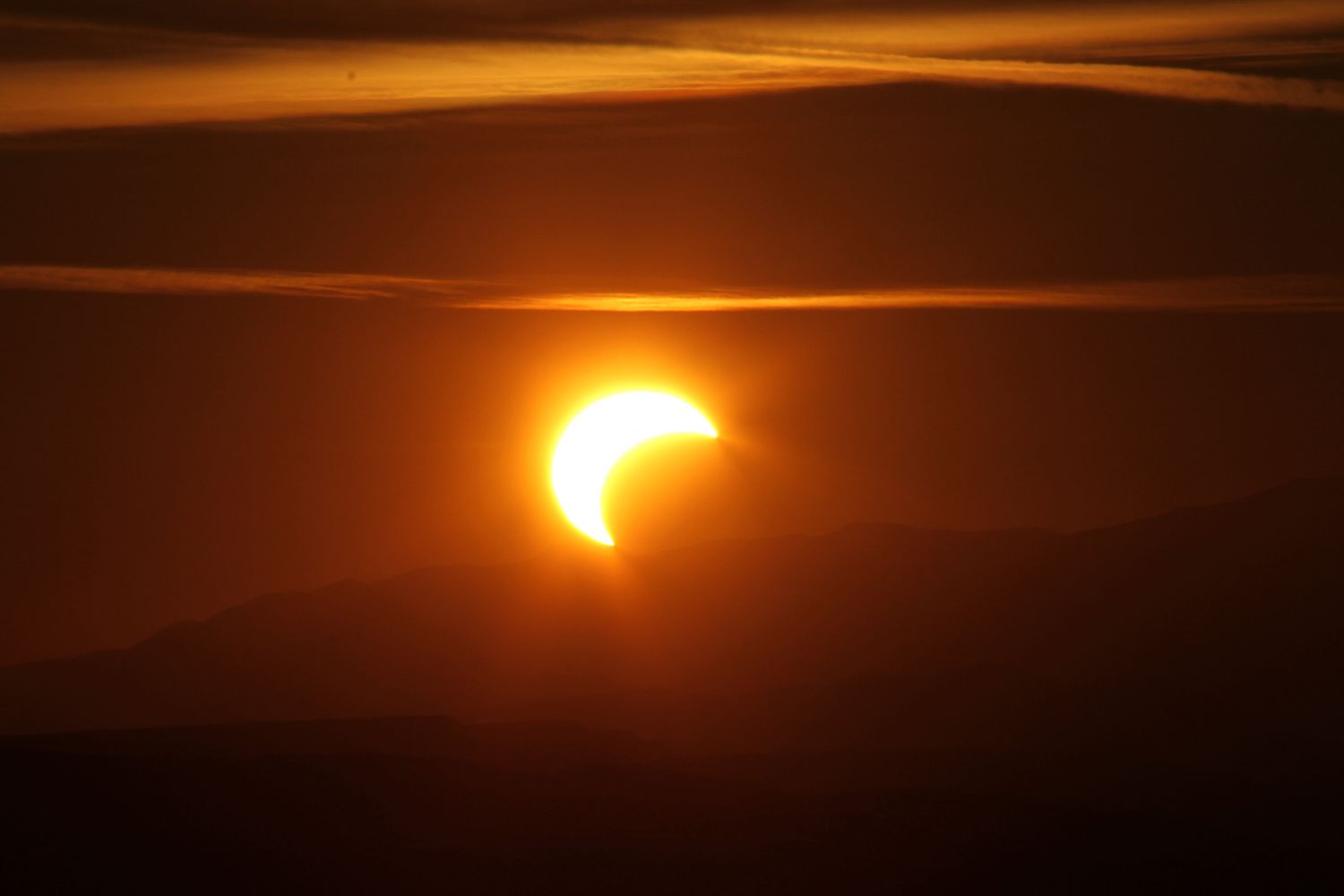
The wait is almost over: today, Wednesday 12 August, it will also be possible to witness a memorable solar eclipse from Italy. In our country the phenomenon will not be total, but partial, and will be particularly suggestive because it will take place in the hours of sunset. Precisely for this reason it will be essential to choose a point with the western horizon as clear as possible and, above all, not to make the mistake of observing the Sun without adequate protection. According to the National Institute of Astrophysics, the eclipse will begin to be visible from Italy around 7.30pm, while its maximum phase will arrive around 8.20pm. The most favored regions will be the northern and western ones, including Piedmont, Valle d’Aosta, Liguria, Lombardy, Emilia-Romagna, Tuscany and Sardinia, where the coverage of the solar disk can reach and in some cases exceed 90%. In Central and Southern Italy the phenomenon will be less marked.
In Milan, for example, NASA data indicates the start of the partial eclipse at 7.27pm, with the maximum at 8.20pm and approximately 92 percent of the solar disk covered by the Moon. The Sun will set before the entire astronomical phenomenon can conclude.
View this post on Instagram
Where to watch the eclipse in Italy
The real obstacle, even more than the differences in the percentage of obscuration, will be the height of the Sun. At the moment of the eclipse it will in fact already be very low on the horizon. INAF therefore recommends looking for a place with a very wide view towards the west and west-northwest. Mountains, hills, buildings or even relatively distant reliefs could completely block the view of the Sun during the most spectacular phases.
Those who are unable to observe it directly will also be able to follow the live broadcast organized by INAF together with the Union of Italian Amateur Astronomers and the Association of Italian Planetariums, scheduled to start from 7.30pm.
Because you should never look at the Sun with the naked eye
The fact that much of the Sun is covered by the Moon makes it unsafe to look at it directly. In Italy the eclipse will remain partial for its entire duration, so there will be no moment in which it is possible to remove the protections and stare at the Sun without risks. Looking directly at the Sun can cause solar retinopathy, i.e. damage to the photosensitive cells of the retina. In more serious cases, consequences may include permanent loss of central vision. Possible symptoms include blurred vision, dark spots in the center of the visual field, changes in color perception and increased sensitivity to light. Furthermore, the disorders may not appear immediately and may manifest themselves in the following hours.
One of the most insidious aspects is that the retina does not have pain receptors: it is therefore possible to damage it without immediately feeling pain or burning in the eyes.
What glasses should you use to watch the eclipse
The glasses to be used are not normal sunglasses. You need specific eclipse glasses or solar visors that comply with the international standard ISO 12312-2 (which sold like hot cakes), designed specifically for direct observation of the Sun.
Even very dark sunglasses, overlapping two or three pairs, or using polarized lenses does not offer sufficient protection. Eclipse glasses must have specific solar filters and must be intact.
Before using them it is therefore advisable to carefully check the lenses: if the filter is scratched, punctured, torn or is detaching from the frame, the glasses must be discarded. Anyone who normally wears eyeglasses can keep them and wear eclipse glasses over them.
The mistakes not to make and the safe alternative if you don’t have the right glasses
They should not be used as makeshift filters sunglasses, tinted glass, photographic film, CDs or DVDs, x-rays, colored plastic or other household materials: the fact that they apparently reduce brightness does not mean that they adequately block harmful radiation. Particular attention should also be paid to binoculars, telescopes and cameras. Don’t just put on eclipse glasses and then look through a telescope or binoculars. The sunlight concentrated by the instrument can in fact damage the filter and cause serious eye damage.
Anyone who doesn’t have a certified viewer doesn’t have to improvise. However, it is possible to observe the eclipse indirectly, for example through a simple pinhole projector. The principle is to practiceand a small hole in a piece of cardboard and let the sunlight pass through it, projecting the image onto a second surface, for example a white sheet of paper. Alternatively you can use a colander. In this way you will be able to look at the projected image, keeping your back turned towards the Sun: be careful, however, not to look directly through the hole.
Here is a tutorial that may be useful to you:
Happy viewing!
