
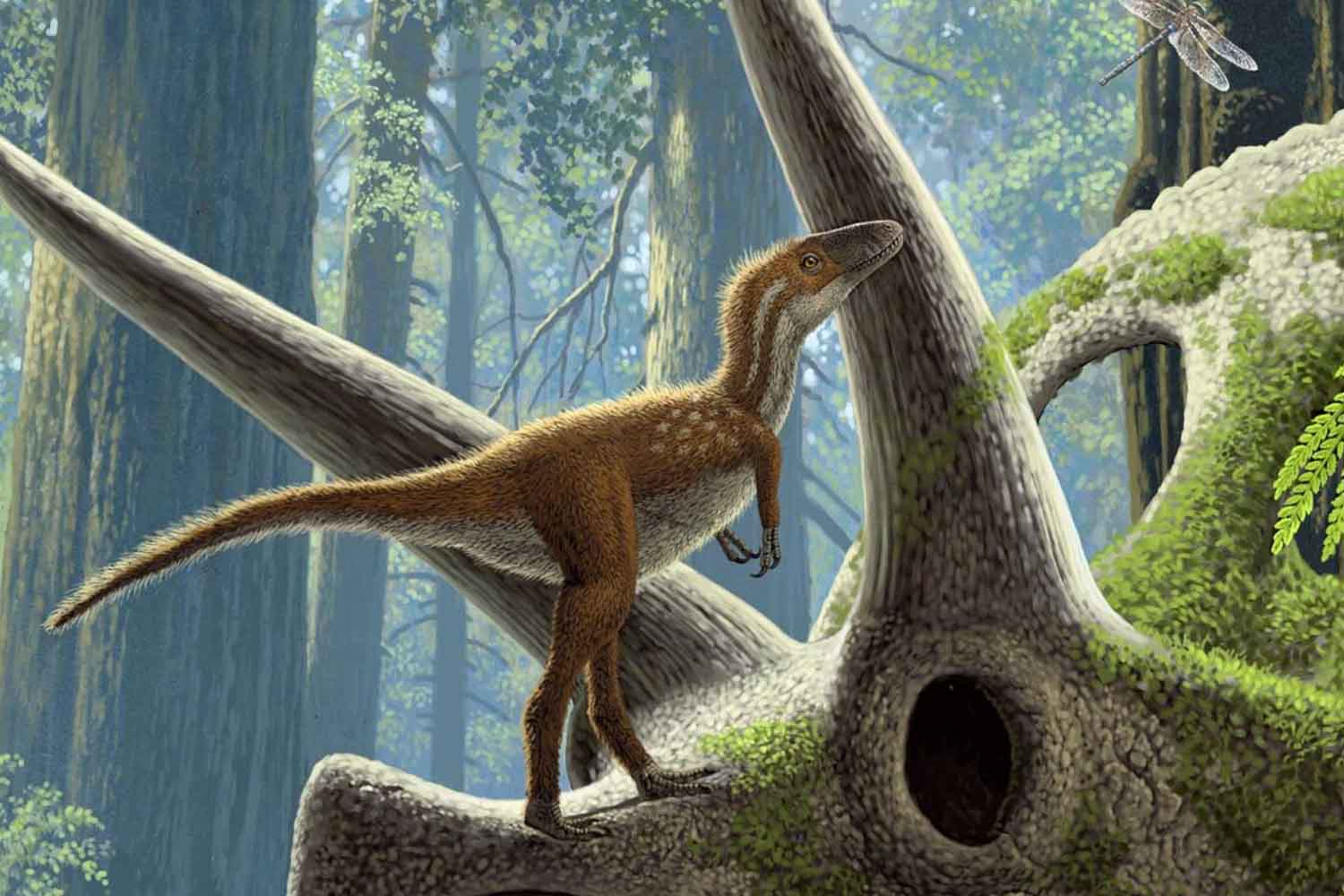
The first T. rex baby recognized by science weighed as much as a small cat. What gave him away was a tiny foot bone preserved in a Canadian museum collection: it belonged to an animal less than a year old, weighing about 2.5 kilograms at the time of death and probably even lighter when it hatched. In short, the king of dinosaurs began life in cat form. With long legs and teeth that had already worked.
The fossil, accompanied by a portion of the jaw and some isolated teeth, has allowed an international group of researchers to reconstruct for the first time in some detail the very first phase of the life of the Tyrannosaurus rex. The study published in the journal Biology it also describes the remains of a little one Gorgosaurus libratusthe oldest relative of T. rex: they would be the first known fossils of tyrannosaurs that had just hatched from the egg.
A small bone that he had already worked on
The crucial find is a metatarsal found in the Frenchman Formation, Saskatchewan, and held by the Royal Saskatchewan Museum. Nicholas Longrich, a paleontologist at the University of Bath and lead author of the study, identified it among many other fossils in the collection of the T. rex Discovery Centre.
Its dimensions reveal a tiny animal compared to the several tons it reaches as an adult. The proportions of the bone indicate a weight of approximately 2.5 kilograms at the time of death; observing the changes that occurred during growth, the authors estimate that at hatching the puppy could weigh around 1.6 kilograms.
The value remains an estimate. In the bone tissue, the researchers did not find a clear hatching line, similar to the sign that in some animals separates life in the egg from life outside. They then reconstructed that passage through changes in bone density.
© Biology
The microtomography performed with synchrotron light showed a very dense network of blood channels, compatible with very rapid growth. The annual rings were also missing, confirming that the animal was less than a year old. The most interesting detail, however, was found in the small tunnels left by bone remodeling, the process by which tissue is demolished and rebuilt when subjected to repeated stress.
An embryo closed in the egg would hardly have subjected the foot to such loads. Together with the already developed joint surface, those signs indicate that the puppy had soon begun to walk and probably run, as explained by Eric Snivelyan anatomist at Oklahoma State University and co-author of the study:
We found channels in the bone indicating that they were quickly out of the nest and on the move.
The teeth were already worn out, the hunt remains a hypothesis
Completing the scene are some tiny, thick and sharp teeth, very similar in shape to those of adults. The tips show signs of wear: whatever they ate, those young tyrannosaurs had already begun to use their mouths in earnest.
The study considers wear compatible with a diet based on relatively large vertebrates. Snively goes further and claims that the little ones also bit the bones of food, already occupying the role of predators within their size range. The fossils, however, do not allow us to see the meal. The cubs may have caught live prey, taken advantage of carcasses or eaten food provided by adults.
The idea of small T. rexes already engaged in hunting comes from the combination of several clues: feet subjected to load, functional joints and worn teeth. It’s a plausible reconstruction, more conservative than the scene of a herd of carnivorous kittens launched into the Cretaceous forest.
The evidence, however, suggests rather precocious animals, capable of moving shortly after birth and perhaps quickly achieving a certain autonomy.
The T. rex may have laid dozens of eggs
So far, no confirmed T. rex eggs and nests have been found. To estimate clutch sizes, the researchers then worked backwards from the weight of the pups.
In newly hatched birds and crocodiles, the hatchling typically accounts for about two-thirds of the egg mass. Applying this ratio to T. rex, the study estimates eggs weighing approximately 2.5 kilograms. The authors then calculated how much mass an adult female could allocate to reproduction.
A female T. rex weighing about 6 tons could have laid about twenty eggs; in the largest specimens the brood would have risen to around thirty. Some models allow even higher numbers, up to fifty or one hundred. They are calculations built on comparisons with living animals and reconstructed body dimensions, therefore they are not equivalent to the discovery of thirty shells arranged inside a nest.
The trend, according to the researchers, indicates a strategy based on many small, relatively light weights. Hence the hypothesis of less intense parental care compared to that of many modern birds. Limited investment does not mean complete abandonment: the adults may have guarded the nest and guided the young for some time, as crocodiles and some large land birds do today.
The discovery fills one of the most persistent gaps in T. rex history. We know of enormous adult skeletons, skulls capable of taking up an entire display case and teeth as long as bananas; the beginning of his life was left entrusted to a few fragments that were difficult even to recognize.
The decisive find, in fact, did not emerge from a skeleton just freed from the rock. It was already in the museum, small enough to go unnoticed. Even the T. rex had to wait its turn in the collection.
