
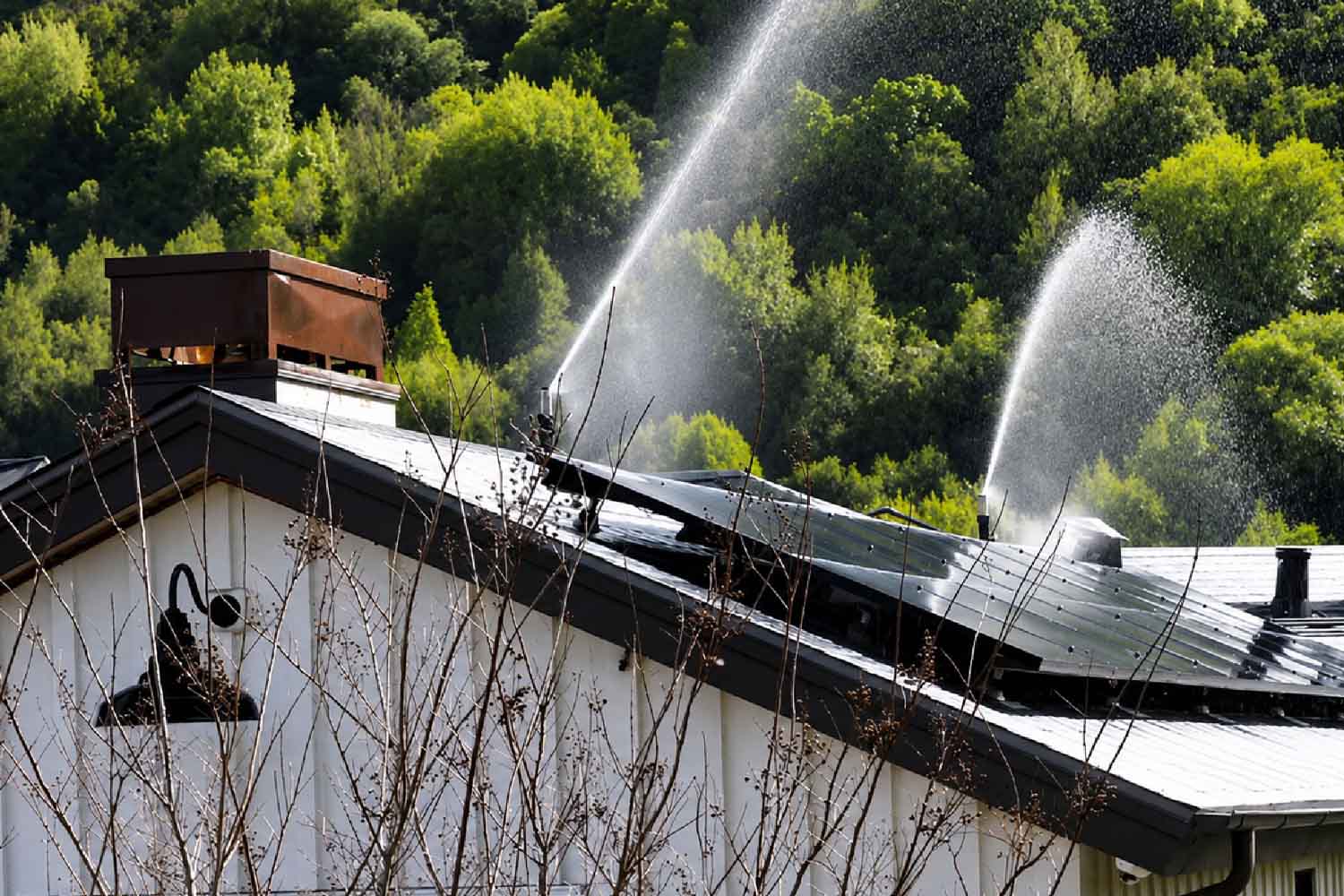
The fire is still eleven kilometers away, but the sprinklers on the roof are already starting to turn. The water runs into the gutters, runs down the walls and wets the ground around the house. The target is embers carried by the wind, small enough to fit under a tile and hot enough to start a fire. Defense System 2developed in the United States by Frontline Wildfire Defense, tries to stop them before they find something to burn.
The system follows fires through software that is active 24 hours a day. When a fire comes within a seven-mile radius of the home, just over 11 kilometers, the owner receives a notification on the phone and a ten-minute countdown starts. It can bring forward the activation or cancel it; without any intervention, the sprinklers start automatically. The idea is reminiscent of a garden plant with decidedly more demanding ambitions. The difference lies above all in timing.
Before the flames come the embers
Images of the fires show walls of fire, burning trees and columns of smoke. Many homes, however, begin to burn in a much less cinematic way. According to the U.S. Forest Service, embers are the most common cause of building ignition during wildfires: they travel for miles and settle on roofs, gutters, woodpiles, dry vegetation and vents.
Frontline installs 360-degree rotating rotors on the highest points of the roof and downward-facing sprinklers under the eaves. Together they wet the roof, the walls and a strip of soil that can extend up to about nine meters from the building. Each system is designed on the individual house, overlapping the castings to reduce the areas left dry when the wind blows. At least on paper: during a fire the wind changes direction and rarely consults the hydraulic plan.
A class A firefighting foam can be added to the water, intended to better penetrate the liquid into combustible materials. The system works in sectors: each area is irrigated for five minutes, followed by a break, then the cycle starts again. His job is to prepare the outside of the house before the embers arrive; prolonged contact with a flame front remains a threat of an entirely different magnitude.
Water usually comes from the domestic supply. If the pressure drops and the property has been serviced, the system can transition to a pool, well or tank. The controller has an emergency battery and Wi-Fi, cellular and satellite connections, so the owner can evacuate and continue to control the system remotely. In the case of pumps connected to a swimming pool or well, a reserve electrical source is still needed. Even the smartest house, without water and electricity, quickly becomes a normal house.
96% of Los Angeles should be read to the last line
The most concrete evidence indicated by the company comes from the fires that devastated the Los Angeles area in January 2025. According to the report published by Frontline, 59 of the 61 homes protected in the affected areas remained standing, some with minor damage. The other two were destroyed: one after prolonged exposure to flames in a canyon, the other because embers had penetrated the interior of the building.
The figure of 96% is notable, but accompanied by several cautions. It comes from the same company that sells the system, it lacks a group of comparable homes without sprinklers, and not all 61 properties were within the officially burned perimeter. They were exposed to embers or dangerous conditions, with different intensities. These are therefore real cases useful for observing the behavior of the system, without the solidity necessary to attribute the survival of the houses to the sprinklers alone. Frontline itself specifies that those results do not guarantee similar performance in subsequent fires.
Water adds a barrier, it doesn’t close all doors
The Insurance Institute for Business & Home Safety, a US institute that studies the resistance of buildings to disasters, also urges caution. Methodical research into the effectiveness of outdoor sprinklers during real fires is still limited, and several unknowns remain before considering them an established solution. Wind can move water, heat accelerate evaporation, and water networks can lose pressure just as many systems come on at once.
Fire sprinklers therefore function as an additional layer. First come a strong roof, vents protected from embers, clean gutters, low-combustible materials and the removal of dry vegetation near walls. Even Frontline recommends combining the system with defensible space around the home and structural reinforcement interventions.
At the moment the company operates through installers in the United States and the system is not available on the Italian market. The principle, however, is clear: prepare the building while people leave, rather than forcing them to choose between evacuation and a last-ditch trip with the water hose. A wet roof can rob an ember of the dry spot it was looking for. A vulnerable vent continues to be a door. And the fire, when it finds it, doesn’t need to knock.
