
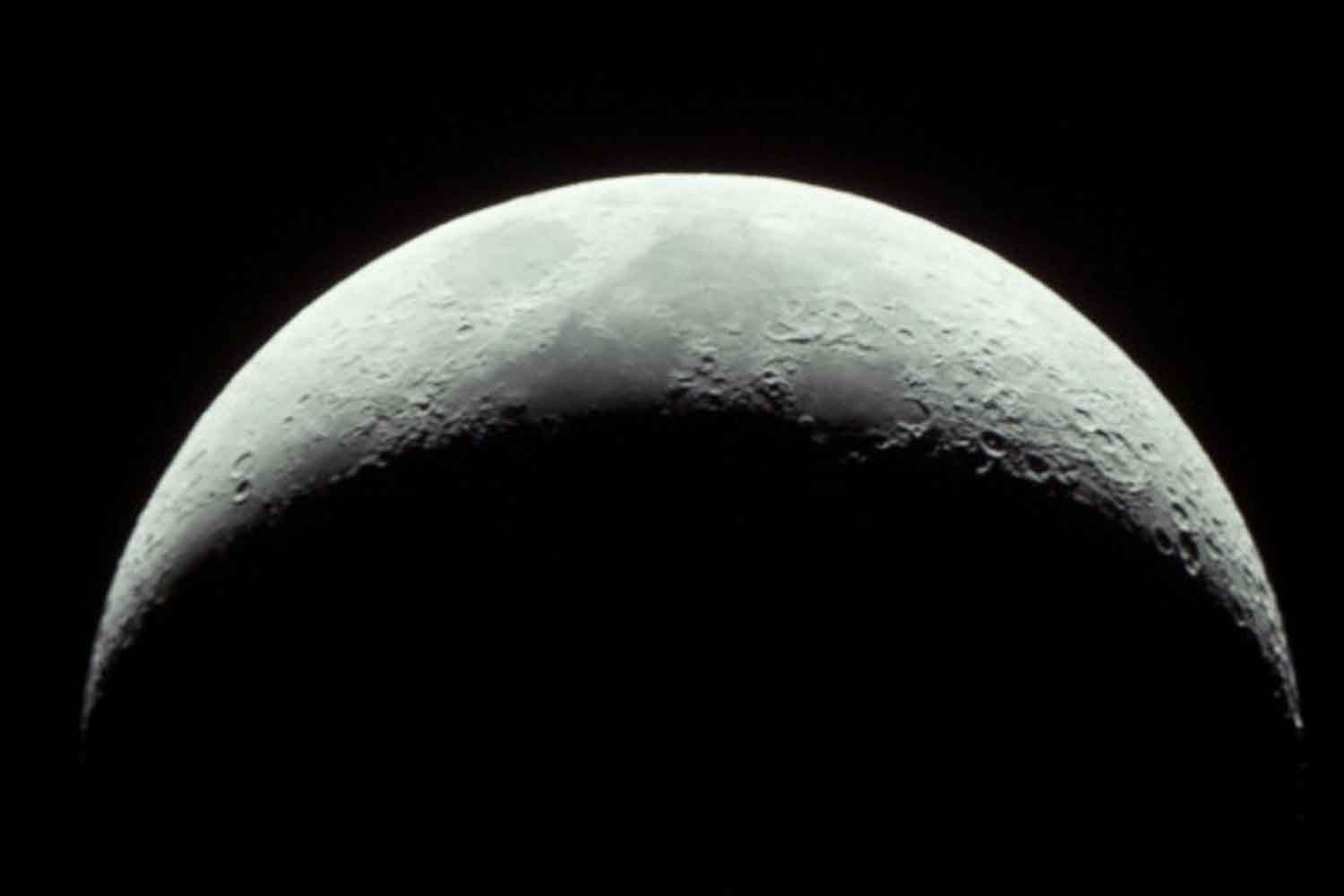
Tonight just wait for the Sun to disappear and look towards the West-South-West. The rest of the disk should also appear next to the bright part of the crescent Moon, much weaker, gray and almost transparent. It’s there ashen light of the Moon: for a few hours our satellite seems to show day and night at the same time. And the light bulb, for once, is us.
The August 17, 2026 the Moon is in fact in the waxing phase, five days after the new Moon on August 12th and a few days from the first quarter, expected on August 20th. In Rome the disk is illuminated directly by the Sun for approximately 26.5%; the value changes slightly during the day, without changing the substance of the show. Phases calculated by the US Naval Observatory place the new Moon on August 12 at 17:37 UTC and the first quarter on August 20 at 02:46 UTC.
That gray part of the Moon is illuminated by the Earth
The bright crescent receives light from the Sun directly. The rest of the disk follows a decidedly more cumbersome path: sunlight reaches the Earth, is reflected from our planet towards the Moon and finally returns from the lunar surface to our eyes. Two bounces and approximately 768 thousand kilometers between the round trip, just to make a light appear that we can observe without instruments.
NASA defines the phenomenon earthshinewhile in Italian we call it light cinerea or chiaro di Terra. When we observe a young crescent from Earth, from the Moon our planet would appear almost completely illuminated: a large bright Earth in the lunar sky capable of illuminating the part of the satellite immersed in the night.
The result is that circular shape barely visible around the scythe. EduINAF explains that the phenomenon can also be observed with the naked eye precisely on the days close to the new Moon, when the geometry between the Sun, Earth and Moon favors the contrast between the very bright sickle and the rest of the disk illuminated by the Earth.
What time to watch the ashen light tonight
Above all, you need a fairly clear western horizon and a few fewer clouds than necessary to ruin an astronomical evening. The precise time changes naturally along the Peninsula. In Rome the Sun sets today at 8.07pmas the Moon descends below the horizon at 10.08pm. A good indicative window therefore starts half an hour after sunset, when the sky begins to darken enough to bring out the faintest light.
Among them 8.35pm and around 9.10pm in Central Italy there should be a favorable compromise: twilight loses brightness while the Moon is still quite high above the horizon. In the North and South the times must be moved based on the local sunset, even by a few tens of minutes.
You don’t need a telescope. With the naked eye you can already distinguish the dark disk, especially from a place with little artificial lighting; with normal binoculars the separation between the scythe and the illuminated surface becomes much more evident. To photograph it, the matter becomes complicated, because the difference in brightness between the two areas is enormous: INAF recommends different exposures to be able to record both well.
©INAF
Ashy light doesn’t just belong in beautiful photographs of the Moon. Astronomers have also used it to study how much our planet reflects solar radiation and therefore its albedo. Looking at the dark area of the Moon means, in a certain sense, looking at a light that still bears the characteristics of the Earth. NASA used observations of earthshine precisely to study the variations in the Earth’s reflectivity.
Tonight, however, decidedly more modest scientific needs are enough: a fairly clear sky, a view towards the west and a few minutes without staring at the smartphone. The Earth will do the rest, illuminating the Moon’s night with the light it received from the Sun a few moments before.
