
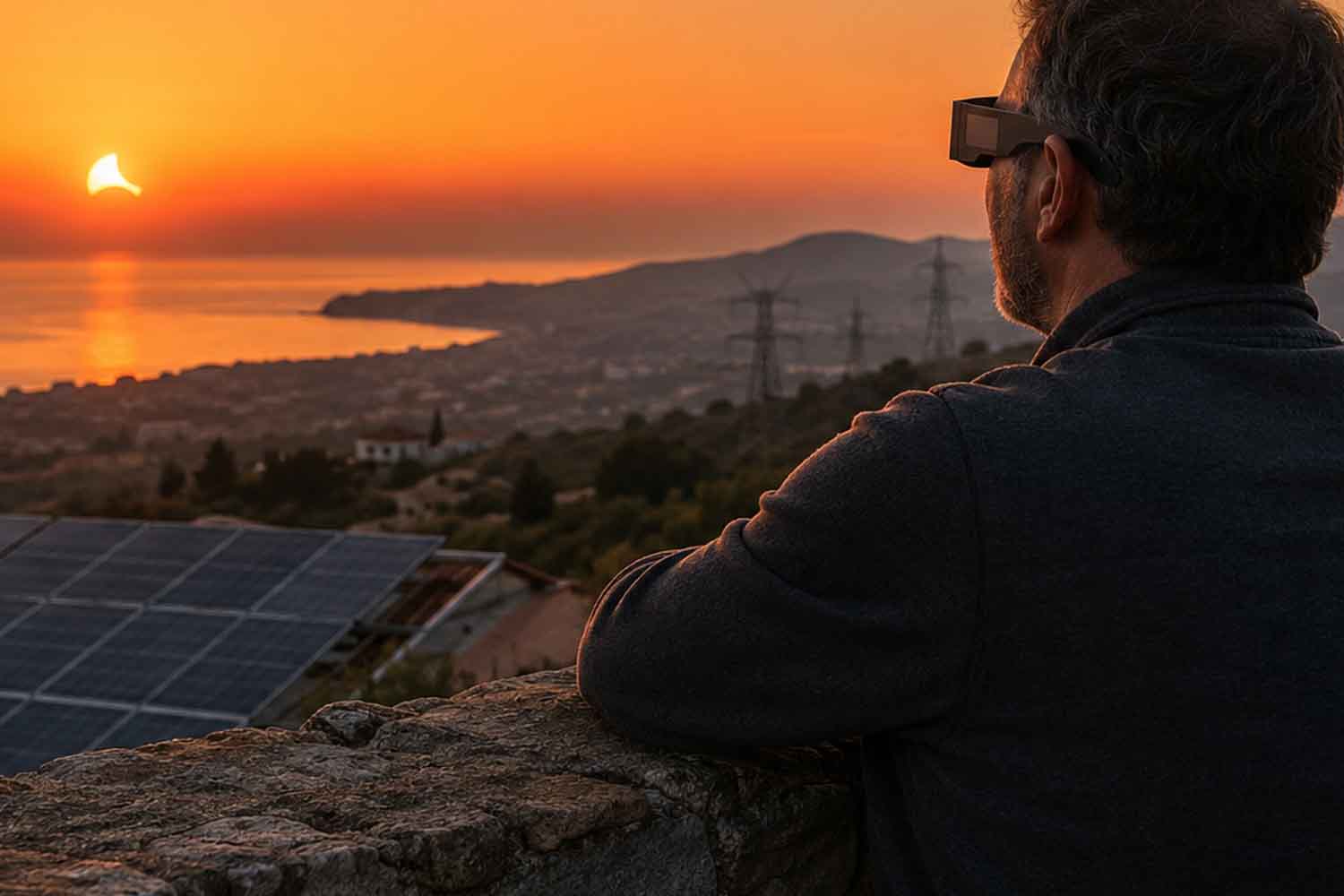
THE’solar eclipse of August 12, 2026 it will be total in a narrow band that will cross northern Russia, Greenland, part of Iceland, Spain and a small strip of Portugal. Much of Europe, including Italy, will instead witness a partial eclipse. It is a rather rare astronomical event: a total eclipse has not been seen on the Iberian Peninsula since 1912.
At around 7.30pm the Sun will begin to lose a piece. In Italy the Moon will never be able to cover it completely, but in the more fortunate areas of the North-West and Sardinia the darkening may approach 95%. Then the Sun will descend towards the horizon and, in many places, will set before the eclipse has even had a chance to show everything it had planned.
Then there is a second show, much less romantic and full of graphics: while millions of people will look at the sky, thousands of European photovoltaic plants will lose production almost simultaneously. Grid operators have prepared additional forecasts, reserves and a dedicated task force. In short, the Moon will do its job. It will be up to the electricity grid to do the same.
View this post on Instagram
Where the eclipse of August 12th will be total
The band of totality will cross Greenland, Iceland, northern Russia and then the Atlantic before arriving on the Iberian Peninsula. In Spain it will travel the country from west to east, passing through numerous cities including In Coruña, León, Bilbao, Zaragoza and Valenciaup to the Balearics.
For those who can travel, Spain is therefore one of the most accessible European destinations to see the Sun disappear completely. However, there is a small complication as big as a mountain: totality will arrive close to sunset, so a completely free western horizon.
In Coruña, for example, it will see totality around 8.28pm, for about 76 seconds, with the Sun still about 12 degrees above the horizon. In Burgos it will last just over a minute and a half, with the sun at around 8 degrees. In Palma de Mallorca, however, the maximum will arrive around 8.32pm with the Sun just 2 degrees high. All it takes is one bump in the wrong direction and the grand finale can end up behind a hill. The maximum duration of totality will be approximately 2 minutes and 18 secondsreached near Iceland.
Where you will see it best in Italy
Here the eclipse will only be partial. As we had already told in our guide to the visibility of the eclipse of August 12th from Italy, the favored regions will be above all the northern and western ones: Piedmont, Valle d’Aosta, Liguria, Lombardy, Emilia-Romagna, Tuscany and Sardinia.
The maps developed by the National Institute of Astrophysics are even more precise. The coverage increases proceeding from the south-east to the north-west: it goes from approximately 18% in Calabria until beyond 93% between Piedmont and Liguriawith values around 95% in western Liguria and north-western Sardinia.
The percentage, however, only tells half the story. The eclipse will begin around 7.30pm and will reach its local maximum around 8.20pm, when the Sun will be very low. In the Centre-South the theoretical maximum will fall in many areas after sunset and therefore will not be observable.
The precise place from which you look will therefore matter more than the name of the city. INAF indicates a direction of approx west-northwest: plains, coasts and well-exposed ridges will be advantaged; valleys and places with mountains towards the west much less. The simplest recommendation is almost banal: go to the point chosen before August 12th and check if, around 8pm, the Sun can still be seen from there.
For those who will remain behind a mountain, under the clouds or simply at home, INAF will also organize one live from 7.30pmwith images from Italy and the band of totality in Spain.
How to watch the eclipse without risking your eyes
Here the rules become much less flexible. In Italy there will be no time when it will be safe to look directly at the Sun with the naked eyebecause the eclipse will remain partial from beginning to end. Even when only a small crescent is visible, sunlight can damage the eyes.
Specific glasses or visors for solar observation compliant with the international standard are required ISO 12312-2. Normal sunglasses, even very dark ones, are not enough. Nor do x-rays, CDs, smoked glasses or other improvised filters become astronomical instruments just because we have a lot of imagination.
We talked about it in more detail in the guide on which glasses to choose for the eclipse on August 12th. A useful clarification concerns memorabilia from 1999: the American Astronomical Society considers recent viewers to be reusable, correctly certified and in perfect condition, indicating products less than ten years old as a reference. Those stored for 27 years in a drawer can easily remain there.
Before use, check the filter for scratches, holes, tears or detachments. Glasses must be worn Before to look towards the Sun; to remove them you first turn to the opposite side. Also be careful with cameras, telescopes and binoculars. Eclipse glasses worn in front of the eyes do not protect from concentrated sunlight from an optical instrument. In these cases a suitable solar filter must be fitted in front of the lens.
The simplest alternative remains indirect observation: a small hole made in a piece of cardboard can project the image of the Sun onto a shaded surface. You look at the projection, never through the hole. Even the spaces between the leaves of the trees can transform into tiny dark rooms and draw many small solar crescents on the ground.
What will happen to solar panels and the electricity grid
The other side of the eclipse will be seen in the control rooms. As we explained in the in-depth analysis of the consequences of the eclipse on European photovoltaic production, ENTSO-E estimates that, with clear skies, photovoltaic production could be reduced by up to 9.7 GW in Europe between 7.15pm and 9.30pm.
The problem isn’t that the panels suddenly stop working. They simply track the amount of available solar radiation: output drops as the Moon advances in front of the sun’s disk and then changes again as the shadow passes. For those who govern an electricity grid, however, it matters a lot how quickly and over how much territory that change occurs.
Photovoltaic now produces around 13% of the European Union’s electricityaccording to 2025 data retrieved from ENTSO-E. A short and predictable astronomical variation has therefore also become an event to be included in the network’s operational plan.
The greatest impact is expected in Spain and Germany. Red Eléctrica estimates for the Iberian Peninsula a maximum reduction of approximately 5 GWequal to approximately 13% of the maximum demand on a normal Wednesday in August. The Spanish manager specifies, however, that he does not foresee problems in covering consumption: the eclipse will arrive when photovoltaic is already in its natural evening decline and far from the normal peak in demand.
However, European operators have prepared the network: control room operators notified, photovoltaic forecasts updated more frequently, greater coordination between countries and suspension of some scheduled works that could reduce the operating margin. ENTSO-E has also activated a dedicated task force.
An eclipse-induced blackout, therefore, is not what operators expect. The production loss is significant enough to require preparation, but it arrives with a known time, trajectory and duration. Rarely has a decline of almost 10 GW had an appointment set so far in advance.
And after sunset the Perseids also arrive
On August 12th the sky will not close up shop together with the Sun. As we said in the guide to the astronomical events of August 2026, we are also in the best days to observe the Perseids.
The International Meteor Organization places the maximum of the shower on August 13 and this year there is a particularly favorable coincidence: the August 12th is the new moonso the night sky will not be disturbed by its light.
First a crescent of the Sun disappears on the horizon, a few hours later a dark sky crossed by meteors. For the first show you need the right glasses. For the second, finally, just look up.
