
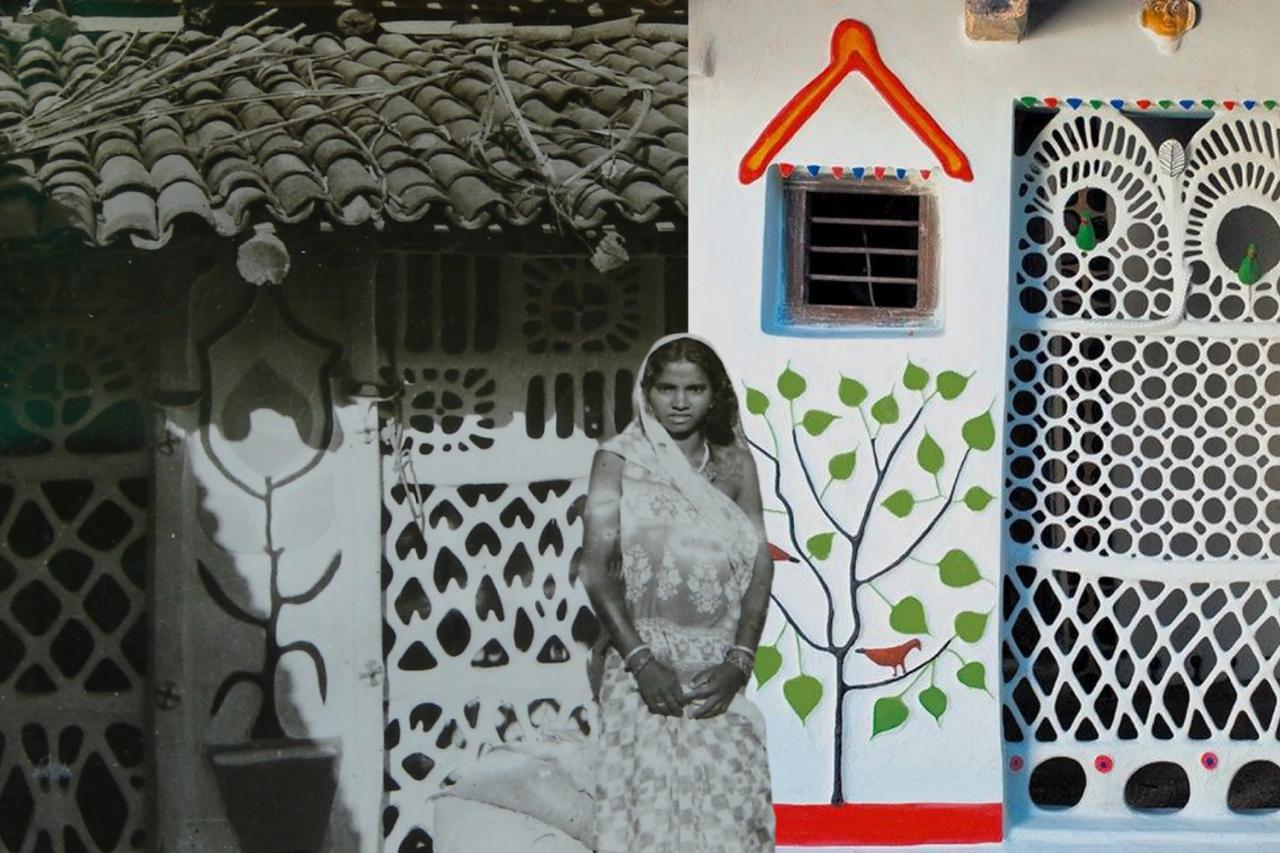
Her husband locked her in a windowless house for years. Instead of dying out, she filled those rooms with colour, shapes and life, until transforming them into one of the most surprising masterpieces of Indian popular art.
This is the story of Sonabai Rajawar, an artist born in a small village in central India, in the current state of Chhattisgarh, and who passed away in 2007.
A life marked by isolation
Sonabai grew up in a large, close-knit family, in a context where men and women, despite having distinct roles, could still talk to each other and live the daily life of the village together. She was married off at a very young age to a man much older than her, and had only one son with him, Daroga Ram.
It was precisely after the birth of the child that his life changed radically. For reasons that were never fully clarified – the sources speak of her husband’s morbid jealousy – Sonabai was isolated from the rest of the world: she could no longer receive visitors, leave the house or speak to anyone except her husband and son. The period of imprisonment lasted for years (the testimonies collected over time indicate different figures, between ten and fifteen years), spent almost entirely within the walls of a clay house on the edge of the village of Puhputra.
Sonabai never wanted to comment publicly on what happened to her. His response to that condition, however, was extraordinary.
Clay as a way of survival
Having no artistic training or materials at her disposal, Sonabai began modeling the clay of the internal courtyard to create toys for her son: horses, cows, birds, snakes, small human figures. What began as a maternal gesture soon transformed into an irrepressible creative necessity.
To color her creations, Sonabai learned to obtain natural pigments by grinding spices, herbs and minerals that she had at home, and made her own brushes. To make the house livable during the scorching heat of the Indian summer, he began to weave bamboo strips left over from construction, covering them with clay to create decorative grates capable of filtering air and light, while reducing the internal heat. On these structures he added climbing snakes, perched birds, flute players, dancers: an entire imaginary world that slowly expanded on walls, lintels and even around the cooking oven.
In total isolation, without ever having seen other similar works, Sonabai thus invented her own artistic language, today known as Surguji Style, named after the district of origin.
View this post on Instagram
The discovery of the outside world
When the doors of that house reopened, the village neighbors found themselves faced with something unexpected: what had been a place of confinement had become a real covered-air art gallery. Word spread quickly and, in 1983, reached the curators of the Bharat Bhavan Museum in Bhopal, who sent researchers to the site. What they found in Sonabai’s house were not simple home decorations, but a complete and original work of art.
From that moment Sonabai’s life changed for the second time, but in the opposite direction. His creations began to be exhibited in India and abroad — he traveled as far as Australia and the United States with his son and daughter-in-law — and in 1985 he received the President’s Award, one of the most prestigious honors for Indian craftsmanship. Thanks to government funding, he was also able to teach his technique to other artists in the community, transforming what had been an expression born in solitude into a shared tradition, capable over time of supporting the economy of the entire village.
Despite her success and international fame, Sonabai remained a shy and reserved woman throughout her life: she felt more at ease expressing herself through shapes and colors than with words.
A legacy that speaks of freedom
Sonabai’s art is sometimes compared to that of Nek Chand, the famous creator of the Rock Garden in Chandigarh: both created worlds populated by fantastic creatures starting from poor materials. But if Nek Chand built his universe outdoors, with objects recovered from the outside, Sonabai did the exact opposite: she brought the world inside the walls of her home, transforming from the inside what confinement had left her.
In his works there is no trace of anger or desperation. There is, rather, a surprising joy of living, almost in contradiction with the history that generated it – confirming that creativity can become, even in the most difficult conditions, a space of freedom that no one can really lock up.
