
White t-shirts are one of the simplest and most versatile items in the wardrobe, they match practically everything, they are light and comfortable and, for this reason, they often end up in the washing machine. But not all white t-shirts are created equal when it comes to standing the test of time. Some may shrink, warp, lose their original appearance or quickly fill with unsightly dots.
The quality of the white t-shirts was tested by the Swiss magazine K-Tipp, which sampled 16 cotton models, 8 for women and 8 for men.
The test was carried out by the Hohenstein Laboratories in Bönnigheim, Germany, specialized in the textile sector. The experts subjected all the t-shirts to various tests to verify not only their initial appearance, but above all how they change with use and washing.
The result is not particularly encouraging: only 4 t-shirts obtained an overall positive rating, while 10 did not convince the testers.
Let’s find out the ranking right away.
The ranking of white t-shirts
For the test, K-Tipp took into consideration white t-shirts sold in Switzerland (but some brands are also popular in Italy), evaluating various aspects related to durability and the ability to maintain shape and appearance over time.
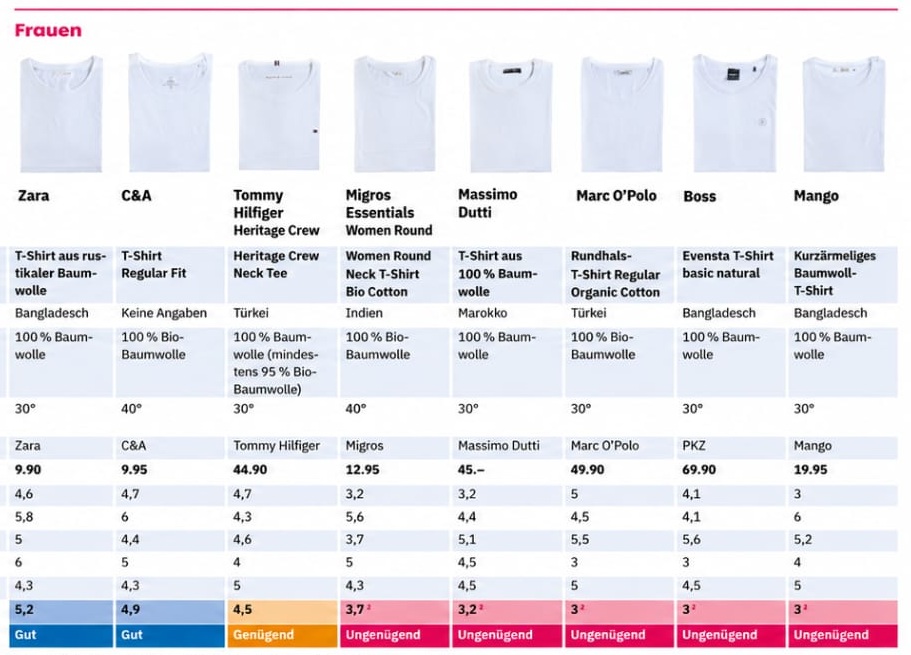
Among women’s t-shirts, the best results were obtained by Zara and C&A. The Zara t-shirt, which cost just under 10 Swiss francs, stood out for its ability to maintain its shape after washing, for its low pilling and for the good resistance of the fabric. The C&A model also received a positive rating.
Among men, however, Nike and Jack & Jones were the models with the best performance. However, the Jack & Jones t-shirt had a price equal to about a third of the Nike one.
It didn’t fare as well for several more expensive brands. The Calvin Klein men’s t-shirt, sold for around 40 Swiss francs, had gone from 75 to just 67 centimeters in length after ten washes. Men’s styles from H&M and Manor also showed significant shrinkage.
Among women’s t-shirts, however, Mango and Massimo Dutti were the ones that shrank the most. Some more expensive products were also bad: the Boss t-shirt, priced at almost 70 francs, showed a heavily deformed side seam, while Massimo Dutti’s came out of the washing machine with a shade tending towards grey.
In the following infographics you can see all the t-shirts tested for men and women, with their scores.
@K-Tipp
The problems found in the t-shirts
The laboratory observed how the appearance of the t-shirts changed after 10 and 20 washes. The difference between the various models was particularly evident after 20 cycles. Almost all men’s t-shirts, with the exception of Nike, appeared significantly worse: in some cases the side seams were deformed, while the prints on the neck had lost some letters or had completely disappeared. Even the washing labels had become so faded that they were difficult, or impossible, to read.
In contrast, the four cheapest women’s T-shirts examined – C&A, Mango, Zara and Migros – still appeared in very good condition after 20 washes.
An interesting result, given that the price does not seem to be a guarantee of longer life.
Another test concerned the so-called pilling, i.e. the formation of small pellets of fibers on the surface of the fabric, one of the most obvious signs of wear on a t-shirt.
To simulate repeated use, technicians subjected the fabrics to 7,000 rubbing cycles. After 5,000 cycles, the T-shirts of Coop, Manor and Migros were already covered in dots. In contrast, fabrics from Nike, Boss and Marc O’Polo have remained almost untouched in this respect.
But the test also verified something more important than the simple aesthetic aspect: how quickly the fabric wore out to the point of breaking. The Boss and Marc O’Polo shirts wore out almost twice as quickly as the Zara and Manor models.
White t-shirts can also undergo color changes when they are used frequently and subjected to the action of sweat and light at the same time.
To test the resistance to this phenomenon, the technicians exposed the fabrics to two different sweat solutions and artificial sunlight. In this case, however, the result was positive: all the t-shirts passed the test without revealing any significant problems.
Manufacturers’ replicas
Faced with the results, some producers provided explanations or clarifications. Coop linked the increased pilling of its t-shirt to the presence of organic cotton, explaining that the use of shorter fibers can encourage pilling and represent a sort of compromise linked to sustainability.
Manor instead stressed that the tested model should be washed on a delicate program and not on the cotton cycle used in the test. According to the company, the longer program and greater mechanical action could favor more marked dimensional variations.
Boss also recalled that its washing instructions recommend a delicate program at 30°C with mild detergent. H&M has stated that it will investigate the problem of shrinkage, while Marc O’Polo has indicated that it intends to verify the results relating to abrasion resistance internally.
Migros, for its part, specified that its t-shirt had not yet been subjected to a specific pilling test and that, in light of the unsatisfactory results, further checks are planned.
